
The Writing of News A Handbook with Chapters on Newspaper Correspondence and Copy Reading
Charles G. (Charles Griffith) Ross
THE CLASSIC COLLECTION · 1851
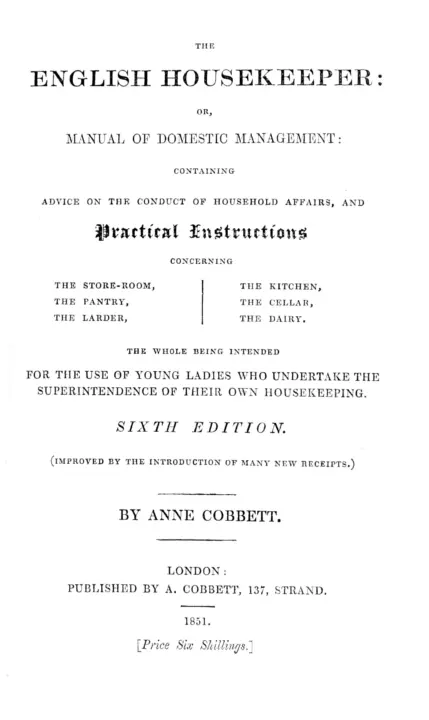
"The English Housekeeper: Or, Manual of Domestic Management" by Anne Cobbett is a practical guide to domestic management written in the mid-19th century. This work serves as a manual for young ladies entering housekeeping, providing instruction on various aspects of household management including cooking, organizing, and maintaining a household effectively. The author emphasizes the importance of practical knowledge in managing a home efficiently, particularly for women of moderate means. The opening of the book outlines the author's goals in providing helpful advice for young housekeepers, particularly in a time when the women of her era may be lacking in essential domestic skills. Cobbett discusses the significance of practical experience over academic learning, lamenting that many young women are ill-prepared for domestic responsibilities due to current educational practices. She emphasizes the value of homemaking skills, from managing finances to culinary practices, and criticizes the societal shift away from these practical arts, thereby setting the stage for the detailed guidance that follows in the subsequent chapters.
Introduction adapted from the source catalogue; source summaries may be automatically generated.
Free to read · English · 150,289 words · No account needed
MAKE TIME FOR A GOOD BOOK
On by default. Untick to stop anonymous reading totals. Each page counts after 10 seconds in view. How this works.
Anonymous counting is on unless you have switched it off.
Boil an equal quantity of rhubarb, cut in pieces, and {306}gooseberries, before they are quite ripe, with ¾ lb. loaf sugar to 1 lb. of fruit. Well boiled, it forms a rich jam, similar to apricot. Or: boil 6 lbs. fruit cut in square pieces, 6 lbs. lump sugar, and let it stand a few hours, to draw out the juice, boil the juice three different times, and pour over the rhubarb.
Black Butter.
A very nice preserve to spread on bread, and is a mixture of currants, gooseberries, cherries, raspberries, or strawberries. To every 2 lbs. fruit, put 1 lb. sugar, and boil it till reduced one-fourth.
Fruit for Puddings.
Pare apples, pears, plums, and any fruit you have, and put them in a stone jar with brown sugar, to sweeten. Place the jar in a cool oven till the fruit is cooked.
To preserve Damsons, Bullaces, Morella Cherries, Gooseberries, and
Currants, for Winter use.
All these fruits may be put into wide-mouthed bottles, with about 6 oz. Lisbon sugar to each; put corks lightly in, and set them in a vessel of cold water, and then let it boil very gently till the syrup rises over the fruit; when the fruit is cold, make the corks tight, dip them in rosin, and tie bladders over.
To Bottle Green Gooseberries and Currants.
The same as the last receipt, only without sugar. Let them remain in the water till the fruit begins to shrivel; take them out, and when the fruit is cold, cork the bottles tight, and dip them in melted rosin. The rough sort is best.
To Bottle Raspberries.
Mix an equal weight of crushed fruit and powdered loaf sugar, put them into wine-bottles, cork tight, and rosin the corks.
{307}Damsons for Tarts.
Gather damsons quite dry, put them into large stone jars, having pricked them with a pin, tie bladders over, and put the jars into a vessel of cold water; set that over the fire, and let it simmer (not boil) for two hours, or till you see the damsons begin to sink (the water should reach nearly to the top of the jars), then wipe the jars, and put them away in a dry place.--Or: choose jars to hold 8 or 9 lbs., of equal size at top and bottom; put in each jar one fourth of the fruit, then a fourth of good moist sugar (allow 3 lbs. sugar to 9 lbs. fruit), then another layer of fruit, and so on, till the jar is full; put it in an oven just hot enough to bake it through. When household bread is drawn the oven is generally hot enough for this purpose, and the jars may remain in all night. When the fruit is cold, put a clean stick, a little forked at one end, into the middle of the jar, leaving the forked end a little above the top; put a piece of white paper over the fruit (which ought to reach the neck of the jar), then run melted mutton suet over it, of an inch thick, and keep the jar in a cool place. When you open it, lift up the covering of suet by the stick.
Your reading position is saved on this browser. Take it to another device with a library code. Reading pages adapt to text, rather than matching a printed edition.
BEHIND THE BOOK
This eBook is for the use of anyone anywhere in the United States and most other parts of the world at no cost and with almost no restrictions whatsoever. You may copy it, give it away or re-use it under the terms of the Project Gutenberg License included with this eBook or online at www.gutenberg.org. If you are not located in the United States, you will have to check the laws of the country where you are located before using this eBook. Read the source licence.
The original source file, including credits and licence, is retained by this library. Request an original-format copy at no charge. Please include the book title and Project Gutenberg identifier #55314.
KEEP YOUR CURIOSITY GOING
Charles G. (Charles Griffith) Ross
Hannah Webster Foster

Emily Lawless
Edwin Hamlin Carr

Charles De Lano Hine
Andrew Ure