
The Writing of News A Handbook with Chapters on Newspaper Correspondence and Copy Reading
Charles G. (Charles Griffith) Ross
THE CLASSIC COLLECTION · 1851
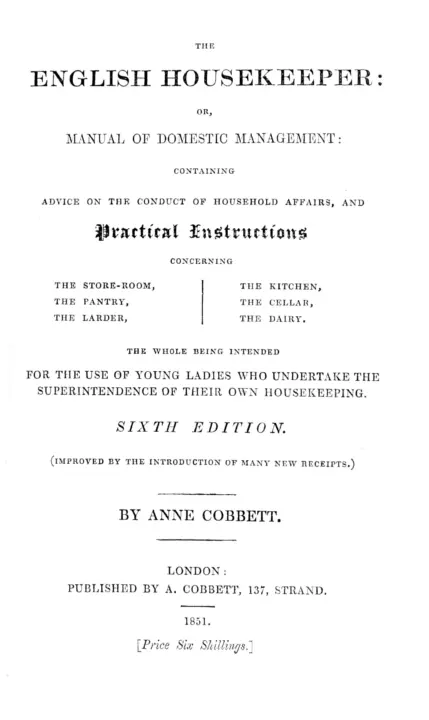
"The English Housekeeper: Or, Manual of Domestic Management" by Anne Cobbett is a practical guide to domestic management written in the mid-19th century. This work serves as a manual for young ladies entering housekeeping, providing instruction on various aspects of household management including cooking, organizing, and maintaining a household effectively. The author emphasizes the importance of practical knowledge in managing a home efficiently, particularly for women of moderate means. The opening of the book outlines the author's goals in providing helpful advice for young housekeepers, particularly in a time when the women of her era may be lacking in essential domestic skills. Cobbett discusses the significance of practical experience over academic learning, lamenting that many young women are ill-prepared for domestic responsibilities due to current educational practices. She emphasizes the value of homemaking skills, from managing finances to culinary practices, and criticizes the societal shift away from these practical arts, thereby setting the stage for the detailed guidance that follows in the subsequent chapters.
Introduction adapted from the source catalogue; source summaries may be automatically generated.
Free to read · English · 150,289 words · No account needed
MAKE TIME FOR A GOOD BOOK
On by default. Untick to stop anonymous reading totals. Each page counts after 10 seconds in view. How this works.
Anonymous counting is on unless you have switched it off.
Melt slowly 1 lb. of good butter in a little water, then stir in 1 lb. of fine, well dried flour; stir till as thick as paste, then simmer it a quarter of an hour, stirring all the time, or it will burn. It will keep two or three days. The common mode of browning soup and gravy with burnt sugar is not so good as brown flour, but the browning is prepared thus: put ¼ lb. of fresh butter with ½ lb. of lump sugar into a saucepan, shake it often, and when of a clear brown bottle it for use.
To Brown Flour.
Spread flour on a plate, set it in the oven, or before the fire, and turn often, that it may brown equally, and any shade you like. Put it by in a jar for use.
Brown Roux.
Melt butter very slowly, and stir in browned flour; it will not require so long as to cook white roux, because the flour has been browned. Will keep two or three days. When you use either of these Roux, mix the quantity you wish (a table-spoonful for a tureen of soup), with a little of the soup or gravy quite smooth, then use it.
The basis of most English sauces is melted butter, yet English cooks do not excel in making it, and the general fault is deficiency of butter.
To Melt Butter, the French Sauce Blanche.
Break ¼ lb. of good butter in small pieces, into a saucepan, with 3 table-spoonsful of sweet cream, or milk, milk and water, or water alone; dredge fine dried flour over, hold the saucepan over the fire, toss it quickly round (always one way) while the butter melts, and becomes as thick as very thick cream; let it just boil, turn the saucepan quickly, and it is done.
Butter for oysters, shrimps, lobsters, eggs, or any {193}thickening ingredient, should be made rather thin, and if to be rich, a great proportion of cream. If for catsup or any flavouring ingredient, melt the butter with water only, and stir the ingredients in, by degrees, just before you serve it.
To Brown Butter.
Toss a lump of butter in a frying-pan, over the fire, till it becomes brown. Skim, then dredge browned flour over, stir round with a spoon till it boils; it ought to be quite smooth. This, adding cayenne, and some flavouring vinegar, is a good fish sauce.
Parsley and Butter, or Maitre d'Hotel Sauce.
Tie the parsley in a bunch, and boil it in salt and water, 5 or 10 minutes, according to its age, drain it, cut off the stalks, mince very fine, and stir it into melted butter.
Your reading position is saved on this browser. Take it to another device with a library code. Reading pages adapt to text, rather than matching a printed edition.
BEHIND THE BOOK
This eBook is for the use of anyone anywhere in the United States and most other parts of the world at no cost and with almost no restrictions whatsoever. You may copy it, give it away or re-use it under the terms of the Project Gutenberg License included with this eBook or online at www.gutenberg.org. If you are not located in the United States, you will have to check the laws of the country where you are located before using this eBook. Read the source licence.
The original source file, including credits and licence, is retained by this library. Request an original-format copy at no charge. Please include the book title and Project Gutenberg identifier #55314.
KEEP YOUR CURIOSITY GOING
Charles G. (Charles Griffith) Ross
Hannah Webster Foster

Emily Lawless
Edwin Hamlin Carr

Charles De Lano Hine
Andrew Ure