
The Writing of News A Handbook with Chapters on Newspaper Correspondence and Copy Reading
Charles G. (Charles Griffith) Ross
THE CLASSIC COLLECTION · 1851
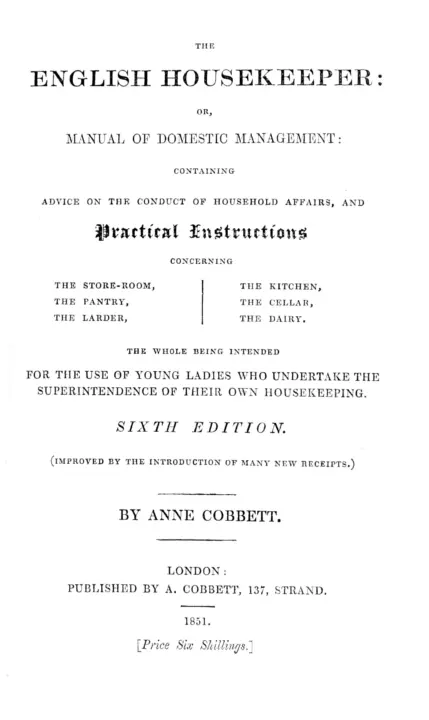
"The English Housekeeper: Or, Manual of Domestic Management" by Anne Cobbett is a practical guide to domestic management written in the mid-19th century. This work serves as a manual for young ladies entering housekeeping, providing instruction on various aspects of household management including cooking, organizing, and maintaining a household effectively. The author emphasizes the importance of practical knowledge in managing a home efficiently, particularly for women of moderate means. The opening of the book outlines the author's goals in providing helpful advice for young housekeepers, particularly in a time when the women of her era may be lacking in essential domestic skills. Cobbett discusses the significance of practical experience over academic learning, lamenting that many young women are ill-prepared for domestic responsibilities due to current educational practices. She emphasizes the value of homemaking skills, from managing finances to culinary practices, and criticizes the societal shift away from these practical arts, thereby setting the stage for the detailed guidance that follows in the subsequent chapters.
Introduction adapted from the source catalogue; source summaries may be automatically generated.
Free to read · English · 150,289 words · No account needed
MAKE TIME FOR A GOOD BOOK
On by default. Untick to stop anonymous reading totals. Each page counts after 10 seconds in view. How this works.
Anonymous counting is on unless you have switched it off.
The desire which many persons feel to give their children a better education than has been bestowed upon themselves is laudable, because it proceeds from sincere affection: but how often is the success equal to the motive which actuates? How often is the manner of attempting at all calculated for attaining the object so earnestly sought? An ambition to promote the welfare of children reconciles parents to part with them at that tender age when they ought to command more constant care than they generally need at a more advanced time of life; and this ambition is so strong that it will even cause little girls to be consigned to the blighting atmosphere of a crowded schoolroom, there to bewail the loss of the warm hearth, or the airy room of their own homes, and all the comforts which depend upon a mother's solicitude. With a view to their being educated, that is to say, fitted for the world, and for the discharge of their respective duties in it, girls are sent to school, and are there condemned to a dull course of lessons, before their minds have sufficient strength to imbibe any kind of learning that requires mental labour, and before their understandings are equal to any greater exertion than that of perceiving the difference between a roasted apple and a sugar-plum.
A knowledge of housekeeping is not difficult to attain. It needs no natural superiority of talent, and no painful application. It is rather a habit than a science, and, like the neatness so characteristic of English women, this knowledge rarely comes to perfection at all, unless it be partly formed in early life, and by means of our very earliest associations. Little girls are always prone to imitate the ways of older persons, particularly in housekeeping matters. They very soon begin to find amusement in learning to make preserves, pastry, and such things. Those children, therefore, who are brought up at home, {vi}and have the daily and hourly practice of domestic duties before their eyes, will naturally fall into habits of usefulness, and acquire, by degrees and imperceptibly, a knowledge of what belongs to home, which should constitute the elementary education of every woman who is not born to rank and to luxury. But the unhappy little creatures who drag through seven or more years of continuous monotony within the walls of a school, their minds taking little or no part in the tasks which their memories are racked upon, have but little chance of learning any thing which will benefit their after lives; for, those whose mothers knead the bread, churn the butter, and help to cook the dinner, have not the benefit of that sort of society that would teach them to apply their learning, that would call forth their acquirements, or that would be able to appreciate those acquirements when displayed. During the period which these children spend at school, their mother continues her old-fashioned occupations, and, as time passes on, she looks forward, perhaps, with cheering anticipations to the help which her daughters are to afford her. But alas! how often do these daughters return from school with false notions of the lives they are to lead, and with mistaken ideas of their own consequence, such as lead them to despise the humble occupations of their home, although their "education" may not have given them one single idea to justify any pretension of the kind. It is generally acknowledged, that girls educated at schools are seldom far advanced in learning. Where history and geography, and other sciences, are learnt by rote, "a page of Greece on Monday," a "page of Rome on Tuesday," a "page of Universal Biography on Wednesday," with occasional readings of the middle ages, of modern times, and application being made to maps, globes, charts, &c., to fill up the time which is not devoted to the fine arts (for it all goes on at once), the stock of real solid information which is gained by the end of the year, will be very scanty, or will probably {vii}have resolved itself into such a confused mass of imperfect information that all practical benefit may be despaired of. No wonder, if, after having undergone a course like this, a young girl is often found to have gained less from books than others have gained from vulgar report, and be puzzled to say whether it was Scipio or Washington who was the first President of the United States of America. They learn lessons, but they do not reason or think about what they are getting by heart; and many girls, whose education has cost a large sum of money, are unable to answer a question of name, place, or date, in their geography or history, without first running over a certain portion of one whole lesson, the sound of which has left a deeper impression on the ear, than its sense has left on the understanding. Just as, when wanting to ascertain the number of days in a particular month, we repeat the words, "Thirty days hath September," &c., thus recalling by means of the jingle of words, what of itself had slipped our memories.
Your reading position is saved on this browser. Take it to another device with a library code. Reading pages adapt to text, rather than matching a printed edition.
BEHIND THE BOOK
This eBook is for the use of anyone anywhere in the United States and most other parts of the world at no cost and with almost no restrictions whatsoever. You may copy it, give it away or re-use it under the terms of the Project Gutenberg License included with this eBook or online at www.gutenberg.org. If you are not located in the United States, you will have to check the laws of the country where you are located before using this eBook. Read the source licence.
The original source file, including credits and licence, is retained by this library. Request an original-format copy at no charge. Please include the book title and Project Gutenberg identifier #55314.
KEEP YOUR CURIOSITY GOING
Charles G. (Charles Griffith) Ross
Hannah Webster Foster

Emily Lawless
Edwin Hamlin Carr

Charles De Lano Hine
Andrew Ure