
The Writing of News A Handbook with Chapters on Newspaper Correspondence and Copy Reading
Charles G. (Charles Griffith) Ross
THE CLASSIC COLLECTION · 1851
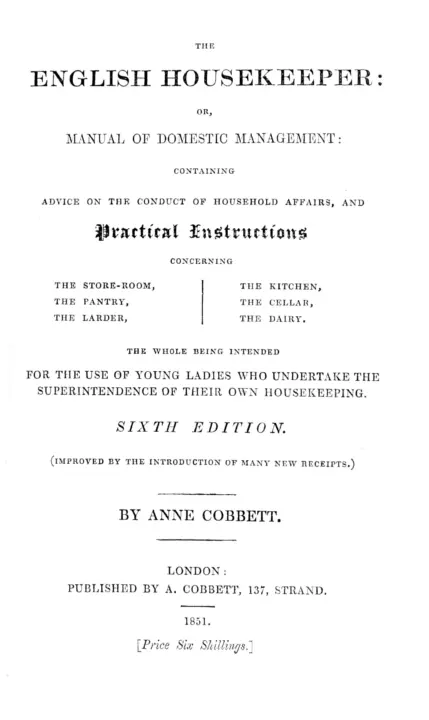
"The English Housekeeper: Or, Manual of Domestic Management" by Anne Cobbett is a practical guide to domestic management written in the mid-19th century. This work serves as a manual for young ladies entering housekeeping, providing instruction on various aspects of household management including cooking, organizing, and maintaining a household effectively. The author emphasizes the importance of practical knowledge in managing a home efficiently, particularly for women of moderate means. The opening of the book outlines the author's goals in providing helpful advice for young housekeepers, particularly in a time when the women of her era may be lacking in essential domestic skills. Cobbett discusses the significance of practical experience over academic learning, lamenting that many young women are ill-prepared for domestic responsibilities due to current educational practices. She emphasizes the value of homemaking skills, from managing finances to culinary practices, and criticizes the societal shift away from these practical arts, thereby setting the stage for the detailed guidance that follows in the subsequent chapters.
Introduction adapted from the source catalogue; source summaries may be automatically generated.
Free to read · English · 150,289 words · No account needed
MAKE TIME FOR A GOOD BOOK
On by default. Untick to stop anonymous reading totals. Each page counts after 10 seconds in view. How this works.
Anonymous counting is on unless you have switched it off.
Lean meat is best. Salt, and let it lie two days. Drain, season with pepper, and spices; bake it in a slow oven. When done, drain it from the gravy, and set it before the fire, to draw the moisture from it. Tear in pieces, and beat it up well in a mortar, with mixed spices, and enough oiled butter to make it the proper consistence. Flavour with mushroom powder, anchovy or minced eschalot. Put it into potting-cans, and pour clarified butter {147}over, which may afterwards be used for various purposes. Potted Beef is generally made of meat which has been used to make clear gravy, or the remains of a joint.
Mock Hare.
Put the inside of a sirloin of beef into an earthen pan, cover it with Port wine, and let it lie 24 hours: then spread over it a forcemeat of veal, suet, and anchovies, chopped, also grated bread, mace, pepper, and mushroom powder, lemon peel, lemon thyme, eschalot, and the yolks of two eggs: roll up the beef tight, and roast it, by dangling before the fire: baste with the wine in which it was soaked, till half done, then with cream, or milk and butter, and froth it, till well coated, like hare. Serve a rich gravy, flavoured with walnut or mushroom catsup, and a table-spoonful of eschalot vinegar. Sweet sauce.--Or: a cold uncut inside of a roasted sirloin may be re-warmed whole, in gravy flavoured with eschalot vinegar, walnut or mushroom catsup, and Port wine.
Fillet of Veal to Stew.
Stuff it with a good forcemeat, roll tightly, and skewer it. Lay skewers at the bottom of a stew-pan, place the meat on them, put in a quart of broth, or soft water, lay some bits of butter on the top of the fillet, cover the stew-pan close, after taking off all the scum, and let it simmer slowly till the meat is tender; take it out, strain the sauce, thicken it, and put it on the fire to re-warm; season with white pepper, mace, nutmeg, a glass of white wine, and the juice of a lemon, pour it hot over the meat; lay slices of lemon, forcemeat balls, pickled mushrooms, or fresh ones stewed, over the meat, and round the dish. Serve white sauce.--This dish is made more savoury if you put mushrooms, and ham or tongue, in the forcemeat. Also, you make it richer by putting the best part of a boiled tongue, whole, where you take the bone out, fill up the cavities round the fillet with forcemeat; tie it up in a good shape, and either stew or bake it, in gravy, as above; or roast it, basting well. This may be served with a wall of mashed potatoes round, and that ornamented with pieces of tongue and bacon, cut in dice, alternately, with sprigs of green {148}vegetable; or pieces of stewed cucumber; or Jerusalem artichokes cooked in white sauce; or garnish with lumps of young green peas.
Your reading position is saved on this browser. Take it to another device with a library code. Reading pages adapt to text, rather than matching a printed edition.
BEHIND THE BOOK
This eBook is for the use of anyone anywhere in the United States and most other parts of the world at no cost and with almost no restrictions whatsoever. You may copy it, give it away or re-use it under the terms of the Project Gutenberg License included with this eBook or online at www.gutenberg.org. If you are not located in the United States, you will have to check the laws of the country where you are located before using this eBook. Read the source licence.
The original source file, including credits and licence, is retained by this library. Request an original-format copy at no charge. Please include the book title and Project Gutenberg identifier #55314.
KEEP YOUR CURIOSITY GOING
Charles G. (Charles Griffith) Ross
Hannah Webster Foster

Emily Lawless
Edwin Hamlin Carr

Charles De Lano Hine
Andrew Ure