
The Writing of News A Handbook with Chapters on Newspaper Correspondence and Copy Reading
Charles G. (Charles Griffith) Ross
THE CLASSIC COLLECTION · 1851
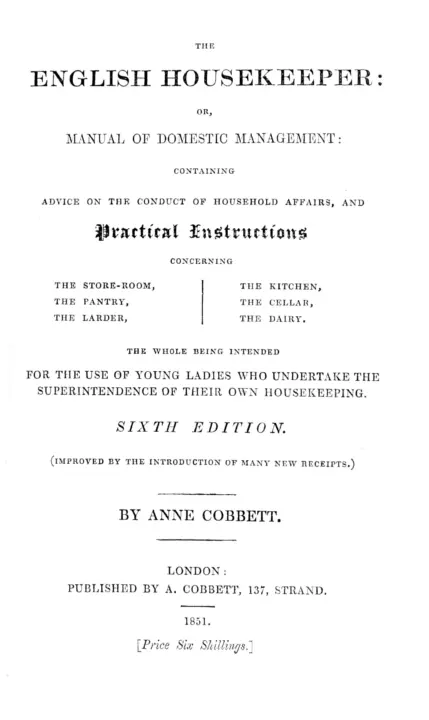
"The English Housekeeper: Or, Manual of Domestic Management" by Anne Cobbett is a practical guide to domestic management written in the mid-19th century. This work serves as a manual for young ladies entering housekeeping, providing instruction on various aspects of household management including cooking, organizing, and maintaining a household effectively. The author emphasizes the importance of practical knowledge in managing a home efficiently, particularly for women of moderate means. The opening of the book outlines the author's goals in providing helpful advice for young housekeepers, particularly in a time when the women of her era may be lacking in essential domestic skills. Cobbett discusses the significance of practical experience over academic learning, lamenting that many young women are ill-prepared for domestic responsibilities due to current educational practices. She emphasizes the value of homemaking skills, from managing finances to culinary practices, and criticizes the societal shift away from these practical arts, thereby setting the stage for the detailed guidance that follows in the subsequent chapters.
Introduction adapted from the source catalogue; source summaries may be automatically generated.
Free to read · English · 150,289 words · No account needed
MAKE TIME FOR A GOOD BOOK
On by default. Untick to stop anonymous reading totals. Each page counts after 10 seconds in view. How this works.
Anonymous counting is on unless you have switched it off.
Have larding pins of various sizes. Cut strips of bacon, with a sharp knife, put one into the pin, pierce the skin and a very little of the flesh, and draw it through; the rows may be either near together or far apart. The bacon is sometimes rolled in seasonings to suit the meat.
To Blanch, either Meat or Vegetables.
This gives plumpness as well as whiteness. Put whatever it be into a saucepan with cold water to cover, and let {135}it come to a boil; take it out, plunge it into cold water, and let it remain till cold.
To Braise.
This is, in fact, to stew in highly seasoned fat. Poultry must be trussed as for boiling. Either lard, or stuff it, with good forcemeat, and provide a thick-bottomed stew-pan, large enough to hold it. Line this with slices of bacon, or fat beef, sliced onion, carrot, and turnip. Strew in a few chopped herbs, salt, mace, black and Jamaica pepper, 2 bay leaves, and a clove of garlic. (The seasoning to suit the meat.) Lay the meat in, and cover it, first with the same quantity of herbs and spices as above, then with thin slices of bacon, and, over all, white paper; wrap a cloth about the lid of the stew-pan, and press it down, setting a weight on the top. Place the stew-pan over a slow fire, and put embers on the lid. The cooking process should be very slow. Braised joints are generally glazed.
To Glaze.
When the meat is sufficiently cooked, take it out of the stew-pan and keep it covered. Strain the gravy into a clean stew-pan, put it on the fire, and let it boil quickly, uncovered, a few minutes; brush the meat over with this, let it cool, and then brush again. What is not used may be kept in a jar tied down, in a cool place.--Fowls, Hams, and Tongues, cooked by plain boiling, are often glazed, to be eaten cold.--Another way is, to prepare a glaze beforehand, for Hams, Tongues, or Fricandeaux, thus: break the bone of a knuckle of veal, cut the meat in pieces, the same with shin of beef, add any poultry or game trimmings, and a few slices of bacon; put them in a stew-pan over a quick fire, and let them catch, then put in a little broth of cow-heels, or calf's-head, or feet. Let this stew to a strong jelly; then strain, and put it by in jars. It may be flavoured to suit the dish, at the time it is heated to be used. Glaze should be heated in a vessel of boiling water, and when quite hot, brushed over the meat. When cream is used, it should be first heated (not boil), poured in by degrees, and stirred, to prevent curdling. In making a stew, remember to let it stand by the fire nearly ten minutes, not simmering, that {136}you may remove the fat, before you put in the thickening. The flour for this should be of the finest kind, well dried. For Ragouts, you may brown it, before the fire, or in the oven, and keep it ready prepared. It is convenient to keep spices ready pounded; the quantity so prepared, as to be proportioned to the usual consumption. Kitchen pepper is: 1 oz. ginger, ½ oz. each, of nutmeg, black and Jamaica pepper, and cinnamon; pound or grind, and keep them in small phials, corked, and labelled. For white sauces, white pepper, nutmeg, mace, and grated lemon peel, in equal proportion, may also be kept prepared; cayenne, added or not, as taste requires; cayenne is used in preparations of brains, kidneys, or liver. Made dishes are sometimes served on a Purée of mushrooms or vegetables. This is: boiled to a mash, just thicker than a sauce, and much used in French cookery. To Marinade is to steep meat or fish, in a mixture of wine, vinegar, herbs and spices.
Your reading position is saved on this browser. Take it to another device with a library code. Reading pages adapt to text, rather than matching a printed edition.
BEHIND THE BOOK
This eBook is for the use of anyone anywhere in the United States and most other parts of the world at no cost and with almost no restrictions whatsoever. You may copy it, give it away or re-use it under the terms of the Project Gutenberg License included with this eBook or online at www.gutenberg.org. If you are not located in the United States, you will have to check the laws of the country where you are located before using this eBook. Read the source licence.
The original source file, including credits and licence, is retained by this library. Request an original-format copy at no charge. Please include the book title and Project Gutenberg identifier #55314.
KEEP YOUR CURIOSITY GOING
Charles G. (Charles Griffith) Ross
Hannah Webster Foster

Emily Lawless
Edwin Hamlin Carr

Charles De Lano Hine
Andrew Ure