
The Writing of News A Handbook with Chapters on Newspaper Correspondence and Copy Reading
Charles G. (Charles Griffith) Ross
THE CLASSIC COLLECTION · 1918
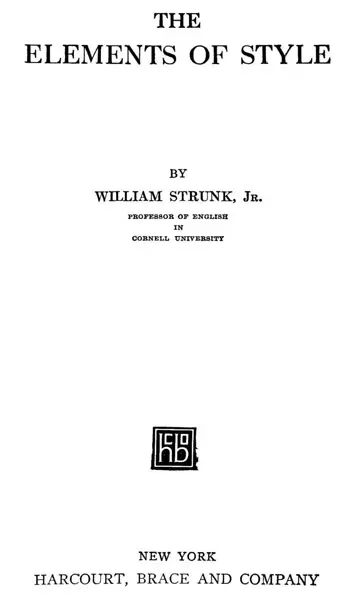
"The Elements of Style" by William Strunk is a style guide first published in 1920. This compact manual distills the essentials of clear English prose into rules about grammar, punctuation, composition, and word usage. Strunk's original "little book" urged writers to omit needless words and embrace brevity. Later enlarged by his former student E. B. White in 1959, it became the influential writing guide known as "Strunk & White," selling millions of copies and shaping generations of American writers with its prescriptive approach to craft.
Introduction adapted from the source catalogue; source summaries may be automatically generated.
Free to read · English · 13,726 words · No account needed
MAKE TIME FOR A GOOD BOOK
On by default. Untick to stop anonymous reading totals. Each page counts after 10 seconds in view. How this works.
Anonymous counting is on unless you have switched it off.
The office and salesrooms are on the ground floor; the rest of the building is devoted to manufacturing.
Its use as a virtual equivalent of although is allowable in sentences where this leads to no ambiguity or absurdity.
While I admire his energy, I wish it were employed in a better cause.
This is entirely correct, as shown by the paraphrase,
I admire his energy; at the same time I wish it were employed in a
better cause.
Compare:
While the temperature reaches 90 or 95 degrees in the daytime, the
nights are often chilly.
Although the temperature reaches 90 or 95 degrees in the daytime, the nights are often chilly.
The paraphrase,
The temperature reaches 90 or 95 degrees in the daytime; at the same time the nights are often chilly,
shows why the use of while is incorrect.
In general, the writer will do well to use while only with strict literalness, in the sense of during the time that.
=Whom.= Often incorrectly used for who before he said or similar expressions, when it is really the subject of a following verb.
His brother, whom he said would send him the money
His brother, who he said would send him the money
The man whom he thought was his friend
The man who (that) he thought was his friend (whom he thought his
friend)
=Worth while.= Overworked as a term of vague approval and (with not) of disapproval. Strictly applicable only to actions: "Is it worth while to telegraph?"
His books are not worth while.
His books are not worth reading (are not worth one's while to read; do not repay reading; are worthless).
The use of worth while before a noun ("a worth while story") is
indefensible.
=Would.= A conditional statement in the first person requires should,
not would.
I should not have succeeded without his help.
The equivalent of shall in indirect quotation after a verb in the past tense is should, not would.
He predicted that before long we should have a great surprise.
To express habitual or repeated action, the past tense, without would, is usually sufficient, and from its brevity, more emphatic.
Once a year he would visit the old mansion.
Once a year he visited the old mansion.
Your reading position is saved on this browser. Take it to another device with a library code. Reading pages adapt to text, rather than matching a printed edition.
BEHIND THE BOOK
This eBook is for the use of anyone anywhere in the United States and most other parts of the world at no cost and with almost no restrictions whatsoever. You may copy it, give it away or re-use it under the terms of the Project Gutenberg License included with this eBook or online at www.gutenberg.org. If you are not located in the United States, you will have to check the laws of the country where you are located before using this eBook. Read the source licence.
The original source file, including credits and licence, is retained by this library. Request an original-format copy at no charge. Please include the book title and Project Gutenberg identifier #37134.
KEEP YOUR CURIOSITY GOING
Charles G. (Charles Griffith) Ross
Hannah Webster Foster

Emily Lawless
Edwin Hamlin Carr

Charles De Lano Hine
Andrew Ure