
The Writing of News A Handbook with Chapters on Newspaper Correspondence and Copy Reading
Charles G. (Charles Griffith) Ross
THE CLASSIC COLLECTION · 1918
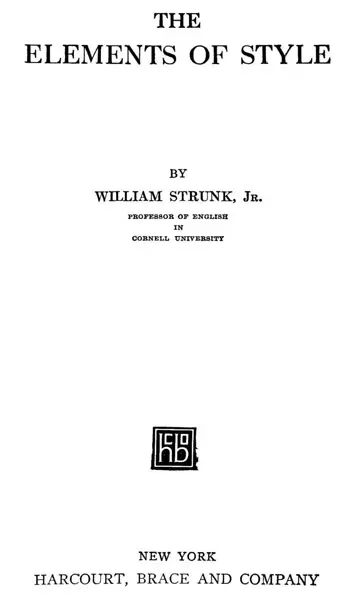
"The Elements of Style" by William Strunk is a style guide first published in 1920. This compact manual distills the essentials of clear English prose into rules about grammar, punctuation, composition, and word usage. Strunk's original "little book" urged writers to omit needless words and embrace brevity. Later enlarged by his former student E. B. White in 1959, it became the influential writing guide known as "Strunk & White," selling millions of copies and shaping generations of American writers with its prescriptive approach to craft.
Introduction adapted from the source catalogue; source summaries may be automatically generated.
Free to read · English · 13,726 words · No account needed
MAKE TIME FOR A GOOD BOOK
On by default. Untick to stop anonymous reading totals. Each page counts after 10 seconds in view. How this works.
Anonymous counting is on unless you have switched it off.
=So.= Avoid, in writing, the use of so as an intensifier: "so good;" "so warm;" "so delightful."
On the use of so to introduce clauses, see Rule 4.
=Sort of.= See under =Kind of=.
=Split Infinitive.= There is precedent from the fourteenth century downward for interposing an adverb between to and the infinitive which it governs, but the construction is in disfavor and is avoided by nearly all careful writers.
To diligently inquire
To inquire diligently
=State.= Not to be used as a mere substitute for say, remark. Restrict it to the sense of express fully or clearly, as, "He refused to state his objections."
=Student Body.= A needless and awkward expression meaning no more than the simple word students.
A member of the student body
A student
Popular with the student body
Liked by the students
The student body passed resolutions.
The students passed resolutions.
=System.= Frequently used without need.
Dayton has adopted the commission system of government.
Dayton has adopted government by commission.
The dormitory system
Dormitories
=Thanking You in Advance.= This sounds as if the writer meant, "It will not be worth my while to write to you again." In making your request, write, "Will you please," or "I shall be obliged," and if anything further seems necessary write a letter of acknowledgment later.
=They.= A common inaccuracy is the use of the plural pronoun when the antecedent is a distributive expression such as each, each one, everybody, every one, many a man, which, though implying more than one person, requires the pronoun to be in the singular. Similar to this, but with even less justification, is the use of the plural pronoun with the antecedent anybody, any one, somebody, some one, the intention being either to avoid the awkward "he or she," or to avoid committing oneself to either. Some bashful speakers even say, "A friend of mine told me that they, etc."
Use he with all the above words, unless the antecedent is or must be
feminine.
=Very.= Use this word sparingly. Where emphasis is necessary, use words
strong in themselves.
=Viewpoint.= Write point of view, but do not misuse this, as many do,
for view or opinion.
=While.= Avoid the indiscriminate use of this word for and, but, and although. Many writers use it frequently as a substitute for and or but, either from a mere desire to vary the connective, or from uncertainty which of the two connectives is the more appropriate. In this use it is best replaced by a semicolon.
The office and salesrooms are on the ground floor, while the rest of the building is devoted to manufacturing.
Your reading position is saved on this browser. Take it to another device with a library code. Reading pages adapt to text, rather than matching a printed edition.
BEHIND THE BOOK
This eBook is for the use of anyone anywhere in the United States and most other parts of the world at no cost and with almost no restrictions whatsoever. You may copy it, give it away or re-use it under the terms of the Project Gutenberg License included with this eBook or online at www.gutenberg.org. If you are not located in the United States, you will have to check the laws of the country where you are located before using this eBook. Read the source licence.
The original source file, including credits and licence, is retained by this library. Request an original-format copy at no charge. Please include the book title and Project Gutenberg identifier #37134.
KEEP YOUR CURIOSITY GOING
Charles G. (Charles Griffith) Ross
Hannah Webster Foster

Emily Lawless
Edwin Hamlin Carr

Charles De Lano Hine
Andrew Ure