
Dark Hester
Anne Douglas Sedgwick
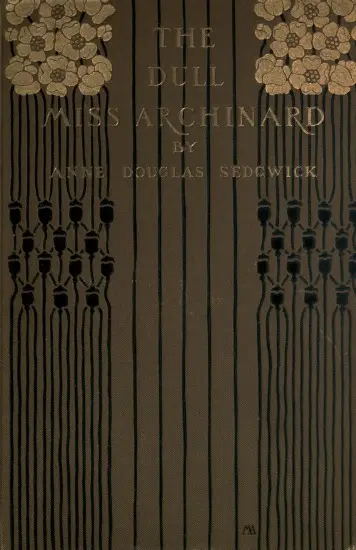
THE CLASSIC COLLECTION · 1898
"The Dull Miss Archinard" by Anne Douglas Sedgwick is a novel written in the late 19th century. The narrative unfolds in a picturesque English countryside setting, exploring the lives and relationships of its characters, particularly focusing on the Archinard family and their interactions with their neighbor, Peter Odd. The story hints at themes of love, social expectations, and the complexities of human emotions, particularly through the dynamics between Peter Odd, his wife, and the Archinard sisters, Hilda and Katherine. At the start of the novel, we meet Peter Odd, a contemplative and somewhat melancholic man who enjoys fishing in the serene countryside. His solitude is interrupted by the joyful sounds of the Archinard daughters, which leads to an incident involving the more timid sister, Hilda, who is initially fearful of diving into the water. The events escalate when she jumps in to save Katherine, who is struggling in the water. This action sparks a connection between Peter and the sisters as he helps rescue Hilda, highlighting contrasts in courage and fear between the two girls. As Peter returns to his life at Allersley Manor, the opening chapters set the stage for the exploration of family dynamics, friendship, and the tension between personal desires and societal expectations.
Introduction adapted from the source catalogue; source summaries may be automatically generated.
Free to read · English · 66,404 words · No account needed
MAKE TIME FOR A GOOD BOOK
On by default. Untick to stop anonymous reading totals. Each page counts after 10 seconds in view. How this works.
Anonymous counting is on unless you have switched it off.
"I like to see you in that dress," he said, as she sat down beside him on the sofa, "there isn't a whiff of paint or palette about it, except that, in it, you look like a picture, and a prettier one than even you could paint."
"That is a very subtle insult!" Hilda's smile showed a most encouraging continuation of the pretty willingness.
"You see," said Odd, "you are not fair to your friends. You should paint fewer pictures, and be more constantly a picture in yourself." She showed a little uneasy doubtfulness of look.
"I am afraid I don't understand you. I am afraid I am stupid."
"You should be a little more, and act a little less."
"But to act is to be," said Hilda, with a sudden laugh. "We are not listening to Schumann," she added, a trifle maliciously. Her face turned toward him in a soft shadow, a line of light just defining the cheek's young oval, the lovely slimness of the throat affected Odd with a really rapturously artistic appreciation. The shape of her small head, too, with its high curves of hair, was elegant with an intimate elegance peculiarly characteristic. An inner gentle dignity, a voluntary submission to exterior facts of existence resulting in a higher freedom, a more perfect self-possession, seemed to emanate from her; the very poise of her head suggested it, and so strong and so sudden was the suggestion that Odd felt his curiosity intolerable, and those groping suspicions outrageously at sea.
"Hilda," he said abruptly, "I went to your studio the other afternoon.
You were not there."
Her finger flashed warningly to her lip, and her glance towards her mother turned again to him, pained and beseeching.
"She--they can't hear," said Odd, in a still lower voice.
"No, I was not there," Hilda repeated.
"And your father, your mother, Katherine, think you are there when you are not. Is that wise? Don't be angry with me, my dear Hilda. You may have confidence in me. Tell me, do you work somewhere else?"
"No. I am not angry. You startled me." Her look was indeed shaken, but sweet, touched even. "Yes, I work somewhere else."
"And you keep it a secret?"
She nodded.
"Is it safe to keep secrets from your father and mother? Or is it a secret kept for their sakes, Hilda?" Peter had made mental combinations, yet he suspected that in this one he was shooting rather far from the mark. No matter. Hilda looked away, and seemed revolving some inner doubt. Her hesitation surprised him; he was more surprised when, half unwillingly, she whispered, "Yes," still not looking at him.
Your reading position is saved on this browser. Take it to another device with a library code. Reading pages adapt to text, rather than matching a printed edition.
Anne Douglas Sedgwick
Anne Douglas Sedgwick

Anne Douglas Sedgwick

Anne Douglas Sedgwick
BEHIND THE BOOK
This eBook is for the use of anyone anywhere in the United States and most other parts of the world at no cost and with almost no restrictions whatsoever. You may copy it, give it away or re-use it under the terms of the Project Gutenberg License included with this eBook or online at www.gutenberg.org. If you are not located in the United States, you will have to check the laws of the country where you are located before using this eBook. Read the source licence.
The original source file, including credits and licence, is retained by this library. Request an original-format copy at no charge. Please include the book title and Project Gutenberg identifier #42109.
KEEP YOUR CURIOSITY GOING
Coulson Kernahan

Maurice Baring
Frances Wright
Cécile Tormay

Frederic Jesup Stimson

W. H. P. (William Henry Pope) Jarvis