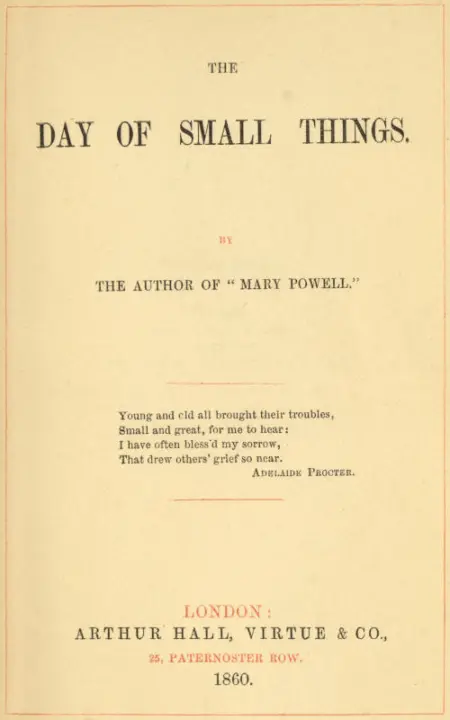
The Day of Small Things
Anne Manning

THE CLASSIC COLLECTION · 1863
"The Duchess of Trajetto" by Anne Manning is a historical novel written in the mid-19th century. It follows the life of Giulia di Gonzaga, the titular Duchess, as she navigates danger and intrigue in 16th-century Italy, particularly in the wake of a pirate attack led by Barbarossa. The narrative intertwines her personal struggles with themes of loyalty, love, and the complexities of her relationships with those around her, including her steely stepdaughter Isabella and the ambitious Cardinal Ippolito de’ Medici. The opening of the book sets a tense scene as the Duchess lies awake in her lavish chamber, troubled by ominous noises that herald an imminent threat. Instantly drawn into a night of chaos, she springs into action as pirate forces invade her castle. With her attendants—Caterina, an elderly woman, and Cynthia, a Moorish girl—she hurriedly attempts to escape the clutches of the marauders. The chaos and danger provide a gripping backdrop, highlighting Giulia's resilience and the intricate dynamics between her and her servants. This initial conflict propels the narrative forward, establishing both the stakes and the vibrant characters who will shape the Duchess's journey in a perilous world filled with political and personal intrigue.
Introduction adapted from the source catalogue; source summaries may be automatically generated.
Free to read · English · 44,083 words · No account needed
MAKE TIME FOR A GOOD BOOK
On by default. Untick to stop anonymous reading totals. Each page counts after 10 seconds in view. How this works.
Anonymous counting is on unless you have switched it off.
"Really frightened, Eccellenza?"
"Yes. Do you not think it possible she might be glad the Moors were landing and might carry her off?"
"Barbarossa, Signora?"
"Well, I know it was Barbarossa; but still he was her own countryman,
and--"
"I do not think she would acknowledge Barbarossa for a countryman, Illustrissima. She claims descent from the old Moors of Grenada--from the Abencerrages."
"Oh, yes, she may claim descent, and call herself a princess and all that. They all do, I believe. You should have seen her look when I told her Mahound was a false prophet--"
"She's very touchy about that, I well know," said Caterina.
"Touchy? Why, I believe she prays to him still--swears by him at any rate. There is no sounding the depths of these Paynims."
"I believe you would find great love for yourself in the depths of Cynthia's heart,--poor, darkened young thing--if you could sound it, Signora."
"Ah, but unfortunately, I cannot; and she behaved very improperly to me
in the cavern."
"You shock me, Illustrissima!"
"She thrust the lamp into my hand, saying: 'Hold the light!' and
stamped!"
"Inconceivable! Abominable!" ejaculated Caterina. "What could she have
been thinking of?"
"And she brandished a dagger! Not to kill me, but telling me to kill
her. So uncalled for!"
"I fear I must give her up," said Caterina, "though Perez lent her the dagger to defend you, and she has returned it. I was beginning to grow fond of her. She must be corrected, Signora."
"Well, truly, I think she must. Let me speak to her first. I dare say she is as hard as a stone. Call her."
To the Duchess's surprise, when Cynthia was brought to the bar of justice, and accused of lèse-majesté, she at once pleaded guilty, saying her proud heart sometimes got the better of her; and kneeling down, kissed the hem of her mistress's garment, in token of submission. This appeased the placable Giulia, who contented herself with asking what business she had with pride.
"You doubted my fidelity, Leila," said Cynthia. "No one must doubt the fidelity of an Abencerrage."
"Tut! how do I know that you are an Abencerrage?" said the Duchess lightly. "And what are the Abencerrages, or any other Moors, in the eyes of Christians?"
"They may be nothing now, but they were something once," said Cynthia proudly; without rising, however, from her knees; or rather, sitting upon her heels. "While the western Caliphate lasted, the Christians were few and straggling in the land; and the mountains of Spain echoed back the cry of the muezzins: 'There is no God but God, and Mahomet is his prophet!'"
Your reading position is saved on this browser. Take it to another device with a library code. Reading pages adapt to text, rather than matching a printed edition.
Anne Manning

Anne Manning
Anne Manning
Anne Manning
BEHIND THE BOOK
This eBook is for the use of anyone anywhere in the United States and most other parts of the world at no cost and with almost no restrictions whatsoever. You may copy it, give it away or re-use it under the terms of the Project Gutenberg License included with this eBook or online at www.gutenberg.org. If you are not located in the United States, you will have to check the laws of the country where you are located before using this eBook. Read the source licence.
The original source file, including credits and licence, is retained by this library. Request an original-format copy at no charge. Please include the book title and Project Gutenberg identifier #42296.
KEEP YOUR CURIOSITY GOING
Cécile Tormay

Moritz Busch
Coulson Kernahan
John L. Ransom

Maurice Baring
Frances Wright