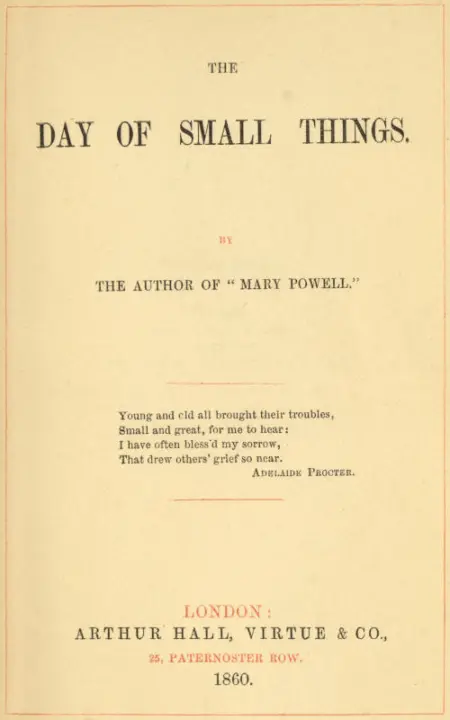
The Day of Small Things
Anne Manning

THE CLASSIC COLLECTION · 1863
"The Duchess of Trajetto" by Anne Manning is a historical novel written in the mid-19th century. It follows the life of Giulia di Gonzaga, the titular Duchess, as she navigates danger and intrigue in 16th-century Italy, particularly in the wake of a pirate attack led by Barbarossa. The narrative intertwines her personal struggles with themes of loyalty, love, and the complexities of her relationships with those around her, including her steely stepdaughter Isabella and the ambitious Cardinal Ippolito de’ Medici. The opening of the book sets a tense scene as the Duchess lies awake in her lavish chamber, troubled by ominous noises that herald an imminent threat. Instantly drawn into a night of chaos, she springs into action as pirate forces invade her castle. With her attendants—Caterina, an elderly woman, and Cynthia, a Moorish girl—she hurriedly attempts to escape the clutches of the marauders. The chaos and danger provide a gripping backdrop, highlighting Giulia's resilience and the intricate dynamics between her and her servants. This initial conflict propels the narrative forward, establishing both the stakes and the vibrant characters who will shape the Duchess's journey in a perilous world filled with political and personal intrigue.
Introduction adapted from the source catalogue; source summaries may be automatically generated.
Free to read · English · 44,083 words · No account needed
MAKE TIME FOR A GOOD BOOK
On by default. Untick to stop anonymous reading totals. Each page counts after 10 seconds in view. How this works.
Anonymous counting is on unless you have switched it off.
Then came so much parry and thrust, and tergiversation, and objurgation, and recrimination, that poor Giulia became seriously ill. Then the Marchioness of Pescara was very kind to her, and sat by her all day, and would have done so all night, but she fidgeted her to death, by what Giulia called preaching, though Vittoria only spoke what she meant for a word in season; and Giulia longed to tell her she would rather be nursed by her own maids.
"Ah, Leila!" said Cynthia, as she knelt, fanning her mistress, "I wish we were all back at Fondi."
"Why do you wish that, Cynthia?"
"You would be better there, Leila. You would be under the care of Bar
Hhasdai."
"Bar Hhasdai has no cure for worry, Cynthia."
"I think you would be better there, Leila."
"Cynthia! do you care for me? do you love me?"
Cynthia replied by repeatedly kissing the hem of the Duchess's garment.
"Ah, it is all very well to make that dumb show; but do you really love
me?"
"Yes, Leila, I love you. When the hound flew at me, you were bathed in my blood, and did not mind."
"Of course, poor girl, I could not help pitying you. By the bye, Cynthia--would you do anything that would make me better?"
"Try me, Leila."
"Well then, Cynthia--do tell me--frankly, as a friend--I'll forget I am your mistress--I will not punish you. Did you have any communication with Barbarossa?"
Cynthia's face changed. "Oh, Leila! how can you ask?"
"Well then, say no! It is so easily spoken."
"It is not easy."
"Easy or difficult, you must say."
Cynthia's obstinate look came on, which showed the case to be hopeless.
"Oh, very well, Cynthia; then you do not love me, that is all." And the Duchess turned her face away.
"I do love you, Leila."
"No, I don't believe you."
Cynthia took her hand and wetted it with tears. The Duchess drew it
away.
"I wish you would kill me, Leila."
"Don't tell such stories, Cynthia. You know it is not my nature to kill people; though there were persons wicked enough to say I had killed poor Muza, after cutting out his tongue, which you know he had lost before he ever came to me."
"I know it, Leila."
"Muza was perhaps sent back as a spy; though he pretended he had escaped. There are so many wicked people in the world that I do not know who to trust--I believe I shall end by distrusting everybody."
"Oh no, Leila. Do not!"
Your reading position is saved on this browser. Take it to another device with a library code. Reading pages adapt to text, rather than matching a printed edition.
Anne Manning

Anne Manning
Anne Manning
Anne Manning
BEHIND THE BOOK
This eBook is for the use of anyone anywhere in the United States and most other parts of the world at no cost and with almost no restrictions whatsoever. You may copy it, give it away or re-use it under the terms of the Project Gutenberg License included with this eBook or online at www.gutenberg.org. If you are not located in the United States, you will have to check the laws of the country where you are located before using this eBook. Read the source licence.
The original source file, including credits and licence, is retained by this library. Request an original-format copy at no charge. Please include the book title and Project Gutenberg identifier #42296.
KEEP YOUR CURIOSITY GOING
Cécile Tormay

Moritz Busch
Coulson Kernahan
John L. Ransom

Maurice Baring
Frances Wright