THE CLASSIC COLLECTION✦Towards democracyCLASSIC FREE BOOKS
Towards democracy
Edward Carpenter
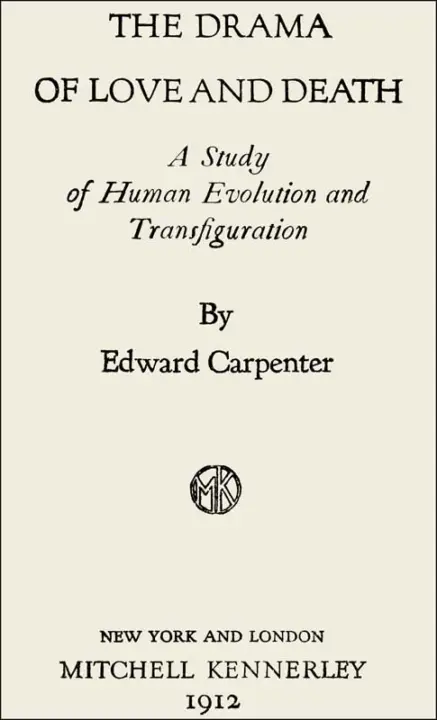
THE CLASSIC COLLECTION · 1912
"The Drama of Love and Death: A Study of Human Evolution and Transfiguration" by Edward Carpenter is a philosophical exploration written in the early 20th century. This work delves into the profound influences of love and death on human existence, framing them as central forces in our evolution and transformation. Carpenter seeks to illuminate the intertwined nature of these concepts, examining how they shape our experiences and relationships throughout life. The opening of the book establishes love and death as formidable and omnipresent dualities that dominate human experience. Carpenter articulates the struggle faced by humanity in understanding and navigating these forces, positing that true growth lies in embracing both love and death. He emphasizes the need for society to confront these realities openly, suggesting that an understanding of their interplay can lead to liberation from their seemingly tyrannical grasp. The chapter introduces these themes with philosophical musings and a call to action, urging readers to reflect on their own relationships with love and the inevitability of death.
Introduction adapted from the source catalogue; source summaries may be automatically generated.
Free to read · English · 71,795 words · No account needed
MAKE TIME FOR A GOOD BOOK
On by default. Untick to stop anonymous reading totals. Each page counts after 10 seconds in view. How this works.
Anonymous counting is on unless you have switched it off.
[115] Immortality, p. 148.
[116] Researches in the Phenomena of Spiritualism (Burns, 1874), p.
86.
[117] Materializations, p. 12.
[118] R. Dale Owen, The Debatable Land, p. 399.
[119] See Annals of Psychical Science, Report 1910–11.
[120] See Gustave Le Bon’s Evolution of Matter (Walter Scott
Publishing Co., 1907).
[121] See Le Bon, p. 45.
[122] For cases of hypnotic trance induced in one person by the telepathic action of another person at a distance, see Myers, op. cit., p. 160.
[123] Revue Philosophique, August, 1887.
[124] Myers, op. cit., p. 149.
[125] Ibid., p. 144. See also Henri Bergson’s L’Évolution Créatrice, p. 102, on the canalization of the senses.
[126] See chapter xiii. p. 243.
[127] It seems probable, from many considerations, that at a certain depth within us—in the region of what has been called the cosmic consciousness—memory does in nowise fade, and the past is always present, but, as Bergson says, the ordinary conscious intellect tends to only select from this mass what is needed for impending action, and has consequently become limited by this tendency.
[128] See the work of Richard Semon on the mneme as a main factor of organic life (Die Mneme als erhaltendes Prinzip im Wechsel des organischen Geschehens, Leipzig, 1904); also quoted by Auguste Forel, The Sexual Question (English edition, Rebman, 1908), pp. 14–17.
[129] See An Adventure, Macmillan & Co., 1911.
[130] See infra, ch. xiv. p. 255; also E. B. Wilson, The Cell, p.
433.
[131] Though this process, it would appear, requires practice, and is
not learned at once.
[132] See the frequent description of the unusual beauty and radiancy of the forms seen in connection with trance-mediums and circles.
[133] It may easily be understood, I think, that the process by which the distinct soul is thus built up may last several lifetimes. That is, there may be a long period during which the budding soul still entangled in the race-life may be reincarnated jointly with the race-soul in a kind of mixed way—family and race-characteristics mingling with and obscuring its expression—though these incarnations would become ever less mixed and more individual in character till the day of the soul’s final disentanglement.
[134] In the Symposium—Shelley’s translation.
[135] Shelley’s translation.
[136] What the physical medium of this transmission may be—whether the germ-plasm of Weismann, or some subtle aura which connects the members of a race together, or anything else—is a question to which the answer at present is not very clear.
[137] And not only out of the abysmal deeps of Man, but also out of the hidden soul of the Earth, and other cosmic beings.
[138] See supra, ch. vii. p. 122.
[139] See note at end of chapter vi.
Your reading position is saved on this browser. Take it to another device with a library code. Reading pages adapt to text, rather than matching a printed edition.
Edward Carpenter
Edward Carpenter
Edward Carpenter
Edward Carpenter
BEHIND THE BOOK
This eBook is for the use of anyone anywhere in the United States and most other parts of the world at no cost and with almost no restrictions whatsoever. You may copy it, give it away or re-use it under the terms of the Project Gutenberg License included with this eBook or online at www.gutenberg.org. If you are not located in the United States, you will have to check the laws of the country where you are located before using this eBook. Read the source licence.
The original source file, including credits and licence, is retained by this library. Request an original-format copy at no charge. Please include the book title and Project Gutenberg identifier #44883.
KEEP YOUR CURIOSITY GOING

David Patterson (Spirit) Hatch
Coulson Kernahan

Ralph Waldo Emerson
Frances Wright

Edwin Abbott Abbott

Joseph Droz