THE CLASSIC COLLECTION✦Towards democracyCLASSIC FREE BOOKS
Towards democracy
Edward Carpenter
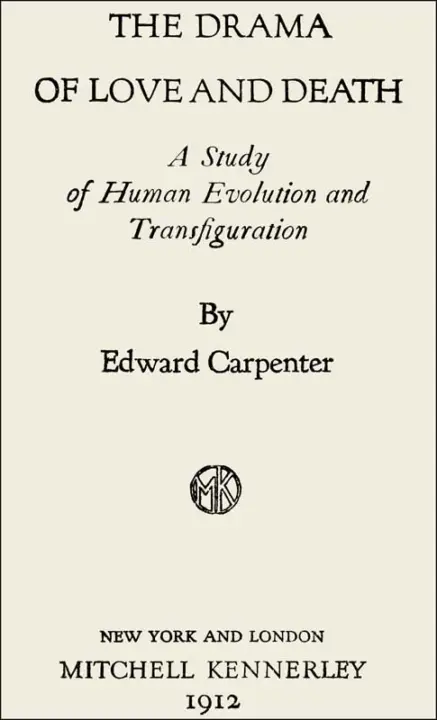
THE CLASSIC COLLECTION · 1912
"The Drama of Love and Death: A Study of Human Evolution and Transfiguration" by Edward Carpenter is a philosophical exploration written in the early 20th century. This work delves into the profound influences of love and death on human existence, framing them as central forces in our evolution and transformation. Carpenter seeks to illuminate the intertwined nature of these concepts, examining how they shape our experiences and relationships throughout life. The opening of the book establishes love and death as formidable and omnipresent dualities that dominate human experience. Carpenter articulates the struggle faced by humanity in understanding and navigating these forces, positing that true growth lies in embracing both love and death. He emphasizes the need for society to confront these realities openly, suggesting that an understanding of their interplay can lead to liberation from their seemingly tyrannical grasp. The chapter introduces these themes with philosophical musings and a call to action, urging readers to reflect on their own relationships with love and the inevitability of death.
Introduction adapted from the source catalogue; source summaries may be automatically generated.
Free to read · English · 71,795 words · No account needed
MAKE TIME FOR A GOOD BOOK
On by default. Untick to stop anonymous reading totals. Each page counts after 10 seconds in view. How this works.
Anonymous counting is on unless you have switched it off.
[97] See a long account in the Spiritualist for 15th May, 1873; also given by F. d’Albe, op. cit., p. 220, et seq.
[98] See R. J. Thompson’s Proofs of Life after Death (1906).
[99] See Phénomènes de la Villa Carmen, by Charles Richet, Paris, 1902; also Lombroso, op. cit., pp. 194–96.
[100] Mr. H. Carrington, in his Physical Phenomena of Spiritualism, has described in detail fraudulent methods of photography with which he is well acquainted. Nevertheless he seems to believe that some cases of “spirit photography” are genuine, and gives instances; see his book already quoted Death, &c., pp. 359, et seq. See also Mr. E. T. Bennett’s book on Spiritualism, with introduction by Sir Oliver Lodge, pp. 113–20.
[101] See The Art of Creation, ch. vi.
[102] The World of Dreams (Constable, 1911), p. 107.
[103] The World of Dreams, p. 190.
[104] See Electrons, by Sir Oliver Lodge (George Bell, 1910).
[105] Say, in millionths of an inch, fifteen millionths for the violet (at the dark line A), and twenty-seven millionths for the red (at B).
[106] See, for examples, ch. x. pp. 186–7, supra.
[107] See document signed by five responsible witnesses and published in the Spiritualist of 15th May, 1873.
[108] See Materializations, by Mme. D’Espérance, a lecture given in 1903 in London (Light Publishing Co.).
[109] See illustrations in Shadowland, passim.
[110] The cobwebby sensation alluded to above is often mentioned by other writers. Dr. J. Maxwell, in his Metaphysical Phenomena (Duckworth, 1905), p. 329, describes a case in which the radiation of force from the fingers of a medium was great enough to move a small statuette five or six inches distant, and absolutely without contact; but the phenomenon was accompanied by a “Spider-web or cobwebby sensation in the hands.” The author of that interesting book Interwoven (Boston, 1905, copyright by S. L. Ford), speaks of “the protoplasmic vapor of the inner man,” and says (p. 15): “It is this frail vapor which comes out at death and tries to form into spiritual body”; and again (p. 19): “I notice at death that nature draws or relieves the fire of the ganglia first and all the lines of sensation in light which were running down the nerves. It looks like white seaweed, very light and airy and fragile ... a veil of shining which is scarcely substance because of its white fire.”
[111] Fenomeni ipnotici, &c., p. 195.
[112] Namely, the highly charged electrostatic condition of mediums, the luminous clouds floating near them, the stars and rays of light in their vicinity, the photographic activity of their emanations, and so forth.
[113] So much smaller than the atom that “if the earth represented an electron, an atom would occupy a sphere with the sun as centre and four times the distance of the earth as radius.” See Electrons, by Oliver Lodge, p. 98.
[114] Ibid., pp. 82, 83.
Your reading position is saved on this browser. Take it to another device with a library code. Reading pages adapt to text, rather than matching a printed edition.
Edward Carpenter
Edward Carpenter
Edward Carpenter
Edward Carpenter
BEHIND THE BOOK
This eBook is for the use of anyone anywhere in the United States and most other parts of the world at no cost and with almost no restrictions whatsoever. You may copy it, give it away or re-use it under the terms of the Project Gutenberg License included with this eBook or online at www.gutenberg.org. If you are not located in the United States, you will have to check the laws of the country where you are located before using this eBook. Read the source licence.
The original source file, including credits and licence, is retained by this library. Request an original-format copy at no charge. Please include the book title and Project Gutenberg identifier #44883.
KEEP YOUR CURIOSITY GOING

David Patterson (Spirit) Hatch
Coulson Kernahan

Ralph Waldo Emerson
Frances Wright

Edwin Abbott Abbott

Joseph Droz