THE CLASSIC COLLECTION✦Towards democracyCLASSIC FREE BOOKS
Towards democracy
Edward Carpenter
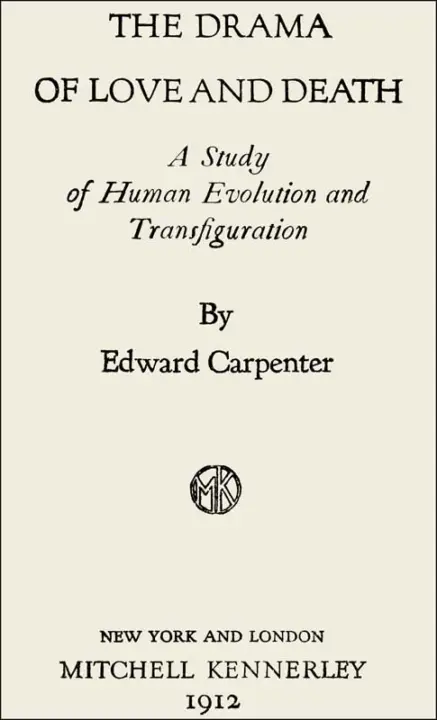
THE CLASSIC COLLECTION · 1912
"The Drama of Love and Death: A Study of Human Evolution and Transfiguration" by Edward Carpenter is a philosophical exploration written in the early 20th century. This work delves into the profound influences of love and death on human existence, framing them as central forces in our evolution and transformation. Carpenter seeks to illuminate the intertwined nature of these concepts, examining how they shape our experiences and relationships throughout life. The opening of the book establishes love and death as formidable and omnipresent dualities that dominate human experience. Carpenter articulates the struggle faced by humanity in understanding and navigating these forces, positing that true growth lies in embracing both love and death. He emphasizes the need for society to confront these realities openly, suggesting that an understanding of their interplay can lead to liberation from their seemingly tyrannical grasp. The chapter introduces these themes with philosophical musings and a call to action, urging readers to reflect on their own relationships with love and the inevitability of death.
Introduction adapted from the source catalogue; source summaries may be automatically generated.
Free to read · English · 71,795 words · No account needed
MAKE TIME FOR A GOOD BOOK
On by default. Untick to stop anonymous reading totals. Each page counts after 10 seconds in view. How this works.
Anonymous counting is on unless you have switched it off.
[39] See Carrington and Meader on Death: its Causes and Phenomena, p.
300.
[40] Reference may be made to the Upanishads (“Sacred books of the East,” vols. i. and xv.); to the Bhagavat Gita; to R. M. Bucke’s Cosmic Consciousness (Purdy Publishing Co., Chicago); to the Raja Yoga Lectures, by Vivekananda (New York, 1899); to the Ancient Wisdom, by Annie Besant; The Art of Creation, and A Visit to a Gnani, by E. Carpenter; and to many other works, of course.
[41] If I seem here to personify unduly these psychic elements and to ascribe to them too much in the way of consciousness and intelligence, I must refer for explanation to the Note at the end of this chapter.
[42] See ch. vii., infra, p. 119.
[43] See The Art of Creation, ch, xii. pp. 209, 210.
[44] Human Personality, &c., ch. vi.
[45] Ibid. p. 196, edition 1909, edited by L. H. Myers.
[46] For evidence on the subject of Phantasms, Wraiths, Haunted Houses, and so forth, see Phantoms of the Living, by Gurney, Myers, and Podmore; and The Report on the Census of Hallucinations, Proceedings of the Psychical Research Society, vol. x.; also L’inconnu et les problems psychiques, by Camille Flammarion; and Lombroso’s chapter on Haunted Houses, in his book Fenomeni Ipnotici e Spiritici (Turin, 1909), ch. xii.; also ch. viii. of the present book, infra.
[47] See Carrington and Meader, op. cit. pp. 318–27.
[48] Dr. Morton Prince’s study, The Dissolution of a Personality (Longmans, 1906), should be read, as going deeply into the whole subject. He suggests (p. 530) the use of the word “co-consciousness,” to indicate the secondary chains of mental operation which coexist side by side with or beneath the primary. Dr. R. Assagioli, in his pamphlet Il Subcosciente (Florence, 1911), also follows the same line.
[49] De Rerum Natura, iii. 890, translated by Mr. H. S. Salt.
[50] See Geddes and Thomson, Evolution of Sex (1901), p. 275.
[51] See ch. ii. p. 18, supra; also, for amplification of this view, Myers’s Human Personality, op. cit., edition 1909, pp. 90, 91.
[52] The Story of My Life, by Helen Keller (1908), p. 17.
[53] For a further account of the subliminal or underlying self, see
next chapter.
Your reading position is saved on this browser. Take it to another device with a library code. Reading pages adapt to text, rather than matching a printed edition.
Edward Carpenter
Edward Carpenter
Edward Carpenter
Edward Carpenter
BEHIND THE BOOK
This eBook is for the use of anyone anywhere in the United States and most other parts of the world at no cost and with almost no restrictions whatsoever. You may copy it, give it away or re-use it under the terms of the Project Gutenberg License included with this eBook or online at www.gutenberg.org. If you are not located in the United States, you will have to check the laws of the country where you are located before using this eBook. Read the source licence.
The original source file, including credits and licence, is retained by this library. Request an original-format copy at no charge. Please include the book title and Project Gutenberg identifier #44883.
KEEP YOUR CURIOSITY GOING

David Patterson (Spirit) Hatch
Coulson Kernahan

Ralph Waldo Emerson
Frances Wright

Edwin Abbott Abbott

Joseph Droz