THE CLASSIC COLLECTION✦Towards democracyCLASSIC FREE BOOKS
Towards democracy
Edward Carpenter
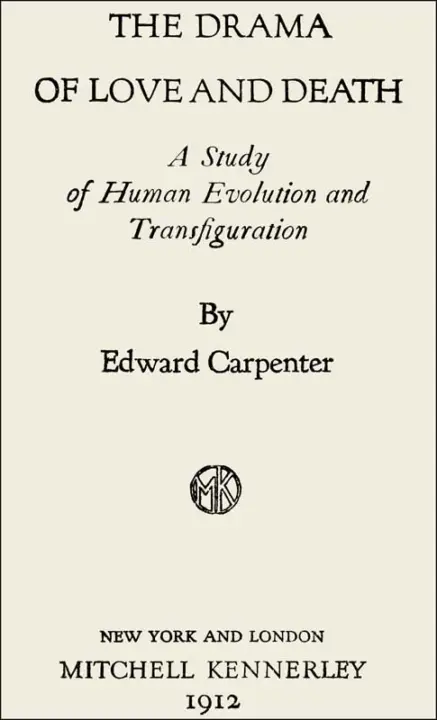
THE CLASSIC COLLECTION · 1912
"The Drama of Love and Death: A Study of Human Evolution and Transfiguration" by Edward Carpenter is a philosophical exploration written in the early 20th century. This work delves into the profound influences of love and death on human existence, framing them as central forces in our evolution and transformation. Carpenter seeks to illuminate the intertwined nature of these concepts, examining how they shape our experiences and relationships throughout life. The opening of the book establishes love and death as formidable and omnipresent dualities that dominate human experience. Carpenter articulates the struggle faced by humanity in understanding and navigating these forces, positing that true growth lies in embracing both love and death. He emphasizes the need for society to confront these realities openly, suggesting that an understanding of their interplay can lead to liberation from their seemingly tyrannical grasp. The chapter introduces these themes with philosophical musings and a call to action, urging readers to reflect on their own relationships with love and the inevitability of death.
Introduction adapted from the source catalogue; source summaries may be automatically generated.
Free to read · English · 71,795 words · No account needed
MAKE TIME FOR A GOOD BOOK
On by default. Untick to stop anonymous reading totals. Each page counts after 10 seconds in view. How this works.
Anonymous counting is on unless you have switched it off.
[17] It might be said that, notwithstanding this, the female obviously has the greater sway, on account of the conjunction taking place within the body of the mother, and subject to all her influences. But there is a curious compensation to this in the fact that while after conjugation the centrosome of the germ-cell disappears, the male centrosome is retained and becomes the organ of division for the new cell, and consequently for the whole future body. (See Parallel Paths, p. 56; also Professor E. B. Wilson in The Cell, p. 171.)
[18] “That a cell can carry with it the sum total of the heritage of the species, that it can in the course of a few days or weeks give rise to a mollusk or a man, is the greatest marvel of biological science” (The Cell, p. 396).
[19] For summary of the conclusions of this chapter, see Appendix,
infra, p. 289.
[20] Havelock Ellis’s very fine essay on “The Art of Love” (see his Studies in the Psychology of Sex, vol. vi, ch. xi) must also be mentioned, as including much of the subject matter of the above treatises, but having a very much wider scope and outlook.
[21] See The Cell, by E. B. Wilson, p. 391; Das Leben, by Jacques Loeb (Leipzig, 1911), pp. 10–20, &c. It seems also to be thought that gall-formations on plants, tumors on animal bodies, &c., are instances of such chemical or indirect fertilization.
[22] Translation by J. Wright, M.A., Golden Treasury Series, p. 57.
[23] Psychology of Sex, vol. vi. p. 517.
[24] Studies in the Psychology of Sex, vol. i.
[25] Ars. Am. iii. 605.
[26] Psychology of Sex, vol. vi. p. 542.
[27] Ibid., p. 544.
[28] “The disgrace which has overtaken the sexual act, and rendered it a deed of darkness, is doubtless largely responsible for the fact that the chief time for its consummation among modern civilized peoples is the darkness of the early night in stuffy bedrooms when the fatigue of the day’s labors is struggling with the artificial stimulation produced by heavy meals and alcoholic drinks. This habit is partly responsible for the indifference or even disgust with which women sometimes view coitus” (H. Ellis, Studies in the Psychology of Sex, vol. vi. p. 558).
[29] See H. Ellis, vol. v. pp. 11 and 12.
[30] See also Kraft-Ebing, Psychopathia sexualis, 7th edition, p. 165.
[31] Modern Woman: Her Intentions, p. 30.
[32] English edition; Heinemann, 1906.
[33] Fischer, Berlin, p. 192.
[34] Berlin, 1910, p. 290.
[35] Berlin, 1905, p. 332. English translation, Love and Marriage;
Putnam’s, 1911.
[36] See chapter on “Visions of the Dying” in Death: its Causes and Phenomena, by Carrington and Meader (1911); also infra, ch. vi. p. 103.
[37] See H. Pieron, “Contribution à la Psychologie des Mourants,” in Revue Philosophique, Dec., 1902.
[38] See Civilization: its Cause and Cure (George Allen, 2s. 6d.),
pp. 11–21.
Your reading position is saved on this browser. Take it to another device with a library code. Reading pages adapt to text, rather than matching a printed edition.
Edward Carpenter
Edward Carpenter
Edward Carpenter
Edward Carpenter
BEHIND THE BOOK
This eBook is for the use of anyone anywhere in the United States and most other parts of the world at no cost and with almost no restrictions whatsoever. You may copy it, give it away or re-use it under the terms of the Project Gutenberg License included with this eBook or online at www.gutenberg.org. If you are not located in the United States, you will have to check the laws of the country where you are located before using this eBook. Read the source licence.
The original source file, including credits and licence, is retained by this library. Request an original-format copy at no charge. Please include the book title and Project Gutenberg identifier #44883.
KEEP YOUR CURIOSITY GOING

David Patterson (Spirit) Hatch
Coulson Kernahan

Ralph Waldo Emerson
Frances Wright

Edwin Abbott Abbott

Joseph Droz