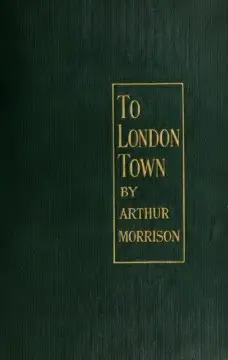
To London Town
Arthur Morrison
THE CLASSIC COLLECTION · 1897
"The Dorrington Deed-Box" by Arthur Morrison is a novel written in the late 19th century. The book unfolds through the narrative of Mr. James Rigby, who returns to England from Australia and finds himself entangled in a web of crime and intrigue linked to his father's mysterious murder years earlier. As he settles back into life in England, he is confronted by unsettling events that suggest that the past may not be as far behind him as he thought. The opening of the novel introduces Mr. James Rigby, who recounts his family's history, particularly the tragic story of his father's murder linked to the Camorra crime syndicate. Rigby reflects on his isolated upbringing in Australia and his recent decision to move to England to pursue his passion for art. However, upon returning, he becomes acutely aware of being followed—a sensation that evokes memories of his father's grim fate. As he attempts to escape this haunting realization, he encounters Horace Dorrington, a charismatic man who offers friendship, but whose true intentions remain ambiguous, adding layers to the tension as the story unfolds. The beginning sets a captivating tone of mystery and foreboding, suggesting that Rigby’s quest for personal reinvention may soon intersect with the dangers of his heritage.
Introduction adapted from the source catalogue; source summaries may be automatically generated.
Free to read · English · 59,283 words · No account needed
MAKE TIME FOR A GOOD BOOK
On by default. Untick to stop anonymous reading totals. Each page counts after 10 seconds in view. How this works.
Anonymous counting is on unless you have switched it off.
Samuel Greer sheered off as the cousinly interview ended, well satisfied with himself. Ten pounds was a fortune to him, and he meant having a good deal more. He did nothing further till the following morning, when he presented himself at the shop of Jarvis Flint.
"Good mornin', Mr. Flint," said Samuel Greer, grinning and squinting affably. "I couldn't help noticin' as you had a few words yesterday with Mr. Cater after the sad loss."
"Well?"
"It 'appens as I've seen the will as Mr. Cater was talkin' of, an' I thought p'raps it 'ud save you makin' mistakes if I told you of it."
"What about it?" Jarvis Flint was not disposed to accept Greer
altogether on trust.
"Well it do seem a scandalous thing, certainly, but what Mr. Cater said was right. He do take the personal property, subjick to debts, an' he do take the freehold prim'ses. An' he is the 'xecutor."
"Was the will witnessed?"
"Yes--two waterside chaps well know'd there-abouts."
"Was it made by a lawyer?"
"No--all in the lamented corpse's 'andwritin'."
"Umph!" Flint maintained his hard stare in Greer's face. "Anything
else?"
"Well, no, Mr. Flint, sir, p'raps not. But I wonder if there might be sich a thing as a codicil?"
"Is there?"
"Oh, I was a-wonderin', that's all. It might make a deal o' difference in the will, mightn't it? And p'raps Mr. Cater mightn't know anythink about the codicil."
"What do you mean? Is there a codicil?"
"Well, reely, Mr. Flint," answered Greer with a deprecatory grin--"reely it ain't business to give information for nothink, is it?"
"Business or not, if you know anything you'll find you'll have to tell it. I'm not going to let Cater have it all his own way, if he is executor. My lawyer'll be on the job before you're a day older, my man, and you won't find it pay to keep things too quiet."
"But it can't pay worse than to give information for nothink," persisted Greer. "Come, now, Mr. Flint, s'pose (I don't say there is, mind--I only say s'pose)--s'pose there was a codicil, and s'pose that codicil meant a matter of a few thousand pound in your pocket. And s'pose some person could tell you where to put your hand on that codicil, what might you be disposed to pay that person?"
"Bring me the codicil," answered Flint, "and if it's all right I'll give you--well, say five shillings."
Your reading position is saved on this browser. Take it to another device with a library code. Reading pages adapt to text, rather than matching a printed edition.
Arthur Morrison
Arthur Morrison
Arthur Morrison
Arthur Morrison
BEHIND THE BOOK
This eBook is for the use of anyone anywhere in the United States and most other parts of the world at no cost and with almost no restrictions whatsoever. You may copy it, give it away or re-use it under the terms of the Project Gutenberg License included with this eBook or online at www.gutenberg.org. If you are not located in the United States, you will have to check the laws of the country where you are located before using this eBook. Read the source licence.
The original source file, including credits and licence, is retained by this library. Request an original-format copy at no charge. Please include the book title and Project Gutenberg identifier #53341.
KEEP YOUR CURIOSITY GOING
Coulson Kernahan

Maurice Baring
Frances Wright
Cécile Tormay

Frederic Jesup Stimson

W. H. P. (William Henry Pope) Jarvis