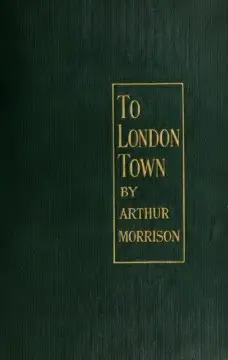
To London Town
Arthur Morrison
THE CLASSIC COLLECTION · 1897
"The Dorrington Deed-Box" by Arthur Morrison is a novel written in the late 19th century. The book unfolds through the narrative of Mr. James Rigby, who returns to England from Australia and finds himself entangled in a web of crime and intrigue linked to his father's mysterious murder years earlier. As he settles back into life in England, he is confronted by unsettling events that suggest that the past may not be as far behind him as he thought. The opening of the novel introduces Mr. James Rigby, who recounts his family's history, particularly the tragic story of his father's murder linked to the Camorra crime syndicate. Rigby reflects on his isolated upbringing in Australia and his recent decision to move to England to pursue his passion for art. However, upon returning, he becomes acutely aware of being followed—a sensation that evokes memories of his father's grim fate. As he attempts to escape this haunting realization, he encounters Horace Dorrington, a charismatic man who offers friendship, but whose true intentions remain ambiguous, adding layers to the tension as the story unfolds. The beginning sets a captivating tone of mystery and foreboding, suggesting that Rigby’s quest for personal reinvention may soon intersect with the dangers of his heritage.
Introduction adapted from the source catalogue; source summaries may be automatically generated.
Free to read · English · 59,283 words · No account needed
MAKE TIME FOR A GOOD BOOK
On by default. Untick to stop anonymous reading totals. Each page counts after 10 seconds in view. How this works.
Anonymous counting is on unless you have switched it off.
"Six months or so back, Deacon received a visit from a Japanese--taller than usual for a Japanese (I have seen him myself) and with the refined type of face characteristic of some of the higher class of his country. His name was Keigo Kanamaro, his card said, and he introduced himself as the son of Keigo Kiyotaki, the man who had sold Deacon his sword. He had come to England and had found my friend after much inquiry, he said, expressly to take back his father's katana. His father was dead, and he desired to place the sword in his tomb, that the soul of the old man might rest in peace, undisturbed by the disgrace that had fallen upon him by the sale of the sword that had been his and his ancestors' for hundreds of years back. The father had vowed when he had received the sword in his turn from Kanamaro's grandfather, never to part with it, but had broken his vow under pressure of want. He (the son) had earned money as a merchant (an immeasurable descent for a samurai with the feelings of the old school), and he was prepared to buy back the Masamuné blade with the Goto mountings for a much higher price than his father had received for it."
"And I suppose Deacon wouldn't sell it?" Dorrington asked.
"No," Mr. Colson replied. "He wouldn't have sold it at any price, I'm sure. Well, Kanamaro pressed him very urgently, and called again and again. He was very gentlemanly and very dignified, but he was very earnest. He apologised for making a commercial offer, assured Deacon that he was quite aware that he was no mere buyer and seller, but pleaded the urgency of his case. 'It is not here as in Japan,' he said, 'among us, the samurai of the old days. You have your beliefs, we have ours. It is my religion that I must place the katana in my father's grave. My father disgraced himself and sold his sword in order that I might not starve when I was a little child. I would rather that he had let me die, but since I am alive, and I know that you have the sword, I must take it and lay it by his bones. I will make an offer. Instead of giving you money, I will give you another sword--a sword worth as much money as my father's--perhaps more. I have had it sent from Japan since I first saw you. It is a blade made by the great Yukiyasu, and it has a scabbard and mountings by an older and greater master than the Goto who made those for my father's sword.' But it happened that Deacon already had two swords by Yukiyasu, while of Masamuné he had only the one. So he tried to reason the Japanese out of his fancy. But that was useless. Kanamaro called again and again and got to be quite a nuisance. He left off for a month or two, but about a fortnight ago he appeared again. He grew angry and forgot his oriental politeness. 'The English have the English ways,' he said, 'and we have ours--yes, though many of my foolish countrymen are in haste to be the same as the English are. We have our beliefs, and we have our knowledge, and I tell you that there are things which you would call superstition, but which are very real! Our old gods are not all dead yet, I tell you! In the old times no man would wear or keep another man's sword. Why? Because the great sword has a soul just as a man has, and it knows and the gods know! No man kept another's sword who did not fall into terrible misfortune and death, sooner or later. Give me my father's katana and save yourself. My father weeps in my ears at night, and I must bring him his katana!' I was talking to poor Deacon, as I told you, only on Tuesday afternoon, and he told me that Kanamaro had been there again the day before, in a frantic state--so bad, indeed, that Deacon thought of applying to the Japanese legation to have him taken care of, for he seemed quite mad. 'Mind, you foolish man!' he said. 'My gods still live, and they are strong! My father wanders on the dark path and cannot go to his gods without the swords in his girdle. His father asks of his vow! Between here and Japan there is a great sea, but my father may walk even here, looking for his katana, and he is angry! I go away for a little. But my gods know, and my father knows!' And then he took himself off. And now"--Mr. Colson nodded towards the next room and dropped his voice--"now poor Deacon is dead and the sword is gone!"
Your reading position is saved on this browser. Take it to another device with a library code. Reading pages adapt to text, rather than matching a printed edition.
Arthur Morrison
Arthur Morrison
Arthur Morrison
Arthur Morrison
BEHIND THE BOOK
This eBook is for the use of anyone anywhere in the United States and most other parts of the world at no cost and with almost no restrictions whatsoever. You may copy it, give it away or re-use it under the terms of the Project Gutenberg License included with this eBook or online at www.gutenberg.org. If you are not located in the United States, you will have to check the laws of the country where you are located before using this eBook. Read the source licence.
The original source file, including credits and licence, is retained by this library. Request an original-format copy at no charge. Please include the book title and Project Gutenberg identifier #53341.
KEEP YOUR CURIOSITY GOING
Coulson Kernahan

Maurice Baring
Frances Wright
Cécile Tormay

Frederic Jesup Stimson

W. H. P. (William Henry Pope) Jarvis