THE CLASSIC COLLECTION✦My diaries, being a personal narrative of events 1888-1914, Part 2 (1900-1914)CLASSIC FREE BOOKS
My diaries, being a personal narrative of events 1888-1914, Part 2 (1900-1914)
Wilfrid Scawen Blunt
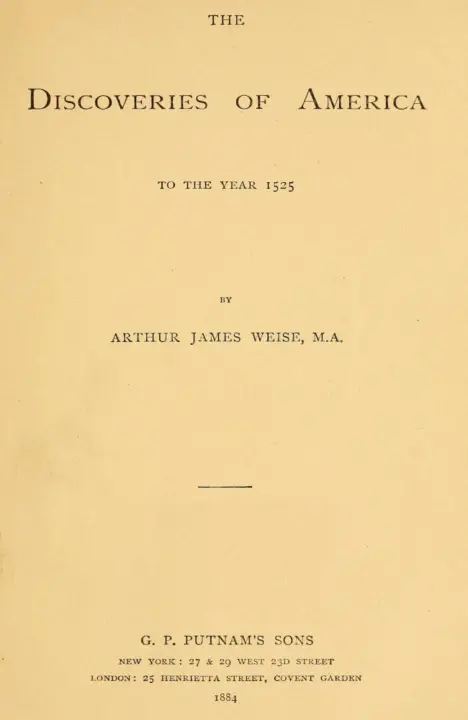
THE CLASSIC COLLECTION · 1884
"The Discoveries of America to the Year 1525" by Arthur James Weise is a historical account written in the late 19th century. This work delves into the early explorations of the American continent, focusing on the significant discoveries made before 1525, particularly by Columbus and other European explorers. The book aims to clarify various narratives about the discovery of America, critically examining the contributions of different explorers and offering insights into the civilizations that existed before European contact. The opening of the book presents a preface that establishes the historical context of America's early discovery and the inhabitants of the continent. Weise discusses the skepticism faced by Columbus and how earlier records, including Egyptian and Greek accounts, hint at a rich and complex civilization in the Americas long before European contact. Additionally, he highlights the contrasting views regarding the supposed discoveries made by the Northmen and other explorers, laying a foundation for the detailed accounts to follow. Overall, the opening sets the stage for a comprehensive exploration of the different narratives surrounding the discovery of America, emphasizing the blend of myth and historical fact.
Introduction adapted from the source catalogue; source summaries may be automatically generated.
Free to read · English · 127,443 words · No account needed
MAKE TIME FOR A GOOD BOOK
On by default. Untick to stop anonymous reading totals. Each page counts after 10 seconds in view. How this works.
Anonymous counting is on unless you have switched it off.
When the island in 1625 was purchased from the Manants by the agents of the Dutch West India Company, the transaction is spoken of in a letter addressed to their high mightinesses, the Lords States General of the United Netherlands, as follows: “Our people have bought the island Manhattes from the Wilden (wild men) for the value of sixty guilders [about twenty-four dollars].”—Holland documents, in the office of the Secretary of State, Albany, N. Y. vol. i. p. 155.
[439] Historische Verhael door Nicolaes à Wassenaer. Amsterdam.
1621-1632. deel vi. fol. 144.
[440] Nieuwe Wereldt. boeck. iii. cap. ix. Novus Orbis. lib. iii. cap. ix.
[441] Korte historial ende journals. Door David Pietersz. de Vries.
Hoorn, 1655. pp. 146, 151.
[442] New York Colonial MSS. xxxv.
Samuel de Champlain, the French explorer, describing in 1632 the coast of America in the vicinity of St. John’s River, New Brunswick, writes: “I was at four islands near the river St. John.... Farther west there are other islands, one of which extends six leagues, which is called by the savages, Menane.” Opposite this word, Champlain writes on the marginal space, “L’isle de Manthane,” adding a t and an h to the second syllable of the words.—Les voyages de la Nouvelle France occidentale, dicte Canada, faits par le Sr. de Champlain, Sanctongeois. Paris, 1632. chap. ii. p. 58.
[443] In different historical works and documents the following modes of spelling the word appear: Manatans, Manates, Manate, Manath, Manathans, Manathe, Manathes, Manatte, Manetto, Menates, Minates, Manhates, Manhatas, Manna-hatta, Manhattes, Manahattes, Manahatta, Mahates, Manahatas, Manahatans, Manahata, Manhatens, Manhathans, Manhatoes, Manhatoos, Manhatos, Manhattans, Manhatten, Manhattoes, Manhattons, Manhattos, Manhuttons, Manahactas, Manchatas, Manades, Manadoes, Manados, Menade, Monhatous, Munhaddon, and Manhattan.—Vide General index to documents relating to the colonial history of the State of New York.
[444] “Anormé, ée, & anormal, adj. Ces mots ne sont plus en usage. Borel dit qu’ils signifient qui est contre la régle commune, & qu’ énorme vient de ces mots.... Énorme, adj. m & f. Prodigieux, éxcessif. Immanis, immensus.”—Dictionnaire Trevoux.
“Par extension de la signification morale à la signification physique, extraordinaire par sa grosseur ou par sa grandeur. Un énorme bloc de granit.... Rem. Quand énorme signifie excessif en grandeur ou en grosseur, il se met avant ou après son substantif.”—Dictionnaire de la langue Française. Littré.
[445] “Berge (bèr-j’). s. f. 1°. Bord relevé, escarpé, d’une rivière, d’un fossé, d’un chemin. 2°. Terme de marine. Certains rochers élevés à pic sur l’eau....
Your reading position is saved on this browser. Take it to another device with a library code. Reading pages adapt to text, rather than matching a printed edition.
BEHIND THE BOOK
This eBook is for the use of anyone anywhere in the United States and most other parts of the world at no cost and with almost no restrictions whatsoever. You may copy it, give it away or re-use it under the terms of the Project Gutenberg License included with this eBook or online at www.gutenberg.org. If you are not located in the United States, you will have to check the laws of the country where you are located before using this eBook. Read the source licence.
The original source file, including credits and licence, is retained by this library. Request an original-format copy at no charge. Please include the book title and Project Gutenberg identifier #67766.
KEEP YOUR CURIOSITY GOING
Wilfrid Scawen Blunt
Wilfrid Scawen Blunt

E. W. (Edgar Watson) Howe
Cécile Tormay

Moritz Busch
John L. Ransom