THE CLASSIC COLLECTION✦My diaries, being a personal narrative of events 1888-1914, Part 2 (1900-1914)CLASSIC FREE BOOKS
My diaries, being a personal narrative of events 1888-1914, Part 2 (1900-1914)
Wilfrid Scawen Blunt
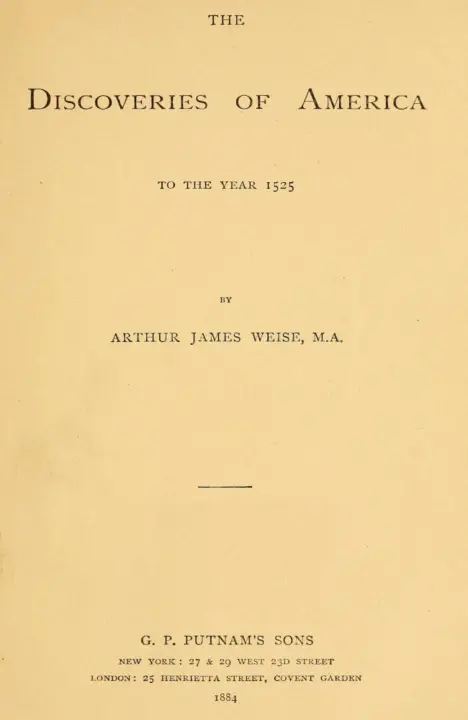
THE CLASSIC COLLECTION · 1884
"The Discoveries of America to the Year 1525" by Arthur James Weise is a historical account written in the late 19th century. This work delves into the early explorations of the American continent, focusing on the significant discoveries made before 1525, particularly by Columbus and other European explorers. The book aims to clarify various narratives about the discovery of America, critically examining the contributions of different explorers and offering insights into the civilizations that existed before European contact. The opening of the book presents a preface that establishes the historical context of America's early discovery and the inhabitants of the continent. Weise discusses the skepticism faced by Columbus and how earlier records, including Egyptian and Greek accounts, hint at a rich and complex civilization in the Americas long before European contact. Additionally, he highlights the contrasting views regarding the supposed discoveries made by the Northmen and other explorers, laying a foundation for the detailed accounts to follow. Overall, the opening sets the stage for a comprehensive exploration of the different narratives surrounding the discovery of America, emphasizing the blend of myth and historical fact.
Introduction adapted from the source catalogue; source summaries may be automatically generated.
Free to read · English · 127,443 words · No account needed
MAKE TIME FOR A GOOD BOOK
On by default. Untick to stop anonymous reading totals. Each page counts after 10 seconds in view. How this works.
Anonymous counting is on unless you have switched it off.
[430] The true and last discouerie of Florida made by Captain John Ribault in the yeere 1562. Dedicated to a great noble man of Fraunce, and translated into Englishe by one Thomas Hackit. Hakluyt’s Divers voyages. 1582.
The whole and true discoverye of Terra Florida (Englished, the Florishing Land) conteyning as well the wonderful straunge Natures and Maners of the People, with the mervylous Commodities and Treasures of the Country; as also the pleasaunt Portes and Havens, and Wayes thereunto never found out before the last year, 1562. Written in French by Captain Ribauld, the fyrst that whollye discovered the same, and now newly set forthe in Englishe, the xxx. of May, 1563.
[431] Voyages. Hakluyt. vol. iii. p. 232.
[432] Brief recit, and succincte narration de la nauigation faicte es ysles de Canada, Hochelage, and Saguenay & autres, auec particulieres meurs, langaige & cerimonies des habitans d’icelles: fort delectable à veoir. Auec priuilege. On les uend à Paris au second pillier en la grand salle du Palais, & en la rue neufue Nostre dame à l’enseigne de lescu de Frāce, par Ponce Roffet dict Fanchuer & Anthoine le Clerc frères. 1545.
[433] “Septem hoies syluestres ex ea isula (que terra noua dicit) Rothomagu adducti sunt.”—Eusebii Caesariensis episcopi chronicon. Paris. 1512. p. 172.
[434] “Manant, s. m. Paysan habitant en un village ou en une metairie à la campagne. Indigena, incola rusticus.... On appelle proprement manans, ceux qui sont originaires du lieu; & habitans, ceux qui y sont venus demeurer.”—Dictionnaire Trevoux. Nancy, 1740.
“Manant (ma-nan), s. m. 1° Terme d’ancienne pratique. Habitant d’un bourg ou d’un village.... 2° Absolument, dans le langage ordinaire, mais archaïque, un paysan.... 3° Aujourd’hui, par extension, homme grossier, mal élevé.”—Dictionnaire de la langue Française. Par É. Littré, de l’académie Française. Paris, 1874.
[435] “The French call the Maques, les Aniuez, the Oneydes, les Onoyants, the Onondagas, les Montagneurs, ... the Caiougas, les Petuneurs, the Senegues, les Paisans.”—Observations of Wenworth Greenhalgh in a journey from Albany to ye Indyans westward. 1677. London documents in the office of the Secretary of State, Albany, N. Y. vol. iii. p. 167.
[436] “This region is called by the peasants (paesani) Norumbega.”—Raccolta di navigationi e viaggi. Ramusio. vol. iii. fol. 353.
“Quando per sua buona uentura intese da paesani, che erano giunto alla marina alcuni nauiglia.” “Here by good luck he heard from the natives that some boats had arrived off the coast.”—Dello Scoprimento dell’ Isole Frislanda, Eslanda, Engronelanda, Estotilanda, & Icaria, fatto per due fratelli Zeni.—Vide Voyages of the Venetian brothers. Major. p. 24.
[437] Nieuwe Wereldt. Door Johannes de Laet. Tot Leyden. 1625. boek. iii.
cap. ix.
[438] Novus Orbis, seu descriptionis Indiæ Occidentalis, autore Joanne de Laet. Antuerpiensi, 1633. lib. iii. cap. vii.
Your reading position is saved on this browser. Take it to another device with a library code. Reading pages adapt to text, rather than matching a printed edition.
BEHIND THE BOOK
This eBook is for the use of anyone anywhere in the United States and most other parts of the world at no cost and with almost no restrictions whatsoever. You may copy it, give it away or re-use it under the terms of the Project Gutenberg License included with this eBook or online at www.gutenberg.org. If you are not located in the United States, you will have to check the laws of the country where you are located before using this eBook. Read the source licence.
The original source file, including credits and licence, is retained by this library. Request an original-format copy at no charge. Please include the book title and Project Gutenberg identifier #67766.
KEEP YOUR CURIOSITY GOING
Wilfrid Scawen Blunt
Wilfrid Scawen Blunt

E. W. (Edgar Watson) Howe
Cécile Tormay

Moritz Busch
John L. Ransom