THE CLASSIC COLLECTION✦A dead man’s diaryCLASSIC FREE BOOKS
A dead man’s diary
Coulson Kernahan
THE CLASSIC COLLECTION · 1919
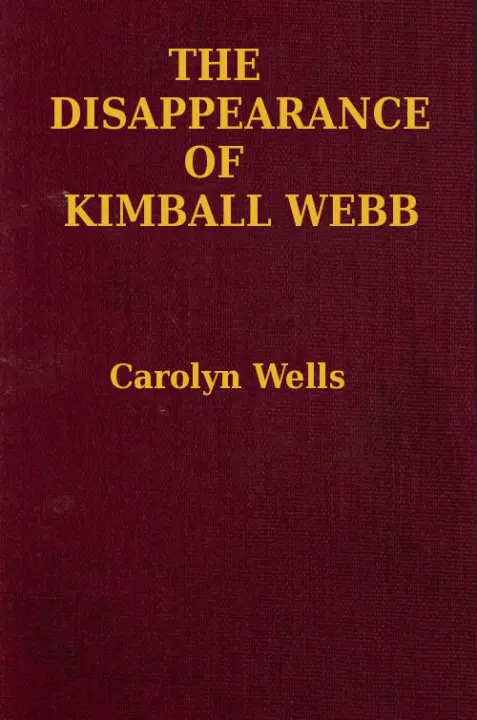
"The Disappearance of Kimball Webb" by Rowland Wright is a mystery novel written in the early 20th century. The story revolves around the mysterious vanishing of Kimball Webb, a New York playwright, on the day he was supposed to marry Elsie Powell. The narrative delves into his family dynamics, particularly the complex relationships with his mother and sister, who seem to hold contempt for Elsie, adding layers to the enigma of his disappearance. At the start of the novel, readers are introduced to Kimball Webb, who seems to lead an ordinary life, on the brink of his wedding. However, on the morning of the big day, his absence sparks concern, leading to the revelation that he is missing under inexplicable circumstances. Despite evidence pointing to the door of his room being locked from the inside, no one can ascertain how he exited without anyone seeing. As his family and Elsie grapple with the mystery, the opening chapters set up a tense atmosphere filled with suspicion, particularly surrounding the disapproving women in his life, hinting at possible motives and leading to a captivating web of intrigue.
Introduction adapted from the source catalogue; source summaries may be automatically generated.
Free to read · English · 64,643 words · No account needed
MAKE TIME FOR A GOOD BOOK
On by default. Untick to stop anonymous reading totals. Each page counts after 10 seconds in view. How this works.
Anonymous counting is on unless you have switched it off.
A tradition in the Webb family was that "haste" is a word unknown to a lady. It may have been the observance of this that caused the lagging footsteps, but to an onlooker it would have appeared that Henrietta Webb was thinking with a rapidity in inverse proportion to her movements.
At Kimball's door, the door from the hall into the front room on the third floor, she paused, and stood looking at it with a sort of fascination. What lay behind it? Tragedy?--or merely the comedy of over sleeping?
"If it should be!" she murmured, in an irrepressible whisper, and her hands clinched into one another, as if in expression of some strong emotion.
"Can't you rouse him, Miss Webb?" asked Hollis, solicitously, as he and the chauffeur came upstairs two or three steps at a bound.
"I--I haven't tried," said Henrietta, dully. "I--I'm afraid--"
"Now, now, Miss Webb," Oscar, the chauffeur, put in cheerily, "I'll bet he's all right. Anyway, we'll soon see."
The mechanician quickly picked the lock, but a firm bolt still held the
door closed.
"Have to smash in," he exclaimed; "no other way."
The door was heavy and solid, as doors of old New York houses are, but after a few futile attempts, the two men burst the bolt from its fastenings and threw the door open.
Kimball Webb was not in the room.
The three, crowding through the doorway, took in this fact without, at first, grasping its full significance.
Then, "The bathroom," said Henrietta, and Oscar, who was more alert than the butler, flung open the bathroom door.
When the Webbs took the old house, they remodelled it slightly to suit their needs. On this third floor, there had been a joint lavatory and dressing room between two large bedrooms. This had been changed to make it a private bath connected only with Kimball's room, and having no outlet elsewhere. The room behind it was used as a family sitting-room or library, and there were no other rooms on the floor. What might have been hall bedrooms were alcoves in the two rooms.
Therefore, when Oscar entered the bathroom, and found no one in it, the situation resolved itself into the simple fact that Kimball Webb had disappeared from a room that had but one exit door, and that had been found locked and bolted.
Oscar turned white and shook, Hollis turned red and shivered, but Miss Webb preserved her colour and her poise. It was not remarkable that her colour remained stationary, she had applied it with that intention, but her unshattered nerves bespoke a marvellous self-control.
Your reading position is saved on this browser. Take it to another device with a library code. Reading pages adapt to text, rather than matching a printed edition.
BEHIND THE BOOK
This eBook is for the use of anyone anywhere in the United States and most other parts of the world at no cost and with almost no restrictions whatsoever. You may copy it, give it away or re-use it under the terms of the Project Gutenberg License included with this eBook or online at www.gutenberg.org. If you are not located in the United States, you will have to check the laws of the country where you are located before using this eBook. Read the source licence.
The original source file, including credits and licence, is retained by this library. Request an original-format copy at no charge. Please include the book title and Project Gutenberg identifier #59060.
KEEP YOUR CURIOSITY GOING
Coulson Kernahan

Maurice Baring
Frances Wright
Cécile Tormay

Frederic Jesup Stimson

W. H. P. (William Henry Pope) Jarvis