THE CLASSIC COLLECTION✦A dead man’s diaryCLASSIC FREE BOOKS
A dead man’s diary
Coulson Kernahan
THE CLASSIC COLLECTION · 1919
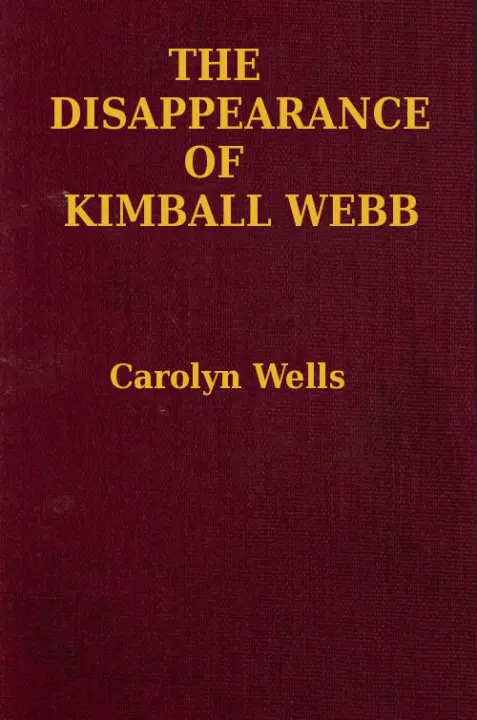
"The Disappearance of Kimball Webb" by Rowland Wright is a mystery novel written in the early 20th century. The story revolves around the mysterious vanishing of Kimball Webb, a New York playwright, on the day he was supposed to marry Elsie Powell. The narrative delves into his family dynamics, particularly the complex relationships with his mother and sister, who seem to hold contempt for Elsie, adding layers to the enigma of his disappearance. At the start of the novel, readers are introduced to Kimball Webb, who seems to lead an ordinary life, on the brink of his wedding. However, on the morning of the big day, his absence sparks concern, leading to the revelation that he is missing under inexplicable circumstances. Despite evidence pointing to the door of his room being locked from the inside, no one can ascertain how he exited without anyone seeing. As his family and Elsie grapple with the mystery, the opening chapters set up a tense atmosphere filled with suspicion, particularly surrounding the disapproving women in his life, hinting at possible motives and leading to a captivating web of intrigue.
Introduction adapted from the source catalogue; source summaries may be automatically generated.
Free to read · English · 64,643 words · No account needed
MAKE TIME FOR A GOOD BOOK
On by default. Untick to stop anonymous reading totals. Each page counts after 10 seconds in view. How this works.
Anonymous counting is on unless you have switched it off.
When Hollis returned, though his face showed amazement and doubt, there was no sign of fear, but rather a suppressed smile and an indulgent twinkle of his eye.
"Mr. Kimball is very sound asleep, ma'am," he reported to his mistress. "Will you not leave him lay for awhile?"
"You are implying," said Mrs. Webb, astutely, "that Mr. Kimball was at a gay party last night. He spoke with me on his return, and I can assure you, Hollis, that he had not been over-celebrating in any way."
The butler looked chagrined, then relieved, then puzzled.
"In that case, ma'am, why does he sleep so very soundly? I rapped as loud as I could, and also shook at the door-knob. And then, I listened at the keyhole, but I could hear no deep breathing, as of a sound sleeper."
"I will go up myself," said Kimball Webb's mother, and the man held the door open for her to pass through.
"It is very strange," said Henrietta, with a covert glance at the
butler.
"Yes, Miss Webb," and the man looked at her until she fidgeted.
"Leave the room," she ordered, sharply, and he obeyed.
"There's something wrong, Henrietta," her mother declared, as she came hastily back. "I've called and called, and pleaded with him to let me in, but he won't."
"Did he reply at all?"
"No; not a sound. I should think he was up and out early, about some business, but that his door is locked."
"He always locks it at night."
"Of course. And last night, as he had the diamonds in his keeping, I daresay he fastened the door with extra care."
"Oh, mother, perhaps somebody has murdered him and stolen the diamonds!"
Henrietta was always outspoken, and the result of this speech was a hysterical scream from the elder lady, that brought Hollis to the scene again, followed by the cook and a housemaid.
Leaving her mother to the attentions of the women servants, Henrietta
spoke to the butler.
"Mr. Kimball's room must be opened," she said; "can you do it, Hollis?"
"Not alone, Miss Henrietta. Shall I get the chauffeur?"
"Yes, and quickly. Meantime I'm going upstairs myself. Come up as soon
as you can get Oscar."
Slowly Henrietta Webb mounted the two flights of stairs to her brother's room. A strange, thoughtful look was on her handsome face.
Not a young woman was Miss Webb, indeed she was three years older than Kimball, who was thirty. But she was what is known as well-preserved, and every detail of her perfect grooming spoke of a determination to look her best at any expense of time, trouble or money.
Your reading position is saved on this browser. Take it to another device with a library code. Reading pages adapt to text, rather than matching a printed edition.
BEHIND THE BOOK
This eBook is for the use of anyone anywhere in the United States and most other parts of the world at no cost and with almost no restrictions whatsoever. You may copy it, give it away or re-use it under the terms of the Project Gutenberg License included with this eBook or online at www.gutenberg.org. If you are not located in the United States, you will have to check the laws of the country where you are located before using this eBook. Read the source licence.
The original source file, including credits and licence, is retained by this library. Request an original-format copy at no charge. Please include the book title and Project Gutenberg identifier #59060.
KEEP YOUR CURIOSITY GOING
Coulson Kernahan

Maurice Baring
Frances Wright
Cécile Tormay

Frederic Jesup Stimson

W. H. P. (William Henry Pope) Jarvis