
Life of Edwin Forrest, the American Tragedian. Volume 2 (of 2)
William Rounseville Alger & Horatio, Jr. Alger
THE CLASSIC COLLECTION · 1895
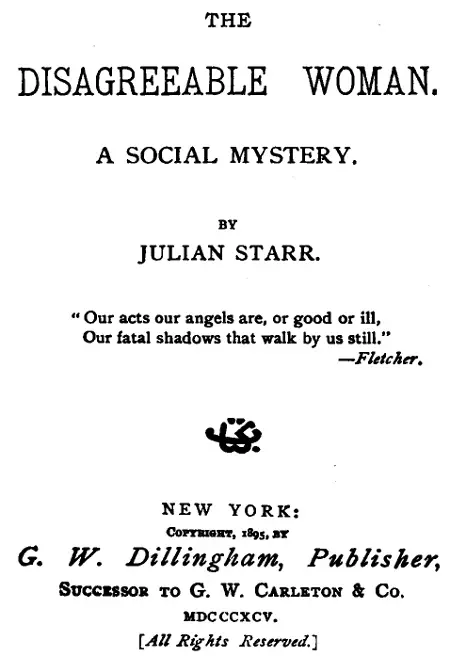
"The Disagreeable Woman: A Social Mystery" by Julian Starr is a novel written in the late 19th century. The story unfolds in a boarding house in New York City, centering around a character known as the Disagreeable Woman, a sharp-tongued and observant figure whose caustic remarks and enigmatic nature intrigue her fellow boarders. The narrative explores themes of social dynamics, human relationships, and the mysteries surrounding personal identities. At the start of the novel, we are introduced to the Disagreeable Woman amidst breakfast in a boarding house run by Mrs. Gray. Her sharp comment about a young widow's apparent age creates a stir among the boarders, hinting at her straightforward disposition. The narrator, a struggling physician who has moved to the city for better opportunities, becomes curious about the Disagreeable Woman, whose true identity and purpose remain cloaked in mystery. As he interacts with other boarders like the earnest Professor Poppendorf and the charming Ruth Canby, both humor and tension arise, setting the stage for deeper explorations of affection, class, and the societal roles of the characters as the story unfolds.
Introduction adapted from the source catalogue; source summaries may be automatically generated.
Free to read · English · 23,560 words · No account needed
MAKE TIME FOR A GOOD BOOK
On by default. Untick to stop anonymous reading totals. Each page counts after 10 seconds in view. How this works.
Anonymous counting is on unless you have switched it off.
We all sat at supper on Thursday evening. There was a general air of expectation. It was on this evening that Prof. Poppendorf was to give his lecture. We all gazed at him with more than ordinary interest. The old Professor, gray and grim-visaged, sat more than usually erect, and his manner and bearing were marked by unusual dignity. He felt himself to be the hero of the hour.
I have neglected to say that Mrs. Wyman had been transferred to the seat adjoining mine. As she could not do without masculine attention I suspect that this arrangement was prompted by herself. Henceforth I was favored with the greater part of her conversation.
"I am quite looking forward to Prof. Poppendorf's lecture!" she said. "You are going, are you not?"
"I think so, but I can't say I am looking forward to it. I fancy it will be dry and difficult to understand."
"You think he is a learned man, do you not?"
"Very probably--in certain directions."
"Dr. Fenwick, I am going to ask a favor of you."
"I hope it isn't money," thought I, "for I was beginning to have some anxiety about my steadily dwindling bank account."
"Name it, Mrs. Wyman," I said, somewhat nervously.
"I am almost ashamed to say it, but I don't like to go to the lecture alone. Would you mind giving me your escort?"
"With pleasure," I answered.
My answer was not quite truthful, for I had intended to ask the young woman from Macy's to accompany me. She was not intellectual, but she had a fresh, country face and complexion; she came from Pomfret, Connecticut, and was at least ten years younger than Mrs. Wyman. But what could I say? I had not the moral courage to refuse a lady.
"Thank you very much. Now I shall look forward to the evening with
pleasure."
"You are complimentary. Do you expect to understand the lecture?"
"I don't know. I never gave much thought to the 'Material and
Immaterial.'"
"Possibly we may understand as much about the subject as the Professor
himself."
"Oh, how severe you are! Now I have great faith in the Professor's
learning."
"He ought to be learned. He certainly has no physical beauty."
Mrs. Wyman laughed.
"I suppose few learned men are handsome," she said.
"Then perhaps I may console myself for having so little learning. Do you think the same rule holds good with ladies?"
"To a certain extent. I am sure the principal of the seminary I attended was frightfully plain; but I am sure she was learned. Prof. Poppendorf, have you sold many lecture tickets?"
"Quite a few!" answered the Professor, vaguely.
Your reading position is saved on this browser. Take it to another device with a library code. Reading pages adapt to text, rather than matching a printed edition.
William Rounseville Alger & Horatio, Jr. Alger

William Rounseville Alger & Horatio, Jr. Alger

Horatio, Jr. Alger

Horatio, Jr. Alger
BEHIND THE BOOK
This eBook is for the use of anyone anywhere in the United States and most other parts of the world at no cost and with almost no restrictions whatsoever. You may copy it, give it away or re-use it under the terms of the Project Gutenberg License included with this eBook or online at www.gutenberg.org. If you are not located in the United States, you will have to check the laws of the country where you are located before using this eBook. Read the source licence.
The original source file, including credits and licence, is retained by this library. Request an original-format copy at no charge. Please include the book title and Project Gutenberg identifier #54660.
KEEP YOUR CURIOSITY GOING
Coulson Kernahan

Maurice Baring
Frances Wright
Cécile Tormay

Frederic Jesup Stimson

W. H. P. (William Henry Pope) Jarvis