
Life of Edwin Forrest, the American Tragedian. Volume 2 (of 2)
William Rounseville Alger & Horatio, Jr. Alger
THE CLASSIC COLLECTION · 1895
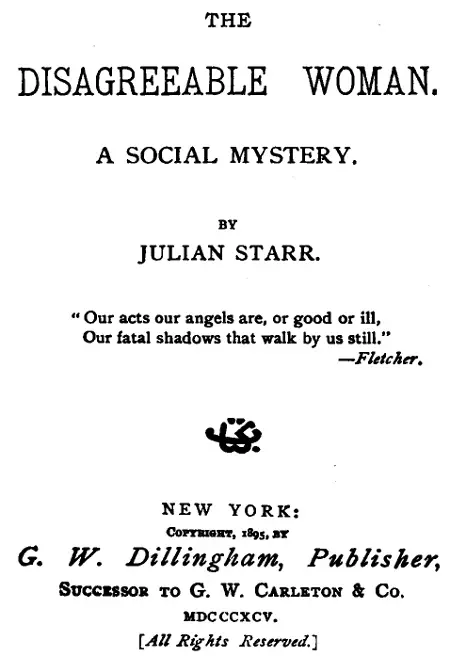
"The Disagreeable Woman: A Social Mystery" by Julian Starr is a novel written in the late 19th century. The story unfolds in a boarding house in New York City, centering around a character known as the Disagreeable Woman, a sharp-tongued and observant figure whose caustic remarks and enigmatic nature intrigue her fellow boarders. The narrative explores themes of social dynamics, human relationships, and the mysteries surrounding personal identities. At the start of the novel, we are introduced to the Disagreeable Woman amidst breakfast in a boarding house run by Mrs. Gray. Her sharp comment about a young widow's apparent age creates a stir among the boarders, hinting at her straightforward disposition. The narrator, a struggling physician who has moved to the city for better opportunities, becomes curious about the Disagreeable Woman, whose true identity and purpose remain cloaked in mystery. As he interacts with other boarders like the earnest Professor Poppendorf and the charming Ruth Canby, both humor and tension arise, setting the stage for deeper explorations of affection, class, and the societal roles of the characters as the story unfolds.
Introduction adapted from the source catalogue; source summaries may be automatically generated.
Free to read · English · 23,560 words · No account needed
MAKE TIME FOR A GOOD BOOK
On by default. Untick to stop anonymous reading totals. Each page counts after 10 seconds in view. How this works.
Anonymous counting is on unless you have switched it off.
"I cannot tell when I shall return to New York. Probably I shall never again be an inmate of your happy home. The Count and I may take a flat up-town--a whole house would be too large for us. But I shall--we shall certainly call on our old friends, and I trust that the ties that bind us together in friendship may never weaken.
"I shall soon be the Countess di Penelli. But once more and for the last time, I subscribe myself
"Your faithful and devoted
"LETITIA WYMAN."
We listened to the reading of the letter in silent excitement. Then there was a chorus of exclamations.
"Did you ever?" ejaculated the young woman from Macy's.
"I am not surprised," said the Disagreeable woman, calmly. "Mrs. Wyman has been courting the Count ever since he came here."
"You mean that he has been paying his attentions to her," suggested Mr.
Blake, the reporter.
"No, I mean what I say."
"She says she had no thought of marrying again."
"Mr. Blake, you are a young man. You don't understand women, and particularly widows. Probably there is not a gentleman at the table whom Mrs. Wyman has not thought of as a matrimonial subject, yourself not excepted."
Mr. Blake was a very young man, and he blushed.
"She would not have married me," growled the Professor.
Most of us smiled.
"Are you pledged to celibacy, Professor?" asked the landlady.
"No, madam. If a certain young lady would marry me I would marry
to-morrow."
Ruth Canby blushed furiously, and was indignant with herself for doing so, especially as it drew all glances to her.
"Let us hope you may be successful in your suit, Professor," said Mrs.
Gray.
"Thank you, my dear lady; time will show."
Miss Blagden turned her searching glance upon the flaming cheeks of Ruth and smiled kindly. If there was any one at the table whom she liked it was the young woman from Macy's.
"I suppose there is no doubt about his being a Count," suggested Mr.
Blake.
"I should say there was a good deal of doubt," answered the Disagreeable
Woman.
"Do you really think so?"
"It is my conjecture."
"Oh, I think there is no doubt about it," said the landlady, who prided herself on having had so aristocratic a boarder.
"I am a loser by this marriage," said Mrs. Gray. "I have two rooms
suddenly vacated."
"A friend of mine will take one of them," said Mr. Blake, the reporter. "He has been wishing to get in here for a month."
"I shall be glad to receive him," said Mrs. Gray, graciously.
The other room was also taken within a week.
Your reading position is saved on this browser. Take it to another device with a library code. Reading pages adapt to text, rather than matching a printed edition.
William Rounseville Alger & Horatio, Jr. Alger

William Rounseville Alger & Horatio, Jr. Alger

Horatio, Jr. Alger

Horatio, Jr. Alger
BEHIND THE BOOK
This eBook is for the use of anyone anywhere in the United States and most other parts of the world at no cost and with almost no restrictions whatsoever. You may copy it, give it away or re-use it under the terms of the Project Gutenberg License included with this eBook or online at www.gutenberg.org. If you are not located in the United States, you will have to check the laws of the country where you are located before using this eBook. Read the source licence.
The original source file, including credits and licence, is retained by this library. Request an original-format copy at no charge. Please include the book title and Project Gutenberg identifier #54660.
KEEP YOUR CURIOSITY GOING
Coulson Kernahan

Maurice Baring
Frances Wright
Cécile Tormay

Frederic Jesup Stimson

W. H. P. (William Henry Pope) Jarvis