
Life of Edwin Forrest, the American Tragedian. Volume 2 (of 2)
William Rounseville Alger & Horatio, Jr. Alger
THE CLASSIC COLLECTION · 1895
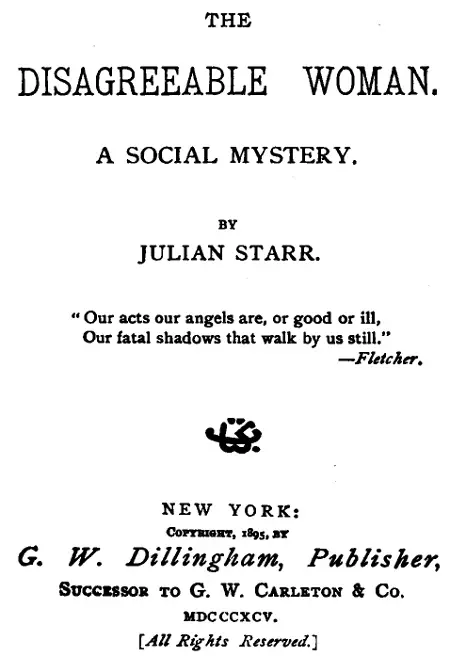
"The Disagreeable Woman: A Social Mystery" by Julian Starr is a novel written in the late 19th century. The story unfolds in a boarding house in New York City, centering around a character known as the Disagreeable Woman, a sharp-tongued and observant figure whose caustic remarks and enigmatic nature intrigue her fellow boarders. The narrative explores themes of social dynamics, human relationships, and the mysteries surrounding personal identities. At the start of the novel, we are introduced to the Disagreeable Woman amidst breakfast in a boarding house run by Mrs. Gray. Her sharp comment about a young widow's apparent age creates a stir among the boarders, hinting at her straightforward disposition. The narrator, a struggling physician who has moved to the city for better opportunities, becomes curious about the Disagreeable Woman, whose true identity and purpose remain cloaked in mystery. As he interacts with other boarders like the earnest Professor Poppendorf and the charming Ruth Canby, both humor and tension arise, setting the stage for deeper explorations of affection, class, and the societal roles of the characters as the story unfolds.
Introduction adapted from the source catalogue; source summaries may be automatically generated.
Free to read · English · 23,560 words · No account needed
MAKE TIME FOR A GOOD BOOK
On by default. Untick to stop anonymous reading totals. Each page counts after 10 seconds in view. How this works.
Anonymous counting is on unless you have switched it off.
"Dr. Fenwick," she said, "can't you play the accompaniment for the
Count?"
"What is the song?"
"'Sweet Marie'."
"I will do my best. I am not professional."
So I played and the Count sang. He had a pleasant, sympathetic voice, and we were pleased with his singing.
"Oh, how charming, Count!" said Mrs. Wyman; "I shall never dare to sing
before you again."
"Why not, signora."
"Because you are such a musical artist."
"Oh, no, no, signora!" he said, deprecatingly.
He was persuaded to sing again, and again he pleased his small audience.
"Miss Blagden, won't you favor us with a song?" asked Mrs. Wyman, in a
tone of mockery.
"Thank you," said the Disagreeable Woman, dryly. "There is so much musical talent here, that I won't undertake to compete with those who possess it."
"Prof. Poppendorf, don't you ever sing?" asked the widow, audaciously.
"I used to sing when I was young," answered the Professor, unexpectedly.
"Then do favor us!"
He seated himself at the piano, and sang a German drinking song, such as in days gone by he had sung with Bismarck and his old comrades at the university.
There was a rough vigor in his performance that was not unpleasant. No one was more surprised than Mrs. Wyman at the outcome of what she had meant as a joke.
"Really, Professor," said the Disagreeable Woman, "you are more
accomplished than I supposed. I like your song better than I did your
lecture."
Prof. Poppendorf removed his glasses, and we saw in his eyes a
suspicious moisture.
"Ah," he said, not appearing to hear the compliment, if it was a compliment, "it brings back the old days. I have not sing that song since I was at the university with Bismarck. There were twenty of us, young students, who sang it together, and now they are almost all gone."
This ended the musical performances of the evening. After this, there was conversation, and later Mrs. Gray provided ice-cream and cake. It was Horton's ice-cream, and the plates were small, but we enjoyed it.
Before we parted, the Professor found himself sitting next to Ruth
Canby.
"Do you ever go to the theatre, fraulein?" he asked.
"Not often, Professor. I cannot go alone, and there is no one to take
me."
"I will take you, Mees Ruth."
The young woman from Macy's looked amazed. She had not dreamed of such an invitation from him. Yet she was very fond of the stage, and she saw no reason why she should not accept.
"You are very kind, Professor," she said. "I did not think you cared
for the theatre."
"I would like to go--with you," he said, gallantly.
Your reading position is saved on this browser. Take it to another device with a library code. Reading pages adapt to text, rather than matching a printed edition.
William Rounseville Alger & Horatio, Jr. Alger

William Rounseville Alger & Horatio, Jr. Alger

Horatio, Jr. Alger

Horatio, Jr. Alger
BEHIND THE BOOK
This eBook is for the use of anyone anywhere in the United States and most other parts of the world at no cost and with almost no restrictions whatsoever. You may copy it, give it away or re-use it under the terms of the Project Gutenberg License included with this eBook or online at www.gutenberg.org. If you are not located in the United States, you will have to check the laws of the country where you are located before using this eBook. Read the source licence.
The original source file, including credits and licence, is retained by this library. Request an original-format copy at no charge. Please include the book title and Project Gutenberg identifier #54660.
KEEP YOUR CURIOSITY GOING
Coulson Kernahan

Maurice Baring
Frances Wright
Cécile Tormay

Frederic Jesup Stimson

W. H. P. (William Henry Pope) Jarvis