
Life of Edwin Forrest, the American Tragedian. Volume 2 (of 2)
William Rounseville Alger & Horatio, Jr. Alger
THE CLASSIC COLLECTION · 1895
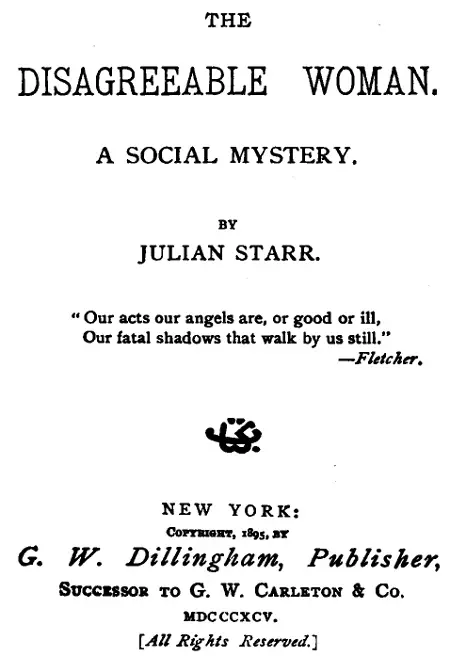
"The Disagreeable Woman: A Social Mystery" by Julian Starr is a novel written in the late 19th century. The story unfolds in a boarding house in New York City, centering around a character known as the Disagreeable Woman, a sharp-tongued and observant figure whose caustic remarks and enigmatic nature intrigue her fellow boarders. The narrative explores themes of social dynamics, human relationships, and the mysteries surrounding personal identities. At the start of the novel, we are introduced to the Disagreeable Woman amidst breakfast in a boarding house run by Mrs. Gray. Her sharp comment about a young widow's apparent age creates a stir among the boarders, hinting at her straightforward disposition. The narrator, a struggling physician who has moved to the city for better opportunities, becomes curious about the Disagreeable Woman, whose true identity and purpose remain cloaked in mystery. As he interacts with other boarders like the earnest Professor Poppendorf and the charming Ruth Canby, both humor and tension arise, setting the stage for deeper explorations of affection, class, and the societal roles of the characters as the story unfolds.
Introduction adapted from the source catalogue; source summaries may be automatically generated.
Free to read · English · 23,560 words · No account needed
MAKE TIME FOR A GOOD BOOK
On by default. Untick to stop anonymous reading totals. Each page counts after 10 seconds in view. How this works.
Anonymous counting is on unless you have switched it off.
This was most astonishing.
"You love her yourself?"
"Ja, Herr Doctor."
"And you want to marry her?"
"Ja."
"But you are an old man."
"Not so old," said he, jealously; "I am only a little over sixty."
"And I think she cannot be over twenty-one."
"But I am a good man. I am strong. I am well. Look here!" and he struck his massive chest a sturdy blow, as if to show how sound he was.
"Yes, you seem to be well."
"You have not told me, Herr Doctor, if you lofe Mees Ruth," he said,
uneasily.
"No, I don't love her."
"But you called to see her--at Macy's."
"I called to buy some socks and handkerchiefs."
"Was that all?" he asked, with an air of relief.
"It was all."
"Then you do not wish to marry Mees Ruth?"
"I do not wish to marry any one. I am not rich enough. Are you?"
"I have just engage to teach philosophy at Mees Smith's school on Madison Avenue. Then I have my private pupils. Ah, ja, I will make quite an income," he said, complacently. "Besides, Mees Ruth, she is a good housekeeper."
"I do not know."
"She will not wish to spend money," he said, anxiously.
"I think she was brought up economically."
"Ja, dat is good. All the German frauleins are good housekeepers. Dey can cook and keep house on a little money."
"Were you ever married, Professor?"
"Ja, long ago, but my frau she not live very long. It is many years
ago."
"If you married Miss Canby would you still board here?"
"No, it would cost too much money. I would hire an apartment--what you call a flat, and Mees Ruth would keep the house--she would wash, she would cook, and--"
"Take care of the babies," I added, jocularly.
"Dat is as God wills."
"Have you spoken to Miss Ruth on the subject?"
"No, not yet. I wish to speak to you first--I thought you might want to
marry her yourself."
"You need have no anxiety on that subject; I never thought of such a
thing."
"Dat is good. I feel better."
"Have you any idea that Miss Canby will agree to marry you?"
"I do not know. I am a Herr Professor," he said, proudly.
In Germany there is a high respect felt for titles of every kind, and the Professor evidently thought that his official dignity would impress the young woman from Macy's.
"Still, you are so much older than she, that she may not at first like
the idea."
"You think she refuse me--that she gives me the mitten?" he said,
uneasily.
"If you propose too quick. Will you take my advice?"
Your reading position is saved on this browser. Take it to another device with a library code. Reading pages adapt to text, rather than matching a printed edition.
William Rounseville Alger & Horatio, Jr. Alger

William Rounseville Alger & Horatio, Jr. Alger

Horatio, Jr. Alger

Horatio, Jr. Alger
BEHIND THE BOOK
This eBook is for the use of anyone anywhere in the United States and most other parts of the world at no cost and with almost no restrictions whatsoever. You may copy it, give it away or re-use it under the terms of the Project Gutenberg License included with this eBook or online at www.gutenberg.org. If you are not located in the United States, you will have to check the laws of the country where you are located before using this eBook. Read the source licence.
The original source file, including credits and licence, is retained by this library. Request an original-format copy at no charge. Please include the book title and Project Gutenberg identifier #54660.
KEEP YOUR CURIOSITY GOING
Coulson Kernahan

Maurice Baring
Frances Wright
Cécile Tormay

Frederic Jesup Stimson

W. H. P. (William Henry Pope) Jarvis