
Life of Edwin Forrest, the American Tragedian. Volume 2 (of 2)
William Rounseville Alger & Horatio, Jr. Alger
THE CLASSIC COLLECTION · 1895
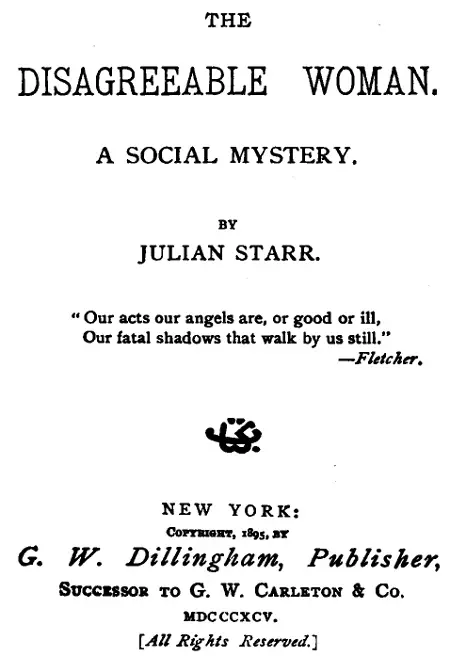
"The Disagreeable Woman: A Social Mystery" by Julian Starr is a novel written in the late 19th century. The story unfolds in a boarding house in New York City, centering around a character known as the Disagreeable Woman, a sharp-tongued and observant figure whose caustic remarks and enigmatic nature intrigue her fellow boarders. The narrative explores themes of social dynamics, human relationships, and the mysteries surrounding personal identities. At the start of the novel, we are introduced to the Disagreeable Woman amidst breakfast in a boarding house run by Mrs. Gray. Her sharp comment about a young widow's apparent age creates a stir among the boarders, hinting at her straightforward disposition. The narrator, a struggling physician who has moved to the city for better opportunities, becomes curious about the Disagreeable Woman, whose true identity and purpose remain cloaked in mystery. As he interacts with other boarders like the earnest Professor Poppendorf and the charming Ruth Canby, both humor and tension arise, setting the stage for deeper explorations of affection, class, and the societal roles of the characters as the story unfolds.
Introduction adapted from the source catalogue; source summaries may be automatically generated.
Free to read · English · 23,560 words · No account needed
MAKE TIME FOR A GOOD BOOK
On by default. Untick to stop anonymous reading totals. Each page counts after 10 seconds in view. How this works.
Anonymous counting is on unless you have switched it off.
I was not in search of a wife. It would have been the height of imprudence for me, with my small income and precarious prospects, to think of setting up a home and a family in this great, expensive city. Yet, had it been otherwise, perhaps Ruth would have made me a better wife than some graduate of a fashionable young ladies' seminary with her smattering of French, and superficial knowledge of the various ologies taught in high-class schools. The young woman from Macy's, though she probably knew nothing of political economy, was doubtless skilled in household economy and able to cook a dinner, as in all probability my wife would find it necessary to do.
As we entered the room at supper, Miss Canby smiled upon me pleasantly.
"I hope you are pleased with your handkerchiefs, Dr. Fenwick."
"I have not had occasion to use them as yet, thank you."
"Aha, what is that?" asked Prof. Poppendorf, who was just behind us.
"Dr. Fenwick called to see me at Macy's," answered Ruth.
Prof. Poppendorf frowned a little, as if not approving the visit.
"Do you have gentlemen call upon you at Macy's, Mees Ruth?" he asked.
"Only when they wish to buy articles," said Ruth, smiling and blushing.
"What do you sell, Mees Ruth?"
"Handkerchiefs, Professor."
"Do you have any like this?" and he pulled out a large red silk
handkerchief.
"No, I have only white linen handkerchiefs."
"I haf never use any but red ones, but I might come in and see what you
have."
"I shall be glad to show you what I have, Professor."
Prof. Poppendorf was soon engaged in the discussion of dinner. He had a good German appetite which never failed. He seldom talked much during a meal, as it would interfere with more important business.
Now that I had changed my place at the table, I sat on one side of the Disagreeable Woman, and Ruth Canby on the other. Next to Ruth sat the Professor, but for the reason already stated, he was not a social companion.
Just opposite sat Mrs. Wyman and Count Penelli. So far as I could judge, he was a quiet young man, and had very little to say for himself. Mrs. Wyman, however, kept plying him with questions and remarks, and did her best to appear on terms of intimate acquaintance with him. Some fragments of her conversation floated across the table.
"You have no idea, Count, how I long to visit Italy, your dear
country."
"It is ver' nice," he said, vaguely.
"Nice? It must be lovely. Have you ever seen the Bay of Naples?"
"Oh, si, signora, many times."
"It is charming, is it not?"
Your reading position is saved on this browser. Take it to another device with a library code. Reading pages adapt to text, rather than matching a printed edition.
William Rounseville Alger & Horatio, Jr. Alger

William Rounseville Alger & Horatio, Jr. Alger

Horatio, Jr. Alger

Horatio, Jr. Alger
BEHIND THE BOOK
This eBook is for the use of anyone anywhere in the United States and most other parts of the world at no cost and with almost no restrictions whatsoever. You may copy it, give it away or re-use it under the terms of the Project Gutenberg License included with this eBook or online at www.gutenberg.org. If you are not located in the United States, you will have to check the laws of the country where you are located before using this eBook. Read the source licence.
The original source file, including credits and licence, is retained by this library. Request an original-format copy at no charge. Please include the book title and Project Gutenberg identifier #54660.
KEEP YOUR CURIOSITY GOING
Coulson Kernahan

Maurice Baring
Frances Wright
Cécile Tormay

Frederic Jesup Stimson

W. H. P. (William Henry Pope) Jarvis