
Life of Edwin Forrest, the American Tragedian. Volume 2 (of 2)
William Rounseville Alger & Horatio, Jr. Alger
THE CLASSIC COLLECTION · 1895
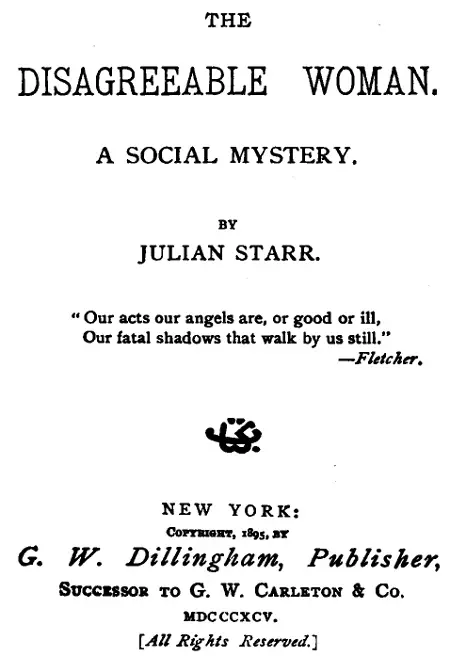
"The Disagreeable Woman: A Social Mystery" by Julian Starr is a novel written in the late 19th century. The story unfolds in a boarding house in New York City, centering around a character known as the Disagreeable Woman, a sharp-tongued and observant figure whose caustic remarks and enigmatic nature intrigue her fellow boarders. The narrative explores themes of social dynamics, human relationships, and the mysteries surrounding personal identities. At the start of the novel, we are introduced to the Disagreeable Woman amidst breakfast in a boarding house run by Mrs. Gray. Her sharp comment about a young widow's apparent age creates a stir among the boarders, hinting at her straightforward disposition. The narrator, a struggling physician who has moved to the city for better opportunities, becomes curious about the Disagreeable Woman, whose true identity and purpose remain cloaked in mystery. As he interacts with other boarders like the earnest Professor Poppendorf and the charming Ruth Canby, both humor and tension arise, setting the stage for deeper explorations of affection, class, and the societal roles of the characters as the story unfolds.
Introduction adapted from the source catalogue; source summaries may be automatically generated.
Free to read · English · 23,560 words · No account needed
MAKE TIME FOR A GOOD BOOK
On by default. Untick to stop anonymous reading totals. Each page counts after 10 seconds in view. How this works.
Anonymous counting is on unless you have switched it off.
"At any rate," she resumed, "I am considerably older than you. I will admit, Dr. Fenwick, that I am not a blind believer in the medical profession. There are some, even of those who have achieved a certain measure of success, whom I look upon as solemn pretenders."
"Yet if you were quite ill you would call in a physician?"
"Yes. I am not quite foolish enough to undertake to doctor myself in a serious illness. But I would repose unquestioning faith in no one, however eminent."
"I don't think we shall disagree on that point. A physician understands his own limitations better than any outsider."
"Come, I think you will do," she said, pleasantly. "If I am ill at any time I shall probably call you in."
"Thank you."
"And I should criticise your treatment. If you gave me any bread pills, I should probably detect the imposture."
"I should prefer, as a patient, bread pills to many that are
prescribed."
"You seem to be a sensible man, Dr. Fenwick. I shall hope to have other opportunities of conversing with you. Let me know from time to time how you are succeeding."
"Thank you. I am glad you are sufficiently interested in me to make the
request."
By this time we had reached the boarding-house. We could see Mrs. Wyman at the window of the reception room. She was evidently surprised and amused to see us together. I was sure that I should hear more of it, and I was not mistaken.
"Oh, Dr. Fenwick," she said playfully, as she took a seat beside me at the table. "I caught you that time."
"I don't understand you," I said, innocently.
"Oh, yes, you do. Didn't I see you and Miss Blagden coming in together?"
"Yes."
"I thought you would confess. Did you have a pleasant walk?"
"It was only from the Star Theatre."
"I see you are beginning to apologize. You could say a good deal between Waverley Place and the Star Theatre."
"We did."
"So I thought. I suppose you were discussing your fellow boarders,
including poor me."
"Not at all."
"Then my name was not mentioned?"
"Yes, I believe you were referred to."
"What did she say about me?" inquired the widow, eagerly.
"Only that she was older than you."
"Mercy, I should think she was. Why, she's forty if she's a day. Don't
you think so?"
"I am no judge of ladies' ages."
"I am glad you are not. Not that I am sensitive about my own. I am perfectly willing to own that I am twenty seven."
"I thought you said twenty-nine, the other evening?"
Your reading position is saved on this browser. Take it to another device with a library code. Reading pages adapt to text, rather than matching a printed edition.
William Rounseville Alger & Horatio, Jr. Alger

William Rounseville Alger & Horatio, Jr. Alger

Horatio, Jr. Alger

Horatio, Jr. Alger
BEHIND THE BOOK
This eBook is for the use of anyone anywhere in the United States and most other parts of the world at no cost and with almost no restrictions whatsoever. You may copy it, give it away or re-use it under the terms of the Project Gutenberg License included with this eBook or online at www.gutenberg.org. If you are not located in the United States, you will have to check the laws of the country where you are located before using this eBook. Read the source licence.
The original source file, including credits and licence, is retained by this library. Request an original-format copy at no charge. Please include the book title and Project Gutenberg identifier #54660.
KEEP YOUR CURIOSITY GOING
Coulson Kernahan

Maurice Baring
Frances Wright
Cécile Tormay

Frederic Jesup Stimson

W. H. P. (William Henry Pope) Jarvis