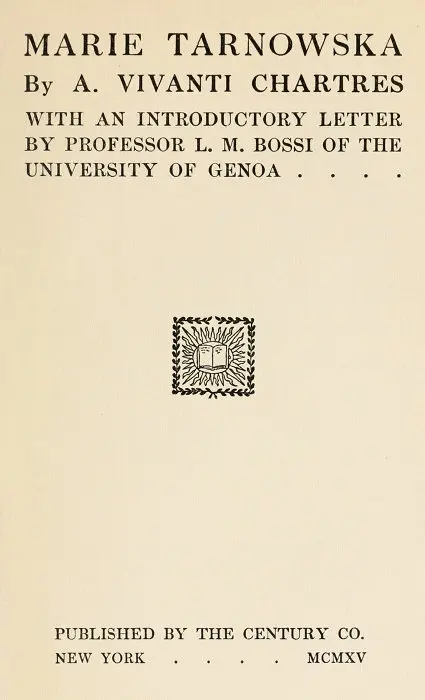
Marie Tarnowska
Annie Vivanti
THE CLASSIC COLLECTION · 1910
"The Devourers" by A. Vivanti Chartres is a novel written in the early 20th century. The book explores themes of family, loss, and the complexities of relationships through the lens of Edith Avory and her new family dynamics following the arrival of her half-sister Valeria and Valeria's baby. Readers are introduced to the intricate emotional landscape of the characters as they navigate the challenges posed by grief and the stark realities of life. The opening of "The Devourers" introduces the character of Edith Avory, who is excited about the arrival of the new baby, her half-sister’s child born from a recent tragedy. As she encounters the contrasting feelings of joy and confusion, particularly in her initial disappointment at the baby's appearance, the narrative captures the innocence of childhood mixed with the weight of adult sorrow. The text reveals Edith's interactions with the larger family, including their grieving experiences, and sets the stage for deeper explorations of love, mourning, and childhood naivety as the story unfolds. The juxtaposition of happy family moments against the backdrop of loss creates a poignant atmosphere that draws readers into the emotional challenges each character faces.
Introduction adapted from the source catalogue; source summaries may be automatically generated.
Free to read · English · 89,820 words · No account needed
MAKE TIME FOR A GOOD BOOK
On by default. Untick to stop anonymous reading totals. Each page counts after 10 seconds in view. How this works.
Anonymous counting is on unless you have switched it off.
Nancy laughed. "We go from bad to worse," she exclaimed, dimpling and
blushing. "Wait a minute."
"And if I cage the birdlings...."
"What birdlings?" said Fraeulein.
"Why, the words that I caught in the orchard," said Nancy hurriedly.
Everybody looked vague. "Why do you want to cage them?" asked Fraeulein,
who had a tidy mind.
"Because," said Nancy excitedly, making her reasons while she spoke, "words must not be allowed to fly about anyhow as they like--they must be caught, and shut in lines; they must be caged by the--by the----"
"The rhythm," suggested Edith.
"What is that?" said Nancy.
"The measure, the time, as in music."
"Yes, that's it!" said Nancy.
"And if the flowers I nurse...."
"The flowers are the rhymes, of course," explained Nancy, flourishing
her pencil triumphantly.
"And if the flowers I nurse,
The rambling, scrambling things I write--
Are verse!"
"Beautiful! wonderful!" cried everybody; and Uncle Giacomo and Nino clapped their hands a long time, as if they were at the theatre.
When they left off, Mrs. Avory said: "I do not quite like those last lines. They are not clear. But, of course, they are quite good enough for poetry!" she added. And everyone agreed. Mrs. Avory said she thought they ought to have somebody, some poet, down from London at once to teach the child seriously. And Fraeulein went into long details about publishers in Berlin, and how careful one must be if one prints a volume of poems not to let them cheat you.
From that day onward the spirit of Nancy's inspiration ruled the house. Everybody was silent when she came into the room, lest her ideas should be disturbed; meals must wait until Nancy had finished thinking. When Nancy frowned and passed her hand across her forehead in a little quick gesture she often used, Edith would quietly shut the windows and the doors, so that nothing should disturb the little poetess, and no butterfly-thought of hers should fly away. Valeria hovered round, usually followed by Nino; and Fraeulein, in the library, read long chapters of Dante to Zio Giacomo, whether he slept or not, in order, as she put it in her diary: "(a) To practise my Italian; (b) to keep in the house the atmosphere of the Spirit of Poetry."
But the grandfather, who could not understand the silence and the irregular meals, thought that somebody had died, and wandered drearily about, opening doors to see if he could find out who it was. And he frequently made Mrs. Avory turn sick and chilly by asking her suddenly, when she sat at her work, "Who is dead in the house?"
Your reading position is saved on this browser. Take it to another device with a library code. Reading pages adapt to text, rather than matching a printed edition.
Annie Vivanti
Annie Vivanti
BEHIND THE BOOK
This eBook is for the use of anyone anywhere in the United States and most other parts of the world at no cost and with almost no restrictions whatsoever. You may copy it, give it away or re-use it under the terms of the Project Gutenberg License included with this eBook or online at www.gutenberg.org. If you are not located in the United States, you will have to check the laws of the country where you are located before using this eBook. Read the source licence.
The original source file, including credits and licence, is retained by this library. Request an original-format copy at no charge. Please include the book title and Project Gutenberg identifier #39145.
KEEP YOUR CURIOSITY GOING
Coulson Kernahan

Maurice Baring
Frances Wright
Cécile Tormay

Frederic Jesup Stimson

W. H. P. (William Henry Pope) Jarvis