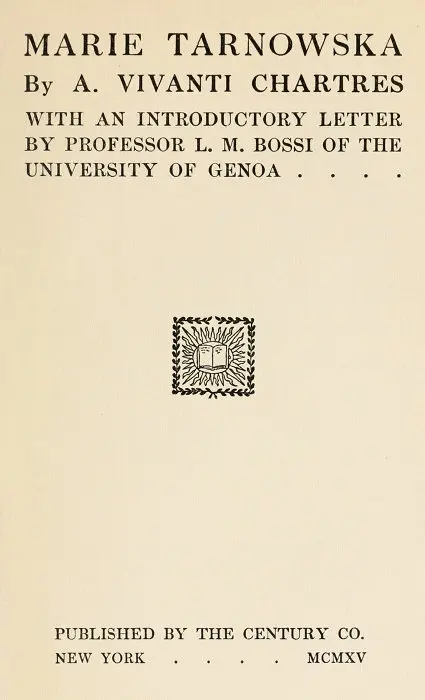
Marie Tarnowska
Annie Vivanti
THE CLASSIC COLLECTION · 1910
"The Devourers" by A. Vivanti Chartres is a novel written in the early 20th century. The book explores themes of family, loss, and the complexities of relationships through the lens of Edith Avory and her new family dynamics following the arrival of her half-sister Valeria and Valeria's baby. Readers are introduced to the intricate emotional landscape of the characters as they navigate the challenges posed by grief and the stark realities of life. The opening of "The Devourers" introduces the character of Edith Avory, who is excited about the arrival of the new baby, her half-sister’s child born from a recent tragedy. As she encounters the contrasting feelings of joy and confusion, particularly in her initial disappointment at the baby's appearance, the narrative captures the innocence of childhood mixed with the weight of adult sorrow. The text reveals Edith's interactions with the larger family, including their grieving experiences, and sets the stage for deeper explorations of love, mourning, and childhood naivety as the story unfolds. The juxtaposition of happy family moments against the backdrop of loss creates a poignant atmosphere that draws readers into the emotional challenges each character faces.
Introduction adapted from the source catalogue; source summaries may be automatically generated.
Free to read · English · 89,820 words · No account needed
MAKE TIME FOR A GOOD BOOK
On by default. Untick to stop anonymous reading totals. Each page counts after 10 seconds in view. How this works.
Anonymous counting is on unless you have switched it off.
Poverty and loneliness pushed Nancy along the dreary year, and she went in her brown dress, with her heels worn down at the side, through the autumn and the winter. Aldo was away for weeks at a time, and although he seemed in good humour when he was at home, and dressed elaborately, he was always parsimonious in the house, warning against rashness and expense.
Anne-Marie went to a kindergarten, where the grocer's children, and the baker's children, and the milkman's children went, and she liked them, and they liked her.
And now April was here. Where it could, it pushed and penetrated; through the trestles of the elevated railroads it spilt its sunshine on the ground. And it ran into the open window of the 82nd Street flat, and stretched its sweetness on the faded yellow silk of the hated lampshade.
To Nancy, who was moping in her dingy brown dress, April said: "Go out." So she put on her hat, and went out. And, having no reason to turn to the right, she turned to the left, and after a few blocks, having no reason to turn to the left, she turned to the right, and ran straight into a little messenger-boy, who was coming round the corner carrying some flowers in tissue-paper, and whistling.
Some trailing maidenhair escaping from the paper caught in her dress, and broke off. "I am sorry," she said.
"Can't yer use yer eyes!" said the boy rudely.
Then April said to Nancy: "Smile!" And she smiled, dimpling, and said
again: "I am sorry."
The boy looked at her, and turned his tongue round in his mouth; then he sniffed, and said: "Here you are! This is for you."
He pushed the bunch of flowers into Nancy's hand, then turned back, and went round the corner again, whistling. Nancy ran after him, but he ran quicker, looking round every now and then and laughing at her. When he turned another corner Nancy stood with the flowers in her hand, wondering.
She opened the paper a little at the top, and looked in. Mauve orchids and maidenhair--a bouquet for a queen. She walked slowly back to her house, carrying the flowers in front of her with both hands, and their idle beauty and extravagant loveliness lifted her prostrate spirit above the dust around her.
She went to her room with them, avoiding Minna, who was clattering dishes in the kitchen, and, locking her door, sat down near the bed. She drew the tissue-paper away, and the fairy-like flowers, scintillant and bedewed, nodded at her.
Your reading position is saved on this browser. Take it to another device with a library code. Reading pages adapt to text, rather than matching a printed edition.
Annie Vivanti
Annie Vivanti
BEHIND THE BOOK
This eBook is for the use of anyone anywhere in the United States and most other parts of the world at no cost and with almost no restrictions whatsoever. You may copy it, give it away or re-use it under the terms of the Project Gutenberg License included with this eBook or online at www.gutenberg.org. If you are not located in the United States, you will have to check the laws of the country where you are located before using this eBook. Read the source licence.
The original source file, including credits and licence, is retained by this library. Request an original-format copy at no charge. Please include the book title and Project Gutenberg identifier #39145.
KEEP YOUR CURIOSITY GOING
Coulson Kernahan

Maurice Baring
Frances Wright
Cécile Tormay

Frederic Jesup Stimson

W. H. P. (William Henry Pope) Jarvis