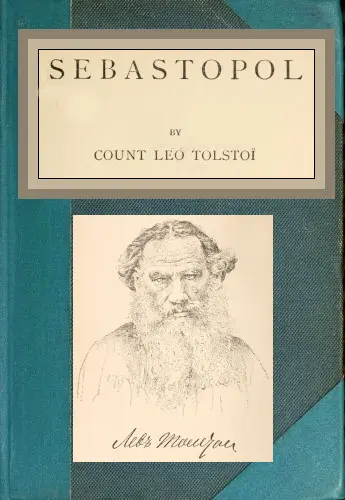
Sebastopol
Leo, graf Tolstoy
THE CLASSIC COLLECTION · 1926
"The Devil" by graf Leo Tolstoy is a novella written in 1889. After inheriting his father's debt-ridden estate, Eugene Irtenev settles into rural life and begins an affair with a local peasant woman, Stepanida. When he marries for love and attempts respectability, Stepanida's presence on his estate reawakens a consuming desire he cannot escape. Tormented by lust and unable to confide in anyone, Eugene faces an impossible choice that spirals toward a desperate conclusion.
Introduction adapted from the source catalogue; source summaries may be automatically generated.
Free to read · English · 19,743 words · No account needed
MAKE TIME FOR A GOOD BOOK
On by default. Untick to stop anonymous reading totals. Each page counts after 10 seconds in view. How this works.
Anonymous counting is on unless you have switched it off.
During coffee, as often happened, a peculiarly feminine kind of conversation went on which had no logical sequence, but which evidently was connected in some way for it went on uninterruptedly.
The two old ladies were pin-pricking one another, and Liza was skilfully manœuvring between them.
"I am so vexed that we had not finished washing your room before you got back," she said to her husband. "But I do so want to get everything arranged."
"Well, did you sleep well after I got up?"
"Yes, I slept well, and I feel well."
"How can a woman be well in her condition during this intolerable heat, when her windows face the sun," said Varvara Alexeevna, her mother. "And they have no venetian-blinds or awnings. I always had awnings."
"But you know we are in the shade after ten o'clock," said Mary
Pavlovna.
"That's what causes fever; it comes of dampness," said Varvara Alexeevna, not noticing that what she was saying did not agree with what she had just said. "My doctor always says that it is impossible to diagnose an illness unless one knows the patient. And he certainly knows, for he is the leading physician and we pay him a hundred rubles a visit. My late husband did not believe in doctors, but he did not grudge me anything."
"How can a man grudge anything to a woman when perhaps her life and the
child's depend . . ."
"Yes, when she has means, a wife need not depend on her husband. A good wife submits to her husband," said Varvara Alexeevna,--"only Liza is too weak after her illness."
"Oh no, mamma, I feel quite well. But why have they not brought you any
boiled cream?"
"I don't want any. I can do with raw cream."
"I offered some to Varvara Alexeevna, but she declined," said Mary Pavlovna, as if justifying herself.
"No, I don't want any to-day." And as if to terminate an unpleasant conversation and yield magnanimously, Varvara Alexeevna turned to Eugene and said: "Well, and have you sprinkled the phosphates?"
Liza ran to fetch the cream.
"But I don't want it. I don't want it."
"Liza, Liza, go gently,"--said Mary Pavlovna. "Such rapid movements do
her harm."
"Nothing does harm, if one's mind is at peace," said Varvara Alexeevna as if referring to something, though she knew that there was nothing that her words could refer to.
Your reading position is saved on this browser. Take it to another device with a library code. Reading pages adapt to text, rather than matching a printed edition.
Leo, graf Tolstoy
Leo, graf Tolstoy
Leo, graf Tolstoy
Leo, graf Tolstoy
BEHIND THE BOOK
This eBook is for the use of anyone anywhere in the United States and most other parts of the world at no cost and with almost no restrictions whatsoever. You may copy it, give it away or re-use it under the terms of the Project Gutenberg License included with this eBook or online at www.gutenberg.org. If you are not located in the United States, you will have to check the laws of the country where you are located before using this eBook. Read the source licence.
The original source file, including credits and licence, is retained by this library. Request an original-format copy at no charge. Please include the book title and Project Gutenberg identifier #67224.
KEEP YOUR CURIOSITY GOING
Coulson Kernahan

Maurice Baring
Frances Wright
Cécile Tormay

Frederic Jesup Stimson

W. H. P. (William Henry Pope) Jarvis