THE CLASSIC COLLECTION✦Harps Hung up in BabylonCLASSIC FREE BOOKS
Harps Hung up in Babylon
Arthur Colton
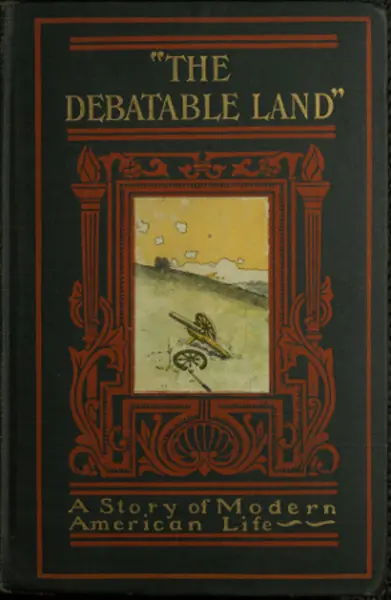
THE CLASSIC COLLECTION · 1901
"The Debatable Land" by Arthur Colton is a novel written in the early 20th century. This work explores themes of identity, community, and the contrast between individual aspirations and societal expectations, primarily through the lives of its characters within a small New England town and the larger city of Hamilton. The opening of the novel introduces widow Bourn and her daughter Helen, hinting at a generational struggle and the emotional weight of legacy and regret. Through vivid descriptions of their surroundings and Helen's youthful aspirations, we see a backdrop steeped in a sense of nostalgia and expectation. The narrative shifts to include characters such as Thaddeus Bourn, who embodies societal expectations, and Morgan Map, whose ambitions and aspirations challenge conventional boundaries. As relationships begin to intertwine—especially concerning Helen and Morgan—the story sets the stage for a rich exploration of human connections against the contrasting landscapes of Hagar and Hamilton, providing a poignant reflection on the "debatable land" between personal hopes and the realities of life.
Introduction adapted from the source catalogue; source summaries may be automatically generated.
Free to read · English · 59,359 words · No account needed
MAKE TIME FOR A GOOD BOOK
On by default. Untick to stop anonymous reading totals. Each page counts after 10 seconds in view. How this works.
Anonymous counting is on unless you have switched it off.
Others who had stopped laughed and swarmed around. "Give me one!" "Me
one!"
"There are more who need them."
"Oh, all right."
"No hogs here."
"Good-luck to you, elder."
The stream flowed on, some chuckling over their tracts, some silent. An
officer said:
"You ought to get a pass, elder." So he came to where the Shenandoah murmured its musical name. A range of blue mountains rose beyond it. There seemed to be little going on by the river. The retreat had shifted to the west along the railroads into the Opequan valley, and he turned and rode west among low, wooded hills. It was Wednesday. They were tearing and burning the southern of the two railroads now--an endless row of bonfires of the ties, the iron rails laid across them to be heated for bending.
"'Let not your hearts be troubled.'"
A man bending over a rail drew his hand back, swore lustily, and
straightened up.
"What's that? Oh!" He took the tract.
"That's what it says, sure enough. Maybe you don't know that rail was hot." The tract was passed around. One read aloud, "He hath taken charge and command. He hath established His law."
Gard sat motionless on his horse, looking placidly over their heads to
the pale-blue horizon.
"Who is the one greatest in authority here?"
"This side of God Almighty and Winchester. I reckon you mean the old man. Hi, lieutenant!" The cantering officer pulled up. "He wants the general."
"Does, does he? What for?"
A pause. Gard dropped his eyes to the officer who was reading the tract.
"It is said to be best that I should have his permission to--"
"Oh, I see. Come along, then."
They rode beside the track through strata of heat and smoke from the fires, Gard following. It occurred to him that he had given his name on an impulse the day before as Moselle, and would possibly need it now. They came to a group of horsemen, talking, except one in front of them, who watched the toiling squads silently. He wore a full black beard, and sat his horse awkwardly.
"This seems to be some kind of a missionary, general. He wants to see
you."
The general glanced up under the brim of his slouched hat; then suddenly flung back his head, so that his big beard stood out from his chest, and said, simply:
"What do you want?"
"I am directed by a Session of the Brethren to distribute these."
"Who are you?"
"Of a congregation in Maryland."
"What is your name?"
"Moselle."
"Who are the Brethren?"
"We are called Dunkers by those not of our communion. We do not use the
name."
Your reading position is saved on this browser. Take it to another device with a library code. Reading pages adapt to text, rather than matching a printed edition.
Arthur Colton
Arthur Colton
Arthur Colton
Arthur Colton
BEHIND THE BOOK
This eBook is for the use of anyone anywhere in the United States and most other parts of the world at no cost and with almost no restrictions whatsoever. You may copy it, give it away or re-use it under the terms of the Project Gutenberg License included with this eBook or online at www.gutenberg.org. If you are not located in the United States, you will have to check the laws of the country where you are located before using this eBook. Read the source licence.
The original source file, including credits and licence, is retained by this library. Request an original-format copy at no charge. Please include the book title and Project Gutenberg identifier #41963.
KEEP YOUR CURIOSITY GOING
Coulson Kernahan

Maurice Baring
Frances Wright
Cécile Tormay

Frederic Jesup Stimson

W. H. P. (William Henry Pope) Jarvis