THE CLASSIC COLLECTION✦Harps Hung up in BabylonCLASSIC FREE BOOKS
Harps Hung up in Babylon
Arthur Colton
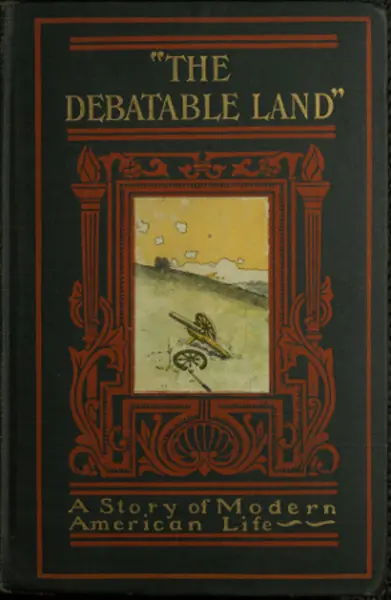
THE CLASSIC COLLECTION · 1901
"The Debatable Land" by Arthur Colton is a novel written in the early 20th century. This work explores themes of identity, community, and the contrast between individual aspirations and societal expectations, primarily through the lives of its characters within a small New England town and the larger city of Hamilton. The opening of the novel introduces widow Bourn and her daughter Helen, hinting at a generational struggle and the emotional weight of legacy and regret. Through vivid descriptions of their surroundings and Helen's youthful aspirations, we see a backdrop steeped in a sense of nostalgia and expectation. The narrative shifts to include characters such as Thaddeus Bourn, who embodies societal expectations, and Morgan Map, whose ambitions and aspirations challenge conventional boundaries. As relationships begin to intertwine—especially concerning Helen and Morgan—the story sets the stage for a rich exploration of human connections against the contrasting landscapes of Hagar and Hamilton, providing a poignant reflection on the "debatable land" between personal hopes and the realities of life.
Introduction adapted from the source catalogue; source summaries may be automatically generated.
Free to read · English · 59,359 words · No account needed
MAKE TIME FOR A GOOD BOOK
On by default. Untick to stop anonymous reading totals. Each page counts after 10 seconds in view. How this works.
Anonymous counting is on unless you have switched it off.
Of Estates in Happiness
"In point of fact," said Thaddeus, "I am proposing a partnership, to be entitled 'The Helen Banking and Brokerage Company,' organized to do business for a commission."
"I don't know that I understand," said Mrs. Mavering, slowly.
"We make investments at interest, speculate in futures, examine securities." He paused, seeking precision of phrase. "It is in terms of happiness. One pursues it--happiness. One sees fortunes in it lost and fortunes won. I find I have spent my own capital. I have to be content with a commission."
But then it was not evident that Mrs. Mavering need be in the same case. It would be poor taste to seem to assume it. "In point of fact," she suggested a hoarded wealth, an unknown, mysterious sum in reserve, rather than even poverty in respect to a future. But she might be allowed to express for herself the terms of her profit.
"I think I understand now," she said.
Her veil had little beads of moisture on it from the damp March wind that blew down Shannon Street in their faces. The gutters were slushy running streams, the elms shook their branches restlessly, as if full of the sweet pains of stirring sap and the coming birth of leaves.
"Acting," continued Thaddeus, "in behalf of the Helen estate, which I believe, I trust, will prove large, but is, I think, I fear--"
"You think uncertain?"
"Doubtless uncertain. There are elements of uncertainty. And in this matter I must confess myself only a man, a sad limitation. Mrs. Mavering; somewhat elderly, too; and so, one who feels he must husband his slender resources. I fear I depend very much on that commission. I fear the bankruptcy of that estate would be disastrous for me."
Mrs. Mavering drew her veil closer, and they walked on a few moments in silence. Then she ventured:
"Uncertain, of course; but you spoke of elements."
"I might mention, in regard to the nature of it at present, a certain impetuosity, a determination, a loyalty perhaps a little too inflexible. Flexibility is, so to speak, to have a good portion of one's capital near by for emergencies. I might mention, to speak technically, as a liability, a certain Morgan Map."
"But that," said she, hurriedly--"I mean. I know him only slightly, but
Helen said--"
"You would wish me to convince you that he is liability rather than an
asset."
"Why not convince her?"
"Ah, but there! Might it not--I have tested, I fear it would, I ask your better intuition--might not the attempt, if made seriously, defeat its end by rousing that loyalty, giving perhaps direction and opportunity to that--that inflexibility?"
"It might."
Your reading position is saved on this browser. Take it to another device with a library code. Reading pages adapt to text, rather than matching a printed edition.
Arthur Colton
Arthur Colton

Arthur Colton
Arthur Colton
BEHIND THE BOOK
This eBook is for the use of anyone anywhere in the United States and most other parts of the world at no cost and with almost no restrictions whatsoever. You may copy it, give it away or re-use it under the terms of the Project Gutenberg License included with this eBook or online at www.gutenberg.org. If you are not located in the United States, you will have to check the laws of the country where you are located before using this eBook. Read the source licence.
The original source file, including credits and licence, is retained by this library. Request an original-format copy at no charge. Please include the book title and Project Gutenberg identifier #41963.
KEEP YOUR CURIOSITY GOING
Coulson Kernahan

Maurice Baring
Frances Wright
Cécile Tormay

Frederic Jesup Stimson

W. H. P. (William Henry Pope) Jarvis