THE CLASSIC COLLECTION✦Harps Hung up in BabylonCLASSIC FREE BOOKS
Harps Hung up in Babylon
Arthur Colton
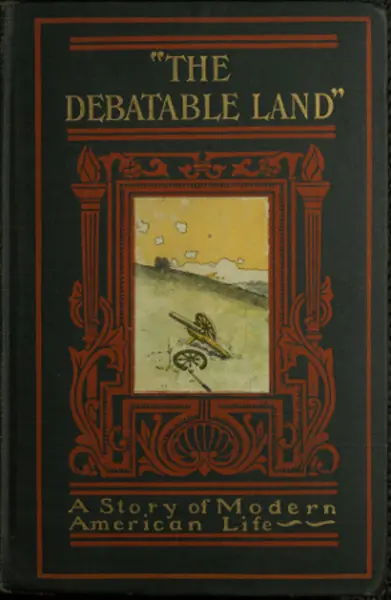
THE CLASSIC COLLECTION · 1901
"The Debatable Land" by Arthur Colton is a novel written in the early 20th century. This work explores themes of identity, community, and the contrast between individual aspirations and societal expectations, primarily through the lives of its characters within a small New England town and the larger city of Hamilton. The opening of the novel introduces widow Bourn and her daughter Helen, hinting at a generational struggle and the emotional weight of legacy and regret. Through vivid descriptions of their surroundings and Helen's youthful aspirations, we see a backdrop steeped in a sense of nostalgia and expectation. The narrative shifts to include characters such as Thaddeus Bourn, who embodies societal expectations, and Morgan Map, whose ambitions and aspirations challenge conventional boundaries. As relationships begin to intertwine—especially concerning Helen and Morgan—the story sets the stage for a rich exploration of human connections against the contrasting landscapes of Hagar and Hamilton, providing a poignant reflection on the "debatable land" between personal hopes and the realities of life.
Introduction adapted from the source catalogue; source summaries may be automatically generated.
Free to read · English · 59,359 words · No account needed
MAKE TIME FOR A GOOD BOOK
On by default. Untick to stop anonymous reading totals. Each page counts after 10 seconds in view. How this works.
Anonymous counting is on unless you have switched it off.
He caught sight of a horse fastened to a maple-tree up the road.
Mavering lay on his back under the maple, smoking.
"Get up. Come along."
"This cigar is the worst--"
"Get on your horse. I want you."
"What do I care what you want? I was about to say, this cigar is the--"
"Throw it away, then."
Mavering unfolded his legs and mounted, grumbling.
"You're the blankedest, most egotistic anchorite that ever petted his soul, not to say dosed it allopathically with wars and red rebellions. One question: Is there any copy in this?"
"Not a word."
"Just what I thought. Wherever a man goes he finds selfishness."
They turned into the northern road, clattered past the cornfield and the church. Gard continued: "One of those Dunker farmers lives up here half a mile. I want his clothes, his expression, and his language, and his theology--the whole outfit."
"Going to steal his most intimate properties. Blanked immoral thing to
do. All right, go on."
"About copy. Anything that goes south of the Potomac will be apt to mean a rope for me, and New York papers go south of the Potomac."
"Egotistic still, but perspicuous. I see."
"It's between me and you and the Dunker."
"And that's a pretty combination!"
"Not a sign, Jack."
"Not a misplaced comma, not an agitated phrase shall betray the mystery of this night. Now, then. Why?"
"Oh, you! You'll have to make me up."
"And the Dunker?"
"They're all anti-slavery and non-combatant. Besides, I picked an acquaintance with this one yesterday."
The small, plain, whitewashed house, with its whitewashed barn, stood close to the road and shining in the moonlit dusk. An elderly man, with smooth, gray hair falling to his collar, shaven lips, and spade-shaped beard, came to the door and stood there, mild, quiet, round-shouldered.
"Can we put up our horses here and pass the night?"
He nodded and turned back into the room without speaking, but left the
door open.
They spent the evening talking with him, studying the while his outward make-up, his manner and language, critically. He had a certain gentle suggestiveness of his own, and before they parted for the night brought out a pair of saddle-bags and a large bundle of printed sheets.
"De is tracts," he said, gently, "of religion."
"Good," said Mavering. "An ungodly army, no doubt. Oh, I beg pardon!"
"De is not of de doctrine of the bruderen only. De is Christian."
"Oh, well, Captain Windham was bred a Catholic. He'll distribute them,
and read some himself."
The quiet elder seemed to have taken a shy liking for Gard. He touched him softly on the back of the hand.
Your reading position is saved on this browser. Take it to another device with a library code. Reading pages adapt to text, rather than matching a printed edition.
Arthur Colton
Arthur Colton

Arthur Colton
Arthur Colton
BEHIND THE BOOK
This eBook is for the use of anyone anywhere in the United States and most other parts of the world at no cost and with almost no restrictions whatsoever. You may copy it, give it away or re-use it under the terms of the Project Gutenberg License included with this eBook or online at www.gutenberg.org. If you are not located in the United States, you will have to check the laws of the country where you are located before using this eBook. Read the source licence.
The original source file, including credits and licence, is retained by this library. Request an original-format copy at no charge. Please include the book title and Project Gutenberg identifier #41963.
KEEP YOUR CURIOSITY GOING
Coulson Kernahan

Maurice Baring
Frances Wright
Cécile Tormay

Frederic Jesup Stimson

W. H. P. (William Henry Pope) Jarvis