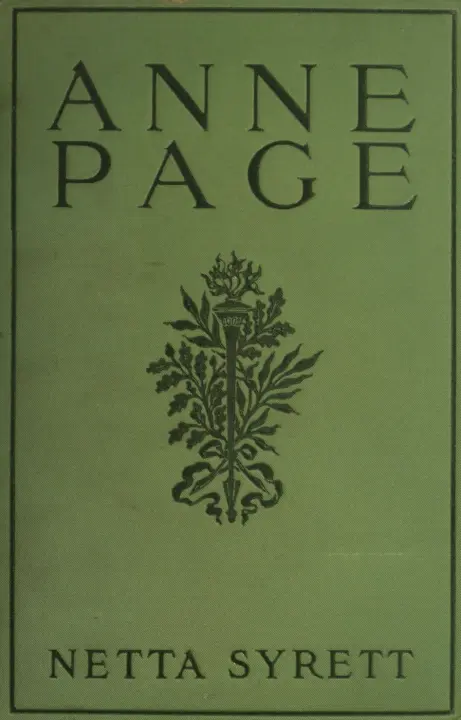
Anne Page
Netta Syrett
THE CLASSIC COLLECTION · 1906
"The Day's Journey" by Netta Syrett is a novel written in the early 20th century. The story centers around Rose Summers, who has returned from living abroad and is visiting her cousin Cecily Kingslake at her picturesque home in the English countryside. The opening chapters hint at the complexities of Cecily's marriage and the emotional undercurrents that exist between the characters, particularly in the context of domestic roles, ambition, and friendship. The beginning of the novel introduces Rose as she arrives at Cecily's home, reflecting on her cousin's life and their past friendship. Rose notices the changes in Cecily since her marriage to Robert Kingslake, a writer who has not achieved the success projected for him. As the characters reconnect, underlying tensions regarding personal fulfillment and dissatisfaction in marriage start to surface. Through their conversations, themes of identity, societal expectations, and the sacrifices women make in personal relationships begin to emerge, setting the stage for deeper exploration of these issues as the story unfolds.
Introduction adapted from the source catalogue; source summaries may be automatically generated.
Free to read · English · 58,178 words · No account needed
MAKE TIME FOR A GOOD BOOK
On by default. Untick to stop anonymous reading totals. Each page counts after 10 seconds in view. How this works.
Anonymous counting is on unless you have switched it off.
To Rose, whose recollection of Robert was as a lover, so devoted that the only clear idea she had retained about his personality was that he loved Cecily,--to Rose, his present obvious indifference seemed a thing almost incredible. It brought to her, as nothing else since her home-coming had brought to her, the realization that five years is long--that the heart of life may be cut out with its passing.
Mrs. Summers felt her eyes dim with sudden tears. She was hurt at her friend’s reticence. The Cecily she knew had vanished, and with her, it seemed, she had taken all youth, all keenness, all desire. In that moment of disappointment, Rose had a horrible premonition of age.
A tap at the door startled her. While she was hurrying towards it, across the moonlit room, it opened, and Cecily came in.
She was in a long, pale-colored Japanese wrapper, her hair all loose about her face. Standing there in the moonlight, she was the girl Mrs. Summers remembered, and with a revulsion of feeling too glad for words she took her by the arms and put her into an easy-chair near the window.
“It was so lovely, I blew out the candles,” she began.
“Yes,” murmured Cecily, absently. She leaned forward and touched her cousin’s dress with trembling fingers. “It wasn’t because I was horrid or anything that I didn’t stay,” she said, incoherently. “It was because I was afraid to begin. I’m afraid to let myself----” She put her hand on her breast with a gesture that, to Rose, was more eloquent than the broken sentence.
“Tell me, dear,” she urged. “I would have bitten off my tongue rather than have said all I did to-day, but, apart from that, I can’t help seeing that things are wrong with you. I felt it from the first moment. It made me nervous, I suppose, and so I babbled on like a fool about the first thing that came into my head.”
“It doesn’t matter,” returned Cecily, in a weak voice. “It isn’t that.”
“Tell me,” urged Rose again.
“It’s difficult,” she murmured, after a moment, “because there doesn’t seem anything definite to tell. It’s just come like this.”
There was a silence through which Mrs. Summers waited patiently.
“Rose,” she heard at last, “you saw Robert with me, before you went away. He seemed in love, didn’t he?”
“I never saw any one quite so infatuated.” Mrs. Summers’ reply was
emphatic.
“And now he speaks of me ‘quite nicely.’... It seems strange, doesn’t it?” She spoke very quietly, as though she were tired.
Your reading position is saved on this browser. Take it to another device with a library code. Reading pages adapt to text, rather than matching a printed edition.
Netta Syrett
Netta Syrett
BEHIND THE BOOK
This eBook is for the use of anyone anywhere in the United States and most other parts of the world at no cost and with almost no restrictions whatsoever. You may copy it, give it away or re-use it under the terms of the Project Gutenberg License included with this eBook or online at www.gutenberg.org. If you are not located in the United States, you will have to check the laws of the country where you are located before using this eBook. Read the source licence.
The original source file, including credits and licence, is retained by this library. Request an original-format copy at no charge. Please include the book title and Project Gutenberg identifier #71317.
KEEP YOUR CURIOSITY GOING
Coulson Kernahan

Maurice Baring
Frances Wright
Cécile Tormay

Frederic Jesup Stimson

W. H. P. (William Henry Pope) Jarvis