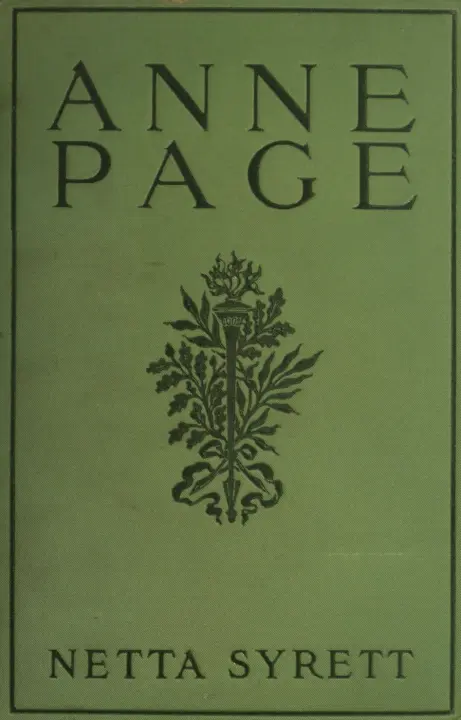
Anne Page
Netta Syrett
THE CLASSIC COLLECTION · 1906
"The Day's Journey" by Netta Syrett is a novel written in the early 20th century. The story centers around Rose Summers, who has returned from living abroad and is visiting her cousin Cecily Kingslake at her picturesque home in the English countryside. The opening chapters hint at the complexities of Cecily's marriage and the emotional undercurrents that exist between the characters, particularly in the context of domestic roles, ambition, and friendship. The beginning of the novel introduces Rose as she arrives at Cecily's home, reflecting on her cousin's life and their past friendship. Rose notices the changes in Cecily since her marriage to Robert Kingslake, a writer who has not achieved the success projected for him. As the characters reconnect, underlying tensions regarding personal fulfillment and dissatisfaction in marriage start to surface. Through their conversations, themes of identity, societal expectations, and the sacrifices women make in personal relationships begin to emerge, setting the stage for deeper exploration of these issues as the story unfolds.
Introduction adapted from the source catalogue; source summaries may be automatically generated.
Free to read · English · 58,178 words · No account needed
MAKE TIME FOR A GOOD BOOK
On by default. Untick to stop anonymous reading totals. Each page counts after 10 seconds in view. How this works.
Anonymous counting is on unless you have switched it off.
“Come and take off your things,” suggested Cecily. Her tone indicated that conversation henceforward was to be of a surface nature, and again Rose understood.
While she took toilet things from her travelling-bag, and straightened her hair, they talked of Cecily’s journeyings, of travelling adventures, of the places she had visited--and later of Diana and her love affairs.
“It will be all right, I think,” Cecily said, laughing a little. “Isn’t she quaint about it, though? But he’s a nice boy.”
When they returned to the drawing-room, and Cecily had settled herself into her favorite chair, she said, comfortably:
“There’s one good thing, we sha’n’t be disturbed this afternoon. No one knows I’m home yet.”
“I’m sorry to have to break it to you, but every one knows!” exclaimed Rose, laughing. “The day I had your telegram I happened to be in town in the afternoon, and I met Lady Wilmot.” She paused dramatically.
Cecily groaned. “You told her, of course?”
“Yes. She came sailing across the road, panting for gossip, and immediately asked after you, hoping for the worst in every feature. I couldn’t resist disappointing her. Then she put on her face of mystery--you know it, and began, ‘My dear, we must have a talk----’ Of course I found I had to catch a train, and rushed off in the middle of a sentence, leaving her palpitating like her own motor-car. She doesn’t know the exact moment of your arrival, but you may be very sure she’ll be round before long.”
“To see whether the situation lends itself to elaborate or simple embroidery? She’s a real artist. Have people been talking much?” she added, after a moment. “But of course they have.”
“Privately, no doubt. That doesn’t matter. But, as far as I can discover, there’s been quite a successful conspiracy of mutual acceptance of Diana’s illness. The paragraphs about Dick have been useful, too.”
“What sort of paragraphs?” asked Cecily, slowly.
“Oh, things like, ‘We learn that Mr. Richard Mayne, the distinguished traveller and explorer, is engaged in active preparations for another expedition into the interior of Central Africa,’ and so on.”
“Is Philippa married?” asked Cecily, suddenly.
“No--apparently not, though why she should hesitate to make a good fellow unhappy, I don’t----”
Her words were cut short by the maid’s announcement of Lady Wilmot. Rose and Cecily had barely time to exchange glances before she was upon them, in emerald green brocade and feather trimming.
Like a Meredithian heroine she “swam” towards Cecily, whom she
voluminously embraced.
Your reading position is saved on this browser. Take it to another device with a library code. Reading pages adapt to text, rather than matching a printed edition.
Netta Syrett
Netta Syrett
BEHIND THE BOOK
This eBook is for the use of anyone anywhere in the United States and most other parts of the world at no cost and with almost no restrictions whatsoever. You may copy it, give it away or re-use it under the terms of the Project Gutenberg License included with this eBook or online at www.gutenberg.org. If you are not located in the United States, you will have to check the laws of the country where you are located before using this eBook. Read the source licence.
The original source file, including credits and licence, is retained by this library. Request an original-format copy at no charge. Please include the book title and Project Gutenberg identifier #71317.
KEEP YOUR CURIOSITY GOING
Coulson Kernahan

Maurice Baring
Frances Wright
Cécile Tormay

Frederic Jesup Stimson

W. H. P. (William Henry Pope) Jarvis