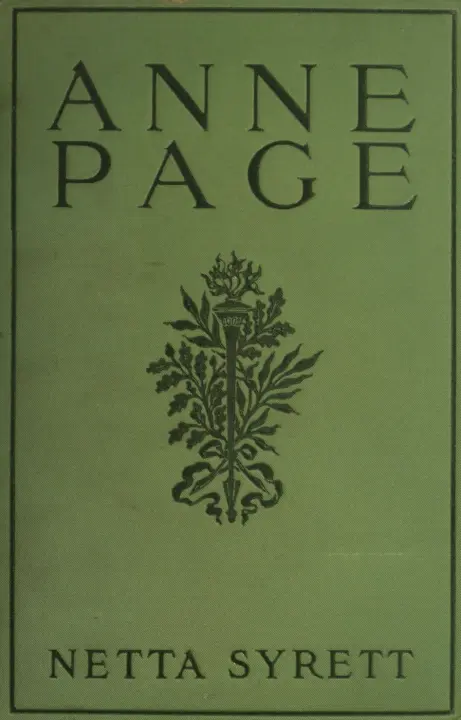
Anne Page
Netta Syrett
THE CLASSIC COLLECTION · 1906
"The Day's Journey" by Netta Syrett is a novel written in the early 20th century. The story centers around Rose Summers, who has returned from living abroad and is visiting her cousin Cecily Kingslake at her picturesque home in the English countryside. The opening chapters hint at the complexities of Cecily's marriage and the emotional undercurrents that exist between the characters, particularly in the context of domestic roles, ambition, and friendship. The beginning of the novel introduces Rose as she arrives at Cecily's home, reflecting on her cousin's life and their past friendship. Rose notices the changes in Cecily since her marriage to Robert Kingslake, a writer who has not achieved the success projected for him. As the characters reconnect, underlying tensions regarding personal fulfillment and dissatisfaction in marriage start to surface. Through their conversations, themes of identity, societal expectations, and the sacrifices women make in personal relationships begin to emerge, setting the stage for deeper exploration of these issues as the story unfolds.
Introduction adapted from the source catalogue; source summaries may be automatically generated.
Free to read · English · 58,178 words · No account needed
MAKE TIME FOR A GOOD BOOK
On by default. Untick to stop anonymous reading totals. Each page counts after 10 seconds in view. How this works.
Anonymous counting is on unless you have switched it off.
“DEAR CECILY,--You will wonder who is addressing you in this familiar fashion, and even when you look at the signature, I wonder whether you will remember your old school-fellow--Philippa Burton? I am writing because, after this week, I shall be a near neighbor of yours. I have broken down a little, over my work; my doctor has ordered me country air, and I find the village to which he is sending me is your village! Sheepcote is so easy of access to town that I can run up when it is absolutely necessary, do as much work as I am allowed, and, I hope, renew my friendship with you. I met your husband yesterday at Lady Wilmot’s. What a charming man he is, and how proud you must be of him.”
“Spare my blushes,” interpolated Kingslake, in a lazy voice. Cecily
concluded--
“May I sign myself, as in old days, “Affectionately yours, “PHILIPPA BURTON.”
She folded the letter deliberately, and replaced it in its envelope.
“Well, you can look after her a little, can’t you?” observed Kingslake. “You might see about getting her rooms, perhaps? Wouldn’t old Mrs. Green take her?--or the Watford woman? But this isn’t very amusing for Mrs. Summers, I’m afraid.” He turned to her politely.
“Oh, on the contrary,” she answered, “these bright, brave young women who work for their living, and at intervals have nervous breakdowns, interest me enormously. It’s a new type to me.”
Kingslake’s face darkened at her flippant tone.
“Ah! you happy married women who are shielded from the world are rather slow to understand some of the truths of life,” he observed, a note of indignation struggling through the suavity of his tone.
“Is it only the lies we encounter then--we happy married women?” she returned, lightly. “That doesn’t speak well for the men who shield us!”
Cecily rose. “Come,” she said, “it’s nearly dinner-time.”
Upstairs, in the spare room to which she showed her friend, Rose turned round with sudden vehemence. “Little devil!” she exclaimed, pointing to the letter her cousin still held. “It’s a feminine masterpiece. Not one untrue statement, yet a lie from beginning to end.”
Cecily was silent. “Don’t!” she said at last, under her breath. “I’ve got to get through the evening.”
Rose glanced at her, and, without speaking again, let her go.
When Cecily entered her bedroom, Kingslake opened his dressing-room
door.
“Miss Burton told me she was a school-fellow of yours,” he began. “Were you great friends?”
“Not particularly,” returned Cecily, taking her tea-gown from the
wardrobe.
There was silence for a moment.
Your reading position is saved on this browser. Take it to another device with a library code. Reading pages adapt to text, rather than matching a printed edition.
Netta Syrett
Netta Syrett
BEHIND THE BOOK
This eBook is for the use of anyone anywhere in the United States and most other parts of the world at no cost and with almost no restrictions whatsoever. You may copy it, give it away or re-use it under the terms of the Project Gutenberg License included with this eBook or online at www.gutenberg.org. If you are not located in the United States, you will have to check the laws of the country where you are located before using this eBook. Read the source licence.
The original source file, including credits and licence, is retained by this library. Request an original-format copy at no charge. Please include the book title and Project Gutenberg identifier #71317.
KEEP YOUR CURIOSITY GOING
Coulson Kernahan

Maurice Baring
Frances Wright
Cécile Tormay

Frederic Jesup Stimson

W. H. P. (William Henry Pope) Jarvis