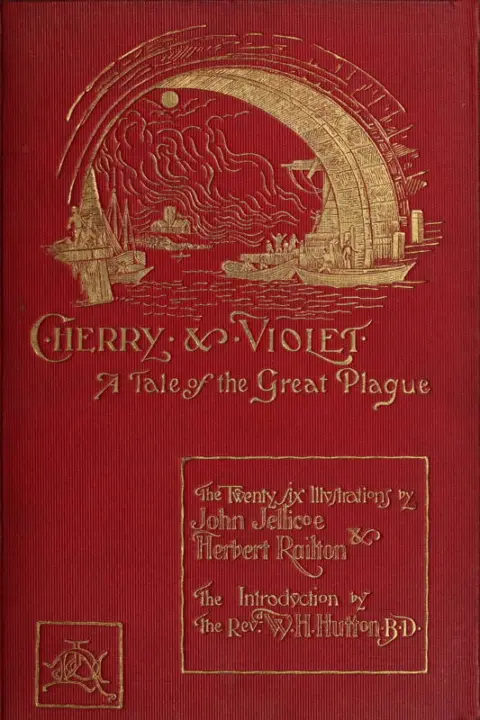
Cherry & Violet: A Tale of the Great Plague
Anne Manning
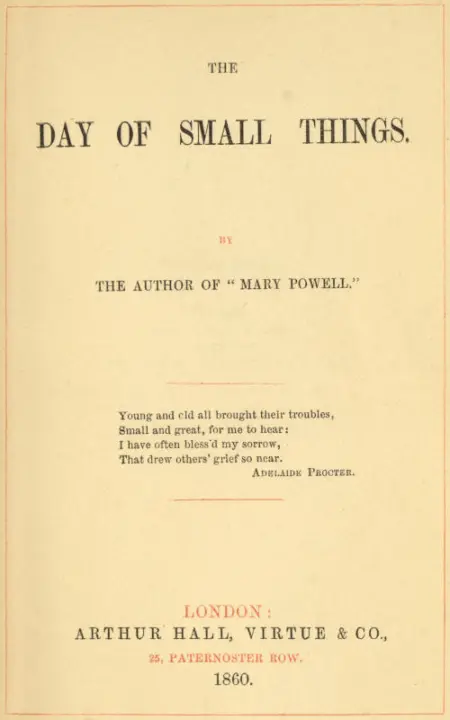
THE CLASSIC COLLECTION · 1860
"The Day of Small Things" by Anne Manning is a novel written in the mid-19th century. The story follows Mrs. Cheerlove, an invalid who reflects on her life as she engages in deep conversations and shared experiences with her maid, Phillis, and the young neighbors visiting her. The narrative emphasizes themes of resilience, the joys of quiet observations, and the significance of small blessings in a life touched by sorrow and loss. At the start of the narrative, Mrs. Cheerlove is confined to her sofa due to a long illness, yet she expresses gratitude for the simple pleasures and mercies she has received during her time of confinement. We see glimpses of her thoughtful character as she contemplates the beauty of her surroundings and the quiet company of Phillis. Their dialogues reveal their personalities, with Mrs. Cheerlove's reflective nature contrasting with Phillis's practical demeanor. The opening establishes a rich tapestry of pastoral life, social interactions, and the deeper emotional currents that flow through the lives of the characters, inviting readers to explore the themes of loss, companionship, and the appreciation of life's small things.
Introduction adapted from the source catalogue; source summaries may be automatically generated.
Free to read · English · 43,461 words · No account needed
MAKE TIME FOR A GOOD BOOK
On by default. Untick to stop anonymous reading totals. Each page counts after 10 seconds in view. How this works.
Anonymous counting is on unless you have switched it off.
“Mrs. Prout knows me very well, ma’am.”
“And so does Mrs. Cheerlove!” said I, laughing. “Oh, Harry! you impostor! I found you out directly!”
“Did you though?” said he, bursting into a fit of laughter, and throwing his disguises right and left, till he stood before me in his original dress. “Phillis didn’t; and a good fright I’ve given her. Served her right, too! Listeners never hear any good of themselves, Mrs. Phillis,” added he, as she put her head a little way into the room.
“Why, I thought I heard a man’s voice, and it gave me quite a turn,” said she, advancing in a hesitating way towards us; “and so I did,—for, whoever would have thought of its being you, Master Prout!”
“You didn’t, it’s certain,” said he, rolling his things up into a bundle, “or you wouldn’t have tried to set me against the place!—so there I have you! Recollect, I’m a lawyer, and can take advantage of you at any time.”
She was, for once, without one word to say.
“Yes, yes,” added he, “I’ve had a grudge against you this long while for calling me Master Prout, when all the world knows I’ve been Mr. Prout ever so long. One would think I took my meals in the nursery. So, mind you, Phillis, if ever you are uncivil to your mistress again, or ever more call me master, I’ll show you I am your master, in one way or another. And, as for your not having answered the bell when Mrs. Cheerlove wanted you, because you were making a cap, why, sooner than keep her waiting for that, I’d have worn a brown-paper cap like a carpenter. So now go and make the kettle boil—very boiling, indeed, for I’m come to drink tea with Mrs. Cheerlove; and we Londoners don’t admire tea made with lukewarm water, I assure you.”
Off she went, with “Well, I’m sure!” on her lips, but with by no means a displeased look on her face; and I could not help thinking, “Some people may steal a horse, while others dare not look over a hedge. She has taken a good deal more from ‘Master Prout’ than she would from Mrs. Cheerlove.”
The Stone House, December 27.
When will wonders cease! I can hardly believe I am awake and in my senses,—yet so it is:—yes, here I am, spending the Christmas holidays with the Pevenseys:—
“And nothing meets my eye but sights of bliss.”
Your reading position is saved on this browser. Take it to another device with a library code. Reading pages adapt to text, rather than matching a printed edition.
Anne Manning
Anne Manning
Anne Manning
Anne Manning
BEHIND THE BOOK
This eBook is for the use of anyone anywhere in the United States and most other parts of the world at no cost and with almost no restrictions whatsoever. You may copy it, give it away or re-use it under the terms of the Project Gutenberg License included with this eBook or online at www.gutenberg.org. If you are not located in the United States, you will have to check the laws of the country where you are located before using this eBook. Read the source licence.
The original source file, including credits and licence, is retained by this library. Request an original-format copy at no charge. Please include the book title and Project Gutenberg identifier #62219.
KEEP YOUR CURIOSITY GOING
Coulson Kernahan

Maurice Baring
Frances Wright
Cécile Tormay

Frederic Jesup Stimson

W. H. P. (William Henry Pope) Jarvis