
Cherry & Violet: A Tale of the Great Plague
Anne Manning
THE CLASSIC COLLECTION · 1860
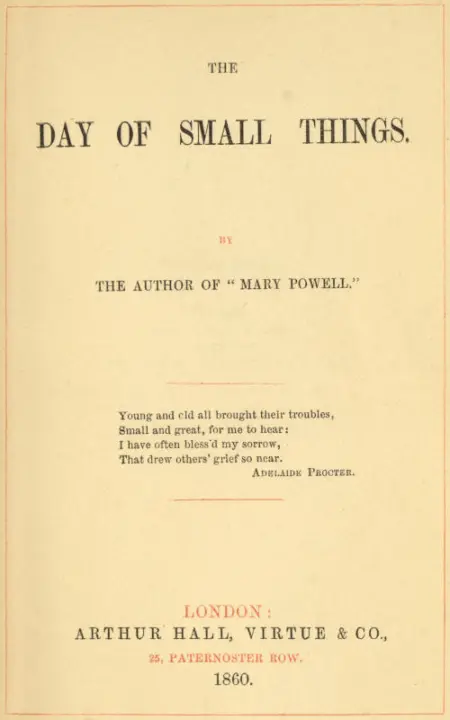
"The Day of Small Things" by Anne Manning is a novel written in the mid-19th century. The story follows Mrs. Cheerlove, an invalid who reflects on her life as she engages in deep conversations and shared experiences with her maid, Phillis, and the young neighbors visiting her. The narrative emphasizes themes of resilience, the joys of quiet observations, and the significance of small blessings in a life touched by sorrow and loss. At the start of the narrative, Mrs. Cheerlove is confined to her sofa due to a long illness, yet she expresses gratitude for the simple pleasures and mercies she has received during her time of confinement. We see glimpses of her thoughtful character as she contemplates the beauty of her surroundings and the quiet company of Phillis. Their dialogues reveal their personalities, with Mrs. Cheerlove's reflective nature contrasting with Phillis's practical demeanor. The opening establishes a rich tapestry of pastoral life, social interactions, and the deeper emotional currents that flow through the lives of the characters, inviting readers to explore the themes of loss, companionship, and the appreciation of life's small things.
Introduction adapted from the source catalogue; source summaries may be automatically generated.
Free to read · English · 43,461 words · No account needed
MAKE TIME FOR A GOOD BOOK
On by default. Untick to stop anonymous reading totals. Each page counts after 10 seconds in view. How this works.
Anonymous counting is on unless you have switched it off.
“Why, you yourself gave warning; and you have never said a word since of being sorry for it, and wishing to stay.”
“You’ve never given me time!”
“To settle the matter at once—do you wish to say so now?”
“Why, dear me, how can one settle a question like that in a minute?”
“Send the person in.”
“Then you do want me to go?”
“Phillis, have you ever said you wanted to stay?”
“Why, you knows as well as I do, that I can’t abear change.”
“There are other things, though, you must bear, Phillis, if you can’t bear that. Let a family be large or little, it can never be a happy one where the great law of obedience is broken, and where the mistress is obliged to follow the lead of the servant. I do not mean to follow that course; and, therefore, if you wish to remain here, you must obey me.”
“Why, don’t I?”
“Certainly you don’t.”
“Then you want to see this gal?”
“Of course, it is the least I can do, since Mrs. Prout, no doubt, has been kind enough to send her down.”
Phillis put the corner of her apron to her eye.
“Then ’tis you wants to change, not I,” said she, in a stifled voice; “for I’m very well content to rub on as I am.”
I took no notice. The next minute, she showed a tall young person into the room, who stood close to the door.
“You may go, Phillis.”
Phillis shut the door, and went.
“Good evening; will you come a little nearer?” said I.
The stranger obeyed, and I suddenly became frightened; for the stride and awkward gait convinced me it was a man in woman’s clothes. Thoughts of robbery and murder rushed through my head as the figure advanced towards me; but just then, the fire, which had been burning dimly, sent up a bright tongue of flame, which lighted up the room, and shone on a face that I thought was not altogether unknown to me.
“Where do you come from?” said I.
“Little Coram Street, London, ma’am,” in a voice of studied softness.
“Hum! then I fear a country place won’t suit you.”
“O yes, it will, ma’am! I likes the country best.”
“I am afraid you are not used to hard work. Did you ever scour a room?”
“I can work harder than people think, ma’am.”
“Well, but, did you ever?”
“O ma’am, there’s nothing I mind setting my hand to.”
“Or clean a saucepan?”
“Surely, ma’am, every servant can do that!”
“Who will recommend you?”
Your reading position is saved on this browser. Take it to another device with a library code. Reading pages adapt to text, rather than matching a printed edition.
Anne Manning
Anne Manning
Anne Manning
Anne Manning
BEHIND THE BOOK
This eBook is for the use of anyone anywhere in the United States and most other parts of the world at no cost and with almost no restrictions whatsoever. You may copy it, give it away or re-use it under the terms of the Project Gutenberg License included with this eBook or online at www.gutenberg.org. If you are not located in the United States, you will have to check the laws of the country where you are located before using this eBook. Read the source licence.
The original source file, including credits and licence, is retained by this library. Request an original-format copy at no charge. Please include the book title and Project Gutenberg identifier #62219.
KEEP YOUR CURIOSITY GOING
Coulson Kernahan

Maurice Baring
Frances Wright
Cécile Tormay

Frederic Jesup Stimson

W. H. P. (William Henry Pope) Jarvis