THE CLASSIC COLLECTION✦An outlaw’s diary: the CommuneCLASSIC FREE BOOKS
An outlaw’s diary: the Commune
Cécile Tormay
THE CLASSIC COLLECTION · 1845
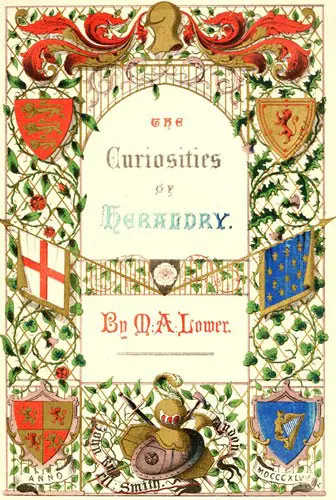
"The Curiosities of Heraldry" by Mark Antony Lower is a historical account written in the mid-19th century. This work delves into the principles and practices of heraldry, a system that denotes family lineage and nobility through intricate symbols and designs. The book aims to shed light on the often-overlooked significance and utility of heraldic study, enlivened by historical anecdotes and examples. The opening of the text presents a preface where Lower establishes the value of heraldry as an essential study for understanding not only genealogy but also the broader historical context of the Middle Ages. He reflects on the misconceptions surrounding heraldry, countering the view that it is merely an outdated collection of symbols. He emphasizes the poetic and practical aspects of heraldry, asserting that it is a rich field worthy of attention. The introduction sets the stage for a detailed exploration of the science of heraldry, hinting at its deep historical roots and its role in the social fabric of medieval society, ultimately preparing the reader for a thorough investigation into the subject throughout the subsequent chapters.
Introduction adapted from the source catalogue; source summaries may be automatically generated.
Free to read · English · 86,967 words · No account needed
MAKE TIME FOR A GOOD BOOK
On by default. Untick to stop anonymous reading totals. Each page counts after 10 seconds in view. How this works.
Anonymous counting is on unless you have switched it off.
The little band surrounding the pieces of which the fleur-de-lis of heraldry is composed is analogous to nothing whatever in the flower, while it does strongly resemble the forril of metal which surrounds the insertion of a spear-head into its staff or pole. After an attentive consideration of both hypotheses, I have no hesitation in affirming that the fleur-de-lis is not the lily. This is shown, not from the occurrence of lilies in their proper shape in some coats, and that of the heraldric lis in others, (for such a variation might have been accidentally made by the incorrect representations of unskilful painters,) but from the fact that both lilies and lis are found in one and the same coat--that of Eton College.[111]
The Tressure surrounding the lion in the royal arms of Scotland is blazoned 'fleury and counter-fleury,' that is, having fleurs-de-lis springing from it, both on the outer and inner sides. The fabulous account of the tressure is that it was given by Charlemagne to Achaius, king of Scotland in the year 792, in token of alliance and friendship. Nisbet says, "The Tressure Flowerie encompasses the Lyon of Scotland, to show that he should defend the Flower-de-lisses, and these to continue a defence to the Lion."[112]
Now, although we must discard this early existence of the Scottish ensigns, it is by no means improbable that the addition of the tressure was made in commemoration of some alliance between the two crowns at a later date. But the defence which a bulwark of lilies could afford the king of beasts would be feeble indeed! Yet, upon the supposition that the fleur-de-lis is intended for a spear-head, such an addition would be exceedingly appropriate, as forming a kind of chevaux-de-frise[113] around the animal.
This doubtful charge may serve as a turning point between 'things naturall' and 'things artificiall.' Among the latter, crowns, sceptres, orbs, caps of maintenance, mantles of state, and such-like insignia may be first named. According to Dame Julyan Berners, crowns formed part of the arms of King Arthur--"iij dragonys and over that an other sheelde of iij crownys." Mitres, crosiers, &c. occur principally, though not exclusively, in church heraldry. From attention in the first instance to the 'arts liberall' came such charges as books, pens, ink-horns, text-letters, as =A='s, =T='s and =S='s, organ-pipes, hautboys, harps, viols, bells, &c. The 'arts mechanicall' furnish us with implements of agriculture, as ploughs, harrows, scythes, wheels, &c. The Catherine Wheel Dallaway takes for a cogged, or denticulated mill-wheel, with reference to some feudal tenure, but it seems rather ungallant to rob the female saint of the instrument of her passion, while St. Andrew and St. George are allowed to retain theirs in undisturbed possession. Manufactures afford the wool-comb, the spindle, the shuttle, the comb, the hemp-break, &c. Among mechanical implements are included pick-axes, mallets, hammers, plummets, squares, axes, nails, &c. Architecture furnishes towers, walls, bridges, pillars, &c. From the marine we have antient ships, boats, rudders, masts, anchors, and sails. From field-sports come bugle (that is bullock) horns, bows, arrows, pheons or fish-spears, falcons' bells, and lures, fish-hooks, eel-spears, nets of various kinds, and bird-bolts. The bird-bolt was a small blunt arrow, with one, two, or three heads, used with the crossbow for shooting at birds. Hence the adage of '=The fool's Bolt is soon shot=,' applied to the hasty expression or retort of an ignorant babbler. John Heywood versifies the proverb thus:
Your reading position is saved on this browser. Take it to another device with a library code. Reading pages adapt to text, rather than matching a printed edition.
BEHIND THE BOOK
This eBook is for the use of anyone anywhere in the United States and most other parts of the world at no cost and with almost no restrictions whatsoever. You may copy it, give it away or re-use it under the terms of the Project Gutenberg License included with this eBook or online at www.gutenberg.org. If you are not located in the United States, you will have to check the laws of the country where you are located before using this eBook. Read the source licence.
The original source file, including credits and licence, is retained by this library. Request an original-format copy at no charge. Please include the book title and Project Gutenberg identifier #38951.
KEEP YOUR CURIOSITY GOING
Cécile Tormay

Moritz Busch
John L. Ransom
Frances Wright
Cécile Tormay

Mabel Potter Daggett