
The Writing of News A Handbook with Chapters on Newspaper Correspondence and Copy Reading
Charles G. (Charles Griffith) Ross
THE CLASSIC COLLECTION · 1876
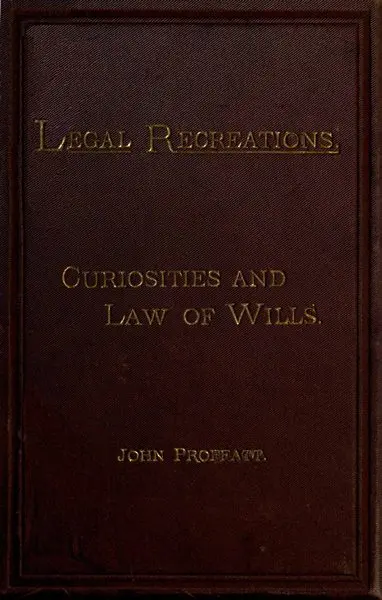
"The Curiosities and Law of Wills" by John Proffatt is a legal treatise written in the late 19th century. This work explores the intricacies surrounding wills, including their formation, legal interpretations, and peculiar cases that highlight human nature. The author aims to present the subject matter in an engaging manner while providing practical and systematic guidance for students, lawyers, and interested readers alike. At the start of the treatise, the author introduces the profound significance of making a last will and testament, noting that it represents a person's final opportunity to express thoughts and feelings about their life and relationships. Proffatt emphasizes that wills can reflect an individual's personality, demonstrating eccentricities, emotions, and views on life and death. He illustrates this premise with various unusual and curious examples of wills throughout history, setting the stage for a deeper exploration of the legal complexities of testamentary documents. The introduction serves as an engaging prelude to the text's more serious discussions on the laws and principles governing wills.
Introduction adapted from the source catalogue; source summaries may be automatically generated.
Free to read · English · 54,497 words · No account needed
MAKE TIME FOR A GOOD BOOK
On by default. Untick to stop anonymous reading totals. Each page counts after 10 seconds in view. How this works.
Anonymous counting is on unless you have switched it off.
[272] Where the word "destroying" is used in the statute, as one mode of revocation, it is generally held to include all modes of defacing not specifically enumerated in the statute, and does not require an absolute and entire destruction. Johnson v. Brailsford, 2 Nott & McCord, 272.
[273] 2 Rev. Stat. 66. It is the same in California: Civil Code, 1292.
[274] Burtenshaw v. Gilbert, 1 Cowp. 49.
[275] Dan v. Brown, 4 Cow. 490.
[276] Etheringham. v. Etheringham, Aleyn, 2.
[277] 3 B. & Ald. 489.
[278] Bibb v. Thomas, 2 W. Bl. 1043.
[279] Pryor v. Coggin, 17 Ga. 444.
[280] White v. Carter, 1 Jones (N. C.) Law, 197.
[281] Smiley v. Gambill, 2 Head, 164.
[282] Blanchard v. Blanchard, 32 Vt. 62.
[283] 7 Jur. N. S. 52.
[284] 1 Jarman, 133.
[285] Bap. Church v. Roberts, 2 Penn. 110.
[286] 1 Johns. Ch. 530.
[287] Bethell v. Moore, 2 Dev. & Batt. 311.
[288] 1 Jarman, 125.
[289] McPherson v. Clark, 3 Bradf. 92.
[290] 1 B. Mon. 57.
[291] 2 Doug. (Mich.) 515.
[292] 8 Jur. N. S. 897.
[293] Legatees are entitled to be paid in the money of the country in which the testator is domiciled and the will is made. 2 Atk. 465; 2 Bro. C. C. 39.
[294] Harrison v. Nixon, 9 Peters, 483.
[295] To determine a person's domicile is sometimes a matter of some difficulty. It is determined on two principles: the fact of one's residence, and the intent of remaining there as at one's home; or it depends upon habitation and the animo manendi. Residence and domicile are not convertible terms, because they are not the same things. The Roman definition has been admired for its expressiveness and force. It is there defined: "It is not doubted that individuals have a home in that place where each one has established his hearth, and the sum of his possessions and fortunes; whence he will not depart if nothing calls him away; whence if he has departed he seems to be a wanderer, and if he returns he ceases to wander." (Code, lib. 10, tit. 39.) It must be assumed as a fact that every person has a domicile, or home, and the domicile of origin remains until another is obtained, not by merely moving or changing, but by leaving it with no intention of returning, without animo revertendi. But an intention to change is not sufficient to alter a domicile until it is actually changed. Therefore, death en route does not alter domicile. (State v. Hallet, 8 Ala. 159.) One who goes abroad, animo revertendi, does not change his domicile, because only the fact of residence is changed, and not the intent. But if he remains very long abroad, and in one place, the intent may be inferred from the fact. The Supreme Court of the United States have intimated that an exercise of the right of suffrage would be the highest evidence, and almost conclusive against the party. (Shelton v. Tiffin, 6 How. 185.)
Your reading position is saved on this browser. Take it to another device with a library code. Reading pages adapt to text, rather than matching a printed edition.
BEHIND THE BOOK
This eBook is for the use of anyone anywhere in the United States and most other parts of the world at no cost and with almost no restrictions whatsoever. You may copy it, give it away or re-use it under the terms of the Project Gutenberg License included with this eBook or online at www.gutenberg.org. If you are not located in the United States, you will have to check the laws of the country where you are located before using this eBook. Read the source licence.
The original source file, including credits and licence, is retained by this library. Request an original-format copy at no charge. Please include the book title and Project Gutenberg identifier #41075.
KEEP YOUR CURIOSITY GOING
Charles G. (Charles Griffith) Ross
Hannah Webster Foster

Emily Lawless
Edwin Hamlin Carr

Charles De Lano Hine
Andrew Ure