
The Writing of News A Handbook with Chapters on Newspaper Correspondence and Copy Reading
Charles G. (Charles Griffith) Ross
THE CLASSIC COLLECTION · 1876
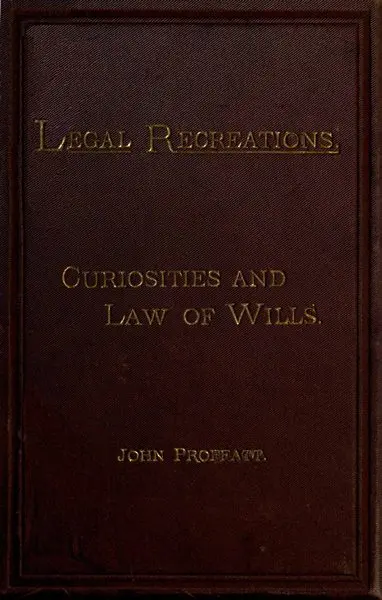
"The Curiosities and Law of Wills" by John Proffatt is a legal treatise written in the late 19th century. This work explores the intricacies surrounding wills, including their formation, legal interpretations, and peculiar cases that highlight human nature. The author aims to present the subject matter in an engaging manner while providing practical and systematic guidance for students, lawyers, and interested readers alike. At the start of the treatise, the author introduces the profound significance of making a last will and testament, noting that it represents a person's final opportunity to express thoughts and feelings about their life and relationships. Proffatt emphasizes that wills can reflect an individual's personality, demonstrating eccentricities, emotions, and views on life and death. He illustrates this premise with various unusual and curious examples of wills throughout history, setting the stage for a deeper exploration of the legal complexities of testamentary documents. The introduction serves as an engaging prelude to the text's more serious discussions on the laws and principles governing wills.
Introduction adapted from the source catalogue; source summaries may be automatically generated.
Free to read · English · 54,497 words · No account needed
MAKE TIME FOR A GOOD BOOK
On by default. Untick to stop anonymous reading totals. Each page counts after 10 seconds in view. How this works.
Anonymous counting is on unless you have switched it off.
"I charge upon my children, in every possible case, and under all circumstances, never to make a matrimonial engagement, or bind themselves to any individuals by promise of marriage, without full parental approbation and consent as it regards the favored individual. And while I consider it unjust as well as unwise for a parent to coerce, or to attempt forcibly to induce a child to marry an object it cannot love, so do I also deem it without any possible excuse on the part of the child to marry without the full consent of the parents. And in the event of disobedience on the part of my child, in this respect, my wish, desire, and intention is to cut that child off from any participation of the benefits arising from any property I may leave at my decease, of every kind and description whatever."
The provisions of the will were in many respects so vague and indefinite, that Chancellor Walworth remarked: "It is very evident that this will was drawn by the decedent himself, or by some other person equally ignorant, not only of legal language, but of legal principles." He held that the children took the same shares as if their father died intestate.
[158] Lord Comyns' Rep. 728.
[159] Brown v. Peck, 1 Eden. 140.
[160] 10 Ves. 13. This was the time allowed in the civil law, 2 Salk. 415.
[161] 2 Rev. Stat. 90.
[162] Benson v. Maude, 6 Madd. 15.
[163] 2 Vern. 31. Roden v. Smith, Amb. 588.
[164] Cricket v. Dolby, 3 Ves. 13.
[165] Nevil v. Nevil, 2 Vern. 431.
[166] Joe v. Hart's Executors, 2 J. J. Marsh. 351.
[167] 1 Hawks 241.
[168] Fawkes v. Gray, 18 Ves. 131.
[169] Wms. Exrs. 1221; 2 Bradf. 77.
[170] 8 Ves. 410.
[171] Poph. 104.
[172] Marsh v. Hague, 1 Edw. Ch. 174.
[173] Ves. 10.
[174] Wms. Exrs. 1222.
[175] Williamson v. Williamson, 6 Paige, 298.
[176] 5 Binney 475.
[177] 1 Vern. 251.
[178] 1 Johns. Ch. 3.
[179] Wms. Exrs. 1206-7.
[180] 2 Rev. St. 450.
[181] Palmer v. Trevor, 1 Vern. 261; Toller 320.
[182] Wms. Exrs. 1213.
[183] 2 Rev. St. 65. So in California: Civil Code 1282.
[184] 1 Seld. 125.
[185] Morris v. Kent, 2 Edw. Ch. 182; Preston on Leg. 281.
[186] The word "children" includes only the immediate legitimate descendants, and not a step-child: Cromer v. Pinckney, 3 Barb. Ch. 466; Mowatt v. Carrow, 7 Paige, 339. Nor does it include grandchildren: Radcliff v. Buckley, 10 Ves. 195; 4 Watts, 82.
[187] Sherer v. Bishop, 4 Bro. C. C. 55; 2 Ves. 84.
[188] Doe v. Clark, 2 H. Bl. 399; Balm v. Balm, 3 Sim. 492.
[189] 1 Barb. Ch. 637; Wms. Exrs. 934.
[190] Rawlins v. Rawlins, 2 Cox's Ca. 425; Marsellis v. Thalheimer, 2
Paige, 35.
[191] Jenkins v. Freyer, 4 Paige, 47.
[192] Collin v. Collin, 1 Barb. Ch. 630.
[193] 2 Paige, 11.
[194] Pratt v. Flamen, 5 Har. & Johns. 10.
[195] Garrett v. Niblock, 1 R. & M. 629; Lady Lincoln v. Pelham, 10 Ves.
106.
[196] Schloss v. Stiebel, 6 Sim. 1.
[197] 1 Jarman, 306.
[198] Vol. II, 96.
[199] Connolly v. Pardon, 1 Paige, 291. In Thomas v. Stevens, 4 Johns. Ch. 607, a legacy to Cornelia Thompson was held a good bequest to Caroline Thompson, it appearing that she was the person intended.
[200] Standen v. Standen, 2 Ves. Jr. 589.
[201] See Chap. VIII.
[202] 4 Ves. 680.
[203] 2 Cha. Ca. 51.
[204] 3 Bro. C. C. 311.
[205] 3 Ves. 148.
[206] Vide the case of Shakspeare, Introduction, p. 23.
Your reading position is saved on this browser. Take it to another device with a library code. Reading pages adapt to text, rather than matching a printed edition.
BEHIND THE BOOK
This eBook is for the use of anyone anywhere in the United States and most other parts of the world at no cost and with almost no restrictions whatsoever. You may copy it, give it away or re-use it under the terms of the Project Gutenberg License included with this eBook or online at www.gutenberg.org. If you are not located in the United States, you will have to check the laws of the country where you are located before using this eBook. Read the source licence.
The original source file, including credits and licence, is retained by this library. Request an original-format copy at no charge. Please include the book title and Project Gutenberg identifier #41075.
KEEP YOUR CURIOSITY GOING
Charles G. (Charles Griffith) Ross
Hannah Webster Foster

Emily Lawless
Edwin Hamlin Carr

Charles De Lano Hine
Andrew Ure