THE CLASSIC COLLECTION✦Harps Hung up in BabylonCLASSIC FREE BOOKS
Harps Hung up in Babylon
Arthur Colton
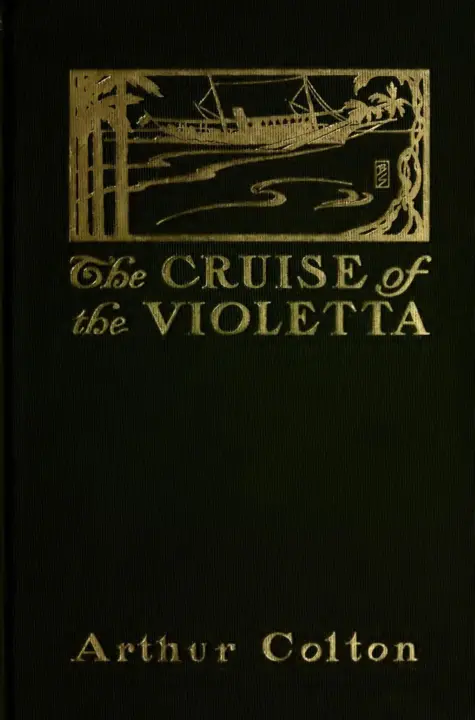
THE CLASSIC COLLECTION · 1906
"The Cruise of The Violetta" by Arthur Colton is a novel written in the early 20th century. The story centers around Christopher "Kit" Kirby, who falls ill in South America and encounters the intriguing Dr. Ulswater during his recovery in the Bahamas. The book sets sail into an exploration of tropical regions, characters, and the adventures that unfold as they encounter various situations, including the enigmatic Mrs. Mink, who owns the yacht "Violetta," and aims to engage in missionary work. At the start of the narrative, Kit Kirby describes his troublesome journey through illness and how he comes under the care of Dr. Ulswater, a well-traveled and unconventional physician. As Kit recovers, he forms a bond with Dr. Ulswater while exploring the vibrant marine life of Nassau. The introduction of Mrs. Mink aboard the yacht brings a domestic twist amid the tropical backdrop, as she reveals her motivations for engaging in foreign missions. Together, they embark on a cruise filled with lively discussions and unexpected encounters, including a diplomatic crisis involving revolutionary figures and whimsical situations, setting the stage for an adventurous exploration of character dynamics and cultural observations.
Introduction adapted from the source catalogue; source summaries may be automatically generated.
Free to read · English · 45,774 words · No account needed
MAKE TIME FOR A GOOD BOOK
On by default. Untick to stop anonymous reading totals. Each page counts after 10 seconds in view. How this works.
Anonymous counting is on unless you have switched it off.
Ram Nad came out of infinity, and answered with welcoming gesture: “Imbecile, why do you trouble me?”
“Where,” I said, “are Georgiana and Dolores, you depraved and disgusting
pundit?”
“How do I know, pig?”
But this limpid flow of pure reason was not, it seemed to me, really headed for Ram Nad's soul secret. I skilfully shifted the attack.
“Why, in this way you might have an idea, illustrious. As I understand your theory of everything, it's this: The entire universe, you say, is only a general idea which has the misfortune to be particularised in spots. Normally, it's just an abstract conception, but parts of the conception have somehow blundered into a curious condition called concreteness. A very distressing condition, very. Bless my soul! Concreteness is an awful catastrophe.”
“As you state it so, it may be so stated,” said Ram Nad.
“Now then, if any person then, such as Georgiana or Dolores, either tragically, or peacefully, or in any manner whatever, becomes dead, you say of them, simply: They have returned to generality; they are no more separately existent; they are rid of the burden of identity; they have, so to speak, disappeared in that airy original mixture again. Such would be your description of the case.”
“You possess some misunderstood fragments of truth, O brother,” said Ram
Nad.
“Very good. But see here! When you churn things in that remarkable basket of yours, and they are gone, and I ask: 'Where are they?' you invariably say: 'They have become general ideas.' When I ask why I can't see or touch them, you answer, 'General ideas are not visible or tangible, but are of the mind purely.' Sometimes, at this point, I have perhaps ejaculated, 'Gammon!' I apologise. Sometimes, on the other hand, you have exclaimed, 'Imbecile!' I forgive. The question is this: What's the difference between being generalised in a basket, and being generalised by drowning? Are they not the same? Or do you follow my argument, illustrious?”
Ram Nad considered.
“This is a worthy inquiry, O brother. It may be your mind is at last becoming capable of thought? But how shall I answer. Is there a difference? Should I not answer that there is none?”
“There can't be, Ram Nad, there can't be!” I exclaimed. “Reason proves it. Then, see here! Why can't you, then, restore Georgiana and Dolores? It's all the same, for reason proves it.”
If there did, as I fancied, for an instant pass over Ram Nad's patriarchal face, into his meditative eyes, an expression, if not of cunning, at least of a certain pleasant humanity, it vanished quickly.
“You have yourself answered,” he said.
Your reading position is saved on this browser. Take it to another device with a library code. Reading pages adapt to text, rather than matching a printed edition.
Arthur Colton

Arthur Colton
Arthur Colton
Arthur Colton
BEHIND THE BOOK
This eBook is for the use of anyone anywhere in the United States and most other parts of the world at no cost and with almost no restrictions whatsoever. You may copy it, give it away or re-use it under the terms of the Project Gutenberg License included with this eBook or online at www.gutenberg.org. If you are not located in the United States, you will have to check the laws of the country where you are located before using this eBook. Read the source licence.
The original source file, including credits and licence, is retained by this library. Request an original-format copy at no charge. Please include the book title and Project Gutenberg identifier #50272.
KEEP YOUR CURIOSITY GOING
Wilfrid Scawen Blunt
Wilfrid Scawen Blunt

E. W. (Edgar Watson) Howe
Coulson Kernahan

Maurice Baring
Frances Wright