THE CLASSIC COLLECTION✦The Hero of Ticonderoga; or, Ethan Allen and His Green Mountain BoysCLASSIC FREE BOOKS
The Hero of Ticonderoga; or, Ethan Allen and His Green Mountain Boys
John De Morgan
THE CLASSIC COLLECTION · 1892
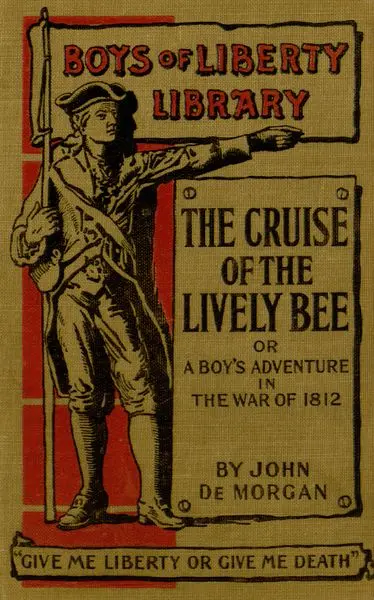
"The Cruise of the 'Lively Bee'; Or, A Boy's Adventures in the War of 1812" by John De Morgan is a historical novel written in the late 19th century. The story is set during the War of 1812 and follows the adventurous exploits of a young boy named John Tempest. He embarks on a journey aboard the privateer ship "Lively Bee" and encounters various challenges and battles as he fights for his country against the British fleet. The opening of the novel sets the stage for the declaration of war. It describes a bustling scene in New York City, where citizens are reacting to news of President Madison’s declaration against Great Britain. Young John Tempest, in the uniform of a midshipman, displays excitement and patriotic zeal as he prepares to sail into action aboard the "Lively Bee." Throughout the initial chapters, readers are introduced to the dynamics of the naval conflict, Tempest's aspirations for valor and glory, and the spirited camaraderie among the crew as they anticipate opportunities for adventure and combat on the high seas.
Introduction adapted from the source catalogue; source summaries may be automatically generated.
Free to read · English · 51,637 words · No account needed
MAKE TIME FOR A GOOD BOOK
On by default. Untick to stop anonymous reading totals. Each page counts after 10 seconds in view. How this works.
Anonymous counting is on unless you have switched it off.
Or
A Boy's Adventure in the War of 1812
by
Author of
"Paul Revere," "The Young Ambassador," "The First
Shot for Liberty," "The Young Guardsman," etc.
Philadelphia
David McKay, Publisher
610 South Washington Square
Copyright, 1892
By Norman L. Munro
The Cruise of the "Lively Bee"
President James Madison had signed the Declaration of War against Great
Britain.
War!
There were many in that crowd who remembered 1783; there stood the man who, in his boyhood's days, had climbed the flagpole and torn down the Union Jack of England, and in its place had hoisted the Star Spangled Banner.
Many whose hair was now turning gray had shouldered the musket and had marched with Washington from victory to victory.
The war had ended when the British evacuated the city, but America was
not free and independent.
England held the supremacy of the seas.
English vessels entered American ports, and men were impressed as seamen on the technical ground that they had never abjured allegiance.
American vessels were boarded on the high seas, and some of the best men taken away and forced to serve under the English flag.
There is a limit to forbearance, and the young nation, whose infancy had scarcely been passed, resolved that it would be better to die than endure such insults.
War was declared.
It looked like madness.
It was so, if judged by the ordinary rules of national conduct.
Great Britain was the mistress of the seas.
On the roll of her navy were over a thousand ships, and eighty-five of the largest were actually in American ports.
President Madison and his Cabinet did not, however, intend that the war should be waged on the high seas.
The American ships-of-war were to remain in the harbors as so many floating batteries for defensive purposes.
In New York Harbor was a small squadron under the command of Commodore
Rodgers.
He heard the rumor that he was not to go out to sea, and dispatched Captains Bainbridge and Stewart to Washington to confer with the Secretary of the Navy.
Secretary Paul Hamilton listened attentively to the two captains, and they thought they had won their case; but with great courtesy he thanked them, and said that the President had, with the consent of his Cabinet, decided to order the ships to remain in the harbors.
Captain Stewart stamped his foot, and with almost anger, exclaimed:
"Sir, you are going to ruin the country; I'll have you impeached!"
Paul Hamilton smiled.
Your reading position is saved on this browser. Take it to another device with a library code. Reading pages adapt to text, rather than matching a printed edition.
BEHIND THE BOOK
This eBook is for the use of anyone anywhere in the United States and most other parts of the world at no cost and with almost no restrictions whatsoever. You may copy it, give it away or re-use it under the terms of the Project Gutenberg License included with this eBook or online at www.gutenberg.org. If you are not located in the United States, you will have to check the laws of the country where you are located before using this eBook. Read the source licence.
The original source file, including credits and licence, is retained by this library. Request an original-format copy at no charge. Please include the book title and Project Gutenberg identifier #46371.
KEEP YOUR CURIOSITY GOING
Cécile Tormay

Moritz Busch
Coulson Kernahan
John L. Ransom

Maurice Baring
Frances Wright