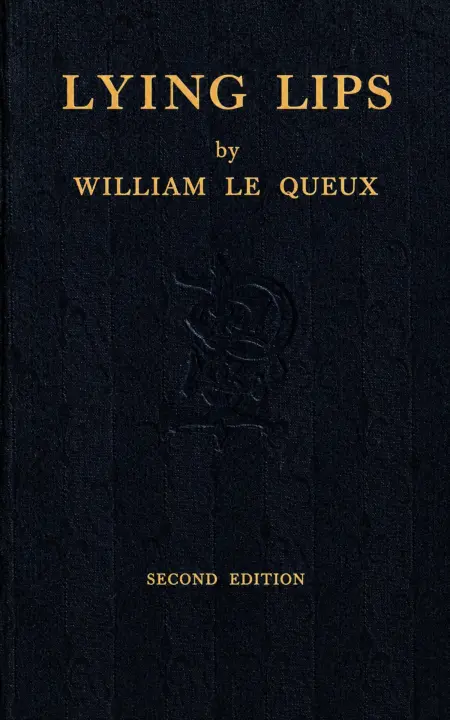
Lying lips
William Le Queux
THE CLASSIC COLLECTION · 1928
"The Crime Code" by William Le Queux is a crime-thriller novel written in the early 20th century. It likely follows Lionel Hipwell, a rising Foreign Office man and would‑be MP, who becomes a fugitive after a fatal street struggle and is swept into a labyrinth of jewel thieves, espionage, and high-stakes intrigue that stretches from London’s underworld to Continental diplomatic salons.
The opening of the story introduces Lionel’s privileged background, secret engagement, and gambling habit before a rainy-night scuffle in Bloomsbury leaves a man dead and Lionel fleeing in panic. He disguises himself as a lorry-driver, returns to London under an alias, and hides in shabby Camberwell lodgings, where a sharp-eyed fellow tenant, Lisely Hatten, begins to suspect him. After a clandestine meeting with his sympathetic father—and fresh press reports revealing the victim was a notorious burglar—Lionel blunders, in a dense fog, into a nearby house where a foreign gang is dividing stolen jewels; Lisely is among them, and they brand Lionel a police spy, planning to blind him. Drugged during the ordeal, he awakens abruptly at a glittering British Embassy dinner in Rome—bewildered, in diplomatic uniform, dancing with the captivating Contessina Angela—before returning to his hotel, where a Swiss-letter awaits, closing this disorienting, high-tension beginning.
Introduction adapted from the source catalogue; source summaries may be automatically generated.
Free to read · English · 74,595 words · No account needed
MAKE TIME FOR A GOOD BOOK
On by default. Untick to stop anonymous reading totals. Each page counts after 10 seconds in view. How this works.
Anonymous counting is on unless you have switched it off.
We both went to her empty bedroom and searched her waste-paper basket for evidence of the plot. But, she had apparently taken the note with her. There had been no fire in the room, therefore she could not have burned it, as she might have done in winter.
At noon the car took us down to Scotland Yard, where, without delay, we were ushered into the bare, official room of the Assistant Commissioner of Metropolitan Police, Mr. Cunningham Lee.
The tall, thin-faced official rose to greet the famous K.C., and then, reseating himself, listened to the story which the bereaved father related.
“This is Mr. Lionel Hipwell of the Foreign Office,” he said, indicating me. “The letter my daughter received purported to come from him, but he never sent any message, either written or verbal.”
“Then your daughter was decoyed away last night, Mr. Gell, eh?”
“No doubt. Or--or perhaps an accident has occurred to her, and she may be in one of the hospitals.”
“The receipt of the note rather points to her being decoyed, does it not?” said the Assistant Commissioner very seriously, as he touched an electric button.
“Send Mr. Nicholas to me,” he said to the clerk who answered his summons. “And--and send Mr. Hayes also.”
In a few minutes the two officers of the Criminal Investigation Department entered. To them the eminent lawyer, who was so well known, gave a detailed description of Joan, together with the clothing she had worn, and described the curious circumstances under which she had left home in a taxi for Wardour Street, about eight o’clock.
Both detectives made some scribbled notes, when Hayes, a round-faced, middle-aged man, who had to his credit the arrest of the bungalow-murderer Collins, hanged only a couple of months before, asked:
“Excuse me, Mr. Gell, but do you think the motive might be vengeance, because you have successfully prosecuted one or other of the recent gangs? You remember the Pittard crowd--the ‘cat’ burglars whom you prosecuted for the Treasury. Don’t you recollect that after they were sentenced by the Recorder they vowed vengeance against you?”
John Gell laughed, his usual hearty laugh.
“My dear Mr. Hayes, every advocate who prosecutes for the Treasury has hundreds of threats and anonymous letters of abuse and warning! I’m not alone. I received two yesterday morning.”
“That is so, Mr. Gell,” admitted the Assistant Commissioner, “but Mr. Hayes is perfectly within his right to suggest a motive.”
“Of course! of course!” said the stout lawyer. “But I leave the matter entirely in your hands to do your best to restore my daughter to me.”
Your reading position is saved on this browser. Take it to another device with a library code. Reading pages adapt to text, rather than matching a printed edition.
William Le Queux
William Le Queux
William Le Queux
William Le Queux
BEHIND THE BOOK
This eBook is for the use of anyone anywhere in the United States and most other parts of the world at no cost and with almost no restrictions whatsoever. You may copy it, give it away or re-use it under the terms of the Project Gutenberg License included with this eBook or online at www.gutenberg.org. If you are not located in the United States, you will have to check the laws of the country where you are located before using this eBook. Read the source licence.
The original source file, including credits and licence, is retained by this library. Request an original-format copy at no charge. Please include the book title and Project Gutenberg identifier #78372.
KEEP YOUR CURIOSITY GOING
Coulson Kernahan

Maurice Baring
Frances Wright
Cécile Tormay

Frederic Jesup Stimson

W. H. P. (William Henry Pope) Jarvis