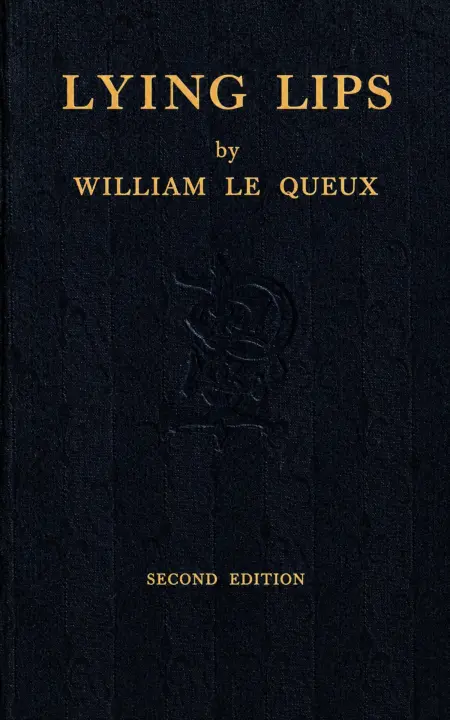
Lying lips
William Le Queux
THE CLASSIC COLLECTION · 1928
"The Crime Code" by William Le Queux is a crime-thriller novel written in the early 20th century. It likely follows Lionel Hipwell, a rising Foreign Office man and would‑be MP, who becomes a fugitive after a fatal street struggle and is swept into a labyrinth of jewel thieves, espionage, and high-stakes intrigue that stretches from London’s underworld to Continental diplomatic salons.
The opening of the story introduces Lionel’s privileged background, secret engagement, and gambling habit before a rainy-night scuffle in Bloomsbury leaves a man dead and Lionel fleeing in panic. He disguises himself as a lorry-driver, returns to London under an alias, and hides in shabby Camberwell lodgings, where a sharp-eyed fellow tenant, Lisely Hatten, begins to suspect him. After a clandestine meeting with his sympathetic father—and fresh press reports revealing the victim was a notorious burglar—Lionel blunders, in a dense fog, into a nearby house where a foreign gang is dividing stolen jewels; Lisely is among them, and they brand Lionel a police spy, planning to blind him. Drugged during the ordeal, he awakens abruptly at a glittering British Embassy dinner in Rome—bewildered, in diplomatic uniform, dancing with the captivating Contessina Angela—before returning to his hotel, where a Swiss-letter awaits, closing this disorienting, high-tension beginning.
Introduction adapted from the source catalogue; source summaries may be automatically generated.
Free to read · English · 74,595 words · No account needed
MAKE TIME FOR A GOOD BOOK
On by default. Untick to stop anonymous reading totals. Each page counts after 10 seconds in view. How this works.
Anonymous counting is on unless you have switched it off.
On the following Monday afternoon I alighted at Calais Maritime from the dusty wagon-lit of the Rome express, glad to stretch my legs after the long journey. On board the Dover boat the wind blew fresh and the crossing, to me, was pleasant; but to many others I fear, it was the reverse.
In due course, after tea in the Pullman, I arrived at Victoria, and in consequence of my official laisser-passer I was soon in a taxi and away to Downing Street, to deliver my dispatches from Sir Richard Kingscliffe. Then, re-entering the cab, I drove to Sackville Street. To my knowledge I had not set foot in my rooms for two whole years.
A complete stranger, who I supposed was Edward Bruce, my new man, Bolland’s successor, threw open the door, bowing me a rather stiff welcome. And then, taking my bags from the taxi-man, he followed me into my small but rather cosy sitting-room. Bruce was quite unlike what I had pictured him, rather tall, young, and slim, with immaculate clothes that fitted him well--evidently a well-trained servant.
“Miss Gell has rung up three times to-day, sir, to inquire if you have returned. She wishes you to speak to her as soon as you possibly can,” he said, handing me about a dozen letters.
I paused for a second. What could I say to Joan?
“Anything else?” I asked.
“Your father called yesterday, sir. He thought you were back. I think he has written to you.”
“Any other callers?” I asked, as he helped me off with my coat.
“Only the blind young gentleman, sir.”
“Blind young gentleman!” I exclaimed, surprised. “Who is he?”
“I don’t know his name, sir. But he continually calls to know when you will be back. He says he knows you, sir.”
“What kind of a man is he?”
“Oh, he’s a young gentleman who wears black glasses. But, poor fellow, he’s stone blind. He finds his way up all right, but I always have to lead him down the stairs and out into the street, till he finds the curb, and taps along it with his stick.”
“I wonder who he is,” I remarked aloud to myself.
“I don’t know, sir. I thought you knew him. He gave me that impression,” Bruce replied. “Will you be at home to him the next time he calls?”
I pondered. The fact that the caller was sightless reminded me of my mysterious and inexplicable escape from the sentence of blindness passed on me by that girl criminal, Lisely Hatten, in Camberwell.
Your reading position is saved on this browser. Take it to another device with a library code. Reading pages adapt to text, rather than matching a printed edition.
William Le Queux
William Le Queux
William Le Queux
William Le Queux
BEHIND THE BOOK
This eBook is for the use of anyone anywhere in the United States and most other parts of the world at no cost and with almost no restrictions whatsoever. You may copy it, give it away or re-use it under the terms of the Project Gutenberg License included with this eBook or online at www.gutenberg.org. If you are not located in the United States, you will have to check the laws of the country where you are located before using this eBook. Read the source licence.
The original source file, including credits and licence, is retained by this library. Request an original-format copy at no charge. Please include the book title and Project Gutenberg identifier #78372.
KEEP YOUR CURIOSITY GOING
Coulson Kernahan

Maurice Baring
Frances Wright
Cécile Tormay

Frederic Jesup Stimson

W. H. P. (William Henry Pope) Jarvis