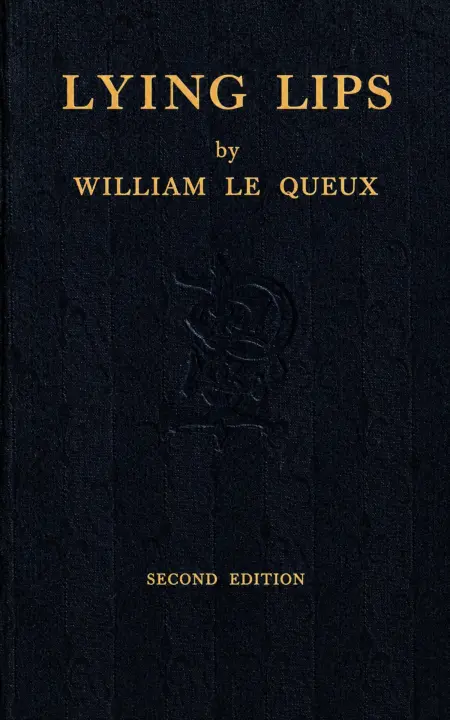
Lying lips
William Le Queux
THE CLASSIC COLLECTION · 1928
"The Crime Code" by William Le Queux is a crime-thriller novel written in the early 20th century. It likely follows Lionel Hipwell, a rising Foreign Office man and would‑be MP, who becomes a fugitive after a fatal street struggle and is swept into a labyrinth of jewel thieves, espionage, and high-stakes intrigue that stretches from London’s underworld to Continental diplomatic salons.
The opening of the story introduces Lionel’s privileged background, secret engagement, and gambling habit before a rainy-night scuffle in Bloomsbury leaves a man dead and Lionel fleeing in panic. He disguises himself as a lorry-driver, returns to London under an alias, and hides in shabby Camberwell lodgings, where a sharp-eyed fellow tenant, Lisely Hatten, begins to suspect him. After a clandestine meeting with his sympathetic father—and fresh press reports revealing the victim was a notorious burglar—Lionel blunders, in a dense fog, into a nearby house where a foreign gang is dividing stolen jewels; Lisely is among them, and they brand Lionel a police spy, planning to blind him. Drugged during the ordeal, he awakens abruptly at a glittering British Embassy dinner in Rome—bewildered, in diplomatic uniform, dancing with the captivating Contessina Angela—before returning to his hotel, where a Swiss-letter awaits, closing this disorienting, high-tension beginning.
Introduction adapted from the source catalogue; source summaries may be automatically generated.
Free to read · English · 74,595 words · No account needed
MAKE TIME FOR A GOOD BOOK
On by default. Untick to stop anonymous reading totals. Each page counts after 10 seconds in view. How this works.
Anonymous counting is on unless you have switched it off.
The knowledge that some desperate plot had been formed against me by certain unknown enemies, made it quite apparent that the conspiracy extended to my well-beloved. I said but little to Mr. Gell, but I became all the more convinced that she had fallen innocently into hostile hands, as the message to her, of course, was a false one. The express messenger had delivered to Joan a written note. She knew my handwriting. Who, therefore, had forged my message?
The unknown Illona had warned me not without reason. What could she
possibly know?
“We’ll wait till noon, and if we hear nothing, we’ll go down and see Cunningham Lee, the Assistant Commissioner at Scotland Yard,” said the King’s Counsel, whose work at the Old Bailey brought him into intimate touch with the head of the police.
Three anxious hours passed, but the telephone did not ring, nor was there any explanatory message from the girl I so dearly loved. She was lost to me as to her friends. There had been some devil’s work somewhere! When I recalled my own experience in the hands of that desperate gang, I trembled for her. And yet, her only offense, apparently, had been her great love for me.
I longed to find Illona and demand the truth from her. What could she know? Could she tell me something to give a clue to Joan’s sudden disappearance? Or was it due to the fierce jealousy of the woman I had unconsciously wedded?
Very probably it was due to the latter! If so, then my efforts to learn the truth, and to rescue Joan, must be unavailing.
Joan’s mother, naturally, was in tears.
“My girl would never of her own will remain away all night!” she cried. “An accident may have happened, John,” she said to her husband. “Inquiry must be made at all the hospitals.”
The maid was called, and described the dress, coat, and hat which Joan had put on before going out.
“She had two one-pound Treasury notes in her bag as well as some silver, madam,” the girl said. “Miss Joan always carries them in her little purse in case of emergency.”
“Did she seem surprised when you gave her the letter?” asked Mr. Gell, assuming his habitual manner of cross-examination.
“Well, just a trifle, I think, sir.”
“What causes you to say a trifle? Explain it.”
“Well,” replied the neatly-dressed maid, rather confused at her master’s hard, legal glance, “when she opened and read the letter, she exclaimed, ‘Oh, how strange--how very interesting! I must go at once. Mr. Hipwell is waiting for me.’”
“She did not say where?”
Your reading position is saved on this browser. Take it to another device with a library code. Reading pages adapt to text, rather than matching a printed edition.
William Le Queux
William Le Queux
William Le Queux
William Le Queux
BEHIND THE BOOK
This eBook is for the use of anyone anywhere in the United States and most other parts of the world at no cost and with almost no restrictions whatsoever. You may copy it, give it away or re-use it under the terms of the Project Gutenberg License included with this eBook or online at www.gutenberg.org. If you are not located in the United States, you will have to check the laws of the country where you are located before using this eBook. Read the source licence.
The original source file, including credits and licence, is retained by this library. Request an original-format copy at no charge. Please include the book title and Project Gutenberg identifier #78372.
KEEP YOUR CURIOSITY GOING
Coulson Kernahan

Maurice Baring
Frances Wright
Cécile Tormay

Frederic Jesup Stimson

W. H. P. (William Henry Pope) Jarvis