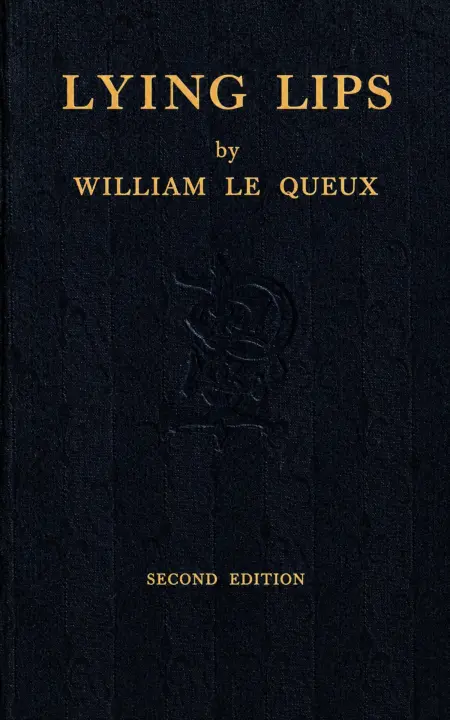
Lying lips
William Le Queux
THE CLASSIC COLLECTION · 1928
"The Crime Code" by William Le Queux is a crime-thriller novel written in the early 20th century. It likely follows Lionel Hipwell, a rising Foreign Office man and would‑be MP, who becomes a fugitive after a fatal street struggle and is swept into a labyrinth of jewel thieves, espionage, and high-stakes intrigue that stretches from London’s underworld to Continental diplomatic salons.
The opening of the story introduces Lionel’s privileged background, secret engagement, and gambling habit before a rainy-night scuffle in Bloomsbury leaves a man dead and Lionel fleeing in panic. He disguises himself as a lorry-driver, returns to London under an alias, and hides in shabby Camberwell lodgings, where a sharp-eyed fellow tenant, Lisely Hatten, begins to suspect him. After a clandestine meeting with his sympathetic father—and fresh press reports revealing the victim was a notorious burglar—Lionel blunders, in a dense fog, into a nearby house where a foreign gang is dividing stolen jewels; Lisely is among them, and they brand Lionel a police spy, planning to blind him. Drugged during the ordeal, he awakens abruptly at a glittering British Embassy dinner in Rome—bewildered, in diplomatic uniform, dancing with the captivating Contessina Angela—before returning to his hotel, where a Swiss-letter awaits, closing this disorienting, high-tension beginning.
Introduction adapted from the source catalogue; source summaries may be automatically generated.
Free to read · English · 74,595 words · No account needed
MAKE TIME FOR A GOOD BOOK
On by default. Untick to stop anonymous reading totals. Each page counts after 10 seconds in view. How this works.
Anonymous counting is on unless you have switched it off.
I pursed my lips and pondered deeply.
An instant later the telephone, upon my table, rang. Involuntarily, I took up the receiver and answered.
“Hulloa, Lionel!” cried Joan, whose merry voice I recognized instantly. “I got your excuse for not writing and I forgive you. So you’re back at last! You were due from Rome two days ago. Are you seeing me to-night, or are you too tired?”
“Tired! I am never too tired to see you, dearest,” I cried, in as gallant a manner as my poor, perturbed brain would allow. “Where shall we meet?”
“Mother and father are going to the Lord Chancellor’s reception at ten o’clock. Come here at half-past, eh?”
“Very well,” I replied. “I’ll dine at the club, and come on after ten
o’clock.”
“Did you have a good journey?” she asked. “I hope you won’t be in one of your moods, you know. The last time you came to see me you were horrible. But I know, dear, you won’t be to-night, will you--for my sake?”
“I was really unconscious of being horrible,” I laughed, “so do forgive me. I’ll try and behave better to-night.”
“Righto! And don’t forget your promise--eh?” laughed the girl I so dearly loved. Then she rang off.
Another mystery! What quarrel had ensued between us? Of what bad behavior had I been unconsciously guilty--and when?
After two years I was to see Joan again! And yet, I was already married--married to a woman I had never consciously seen.
Imagine my feelings as I sat that evening eating my dinner alone in the St. James’s Club, torn by a thousand apprehensions of having betrayed my best friends by making undesirable acquaintances, and, furthermore, by contracting a hazardous and incomprehensible marriage.
What was I to say to Joan?
A little soup, and I could eat nothing more. It was half-past eight, and, in order to carry out my promise to the Contessina, I went into the hall and rang up Mr. Roddy Owen, at Harrington Court.
A man who spoke with a foreign accent and who was evidently a servant answered, and asked who I was. My reply was that I desired to speak with Mr. Owen himself.
In a few moments a man’s gruff voice said, “Owen speaking. What do you
want?”
“I want to see you this evening,” I replied. “You do not know me, but I am bearer of a verbal message to you--from a friend of yours in Rome.”
“Rome?” he echoed. “Oh, yes, thanks. I’ll be delighted to meet
you--what name?”
“Hipwell,” I replied. “May I call--say in half an hour?”
Your reading position is saved on this browser. Take it to another device with a library code. Reading pages adapt to text, rather than matching a printed edition.
William Le Queux
William Le Queux
William Le Queux
William Le Queux
BEHIND THE BOOK
This eBook is for the use of anyone anywhere in the United States and most other parts of the world at no cost and with almost no restrictions whatsoever. You may copy it, give it away or re-use it under the terms of the Project Gutenberg License included with this eBook or online at www.gutenberg.org. If you are not located in the United States, you will have to check the laws of the country where you are located before using this eBook. Read the source licence.
The original source file, including credits and licence, is retained by this library. Request an original-format copy at no charge. Please include the book title and Project Gutenberg identifier #78372.
KEEP YOUR CURIOSITY GOING
Coulson Kernahan

Maurice Baring
Frances Wright
Cécile Tormay

Frederic Jesup Stimson

W. H. P. (William Henry Pope) Jarvis