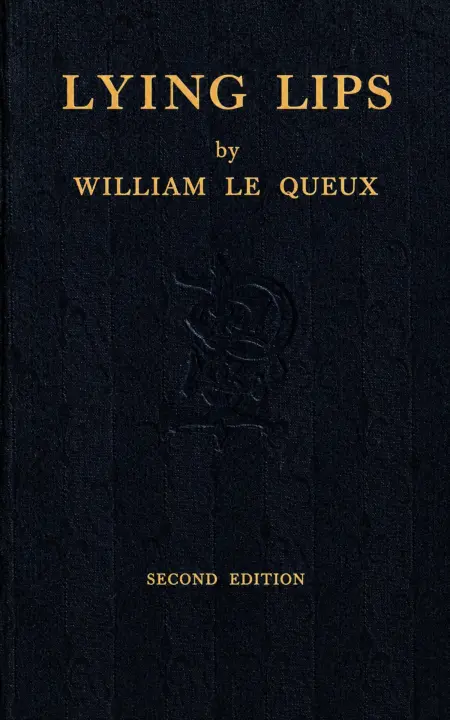
Lying lips
William Le Queux
THE CLASSIC COLLECTION · 1928
"The Crime Code" by William Le Queux is a crime-thriller novel written in the early 20th century. It likely follows Lionel Hipwell, a rising Foreign Office man and would‑be MP, who becomes a fugitive after a fatal street struggle and is swept into a labyrinth of jewel thieves, espionage, and high-stakes intrigue that stretches from London’s underworld to Continental diplomatic salons.
The opening of the story introduces Lionel’s privileged background, secret engagement, and gambling habit before a rainy-night scuffle in Bloomsbury leaves a man dead and Lionel fleeing in panic. He disguises himself as a lorry-driver, returns to London under an alias, and hides in shabby Camberwell lodgings, where a sharp-eyed fellow tenant, Lisely Hatten, begins to suspect him. After a clandestine meeting with his sympathetic father—and fresh press reports revealing the victim was a notorious burglar—Lionel blunders, in a dense fog, into a nearby house where a foreign gang is dividing stolen jewels; Lisely is among them, and they brand Lionel a police spy, planning to blind him. Drugged during the ordeal, he awakens abruptly at a glittering British Embassy dinner in Rome—bewildered, in diplomatic uniform, dancing with the captivating Contessina Angela—before returning to his hotel, where a Swiss-letter awaits, closing this disorienting, high-tension beginning.
Introduction adapted from the source catalogue; source summaries may be automatically generated.
Free to read · English · 74,595 words · No account needed
MAKE TIME FOR A GOOD BOOK
On by default. Untick to stop anonymous reading totals. Each page counts after 10 seconds in view. How this works.
Anonymous counting is on unless you have switched it off.
Later, after an enjoyable hour, during which I endeavored, by all the means in my power, to discover more concerning the mysterious girl, I took her in to supper, where we sat down to a tête-à-tête repast.
Around us were many people I recognized, for very slowly my memory was returning. Rospigliosi, with his wife, the Minister Sonnino, Caetani and his daughter, the pretty Donna Stella, and the ever-popular Princess Odescalchi with her wonderful emeralds.
From the chatter of the Little Countess it was apparent that she moved in high circles and was acquainted with many officials.
Later, I led her back to the ballroom.
“M’sieur Hipwell,” whispered the Little Countess just as we were about to dance, “I wonder if you--well, if I dare ask you to do a very great favor for me?”
“Most certainly I will,” was my eager reply.
“Well, I cannot tell you here. Could you meet me--to-morrow? I will be
alone.”
“Where?” I asked.
She reflected a moment.
“In the Church of Sant’ Agnese, in the Piazza Navona,” she replied in a low voice. “Would eleven o’clock suit you?”
“Certainly. I will be there.”
And thus it was arranged.
Punctually at the hour she had named I entered the great, domed church, with its huge columns of Cottanello, built upon the spot where Saint Agnes suffered martyrdom. The silent interior was quite dark after the glare of the sun in the piazza outside; but in a few moments I saw a slim figure in a neat navy-blue street-suit, which I instantly recognized as the Contessina’s, standing before the antique statue of San Sebastian. A whispered, timorous greeting and a warm handshake, whereupon she suggested in a low voice:
“Let us talk here. If we go outside somebody who knows you may see
us.”
“Bien!” I replied. “There are chairs yonder.” And we crossed to several rush-bottomed chairs near one of the side-altars, before which the light was burning in its red-glass shade. It was evident that she meant to preserve the strictest secrecy, and this very fact increased my interest in her.
“Last night you told me that I could trust you, M’sieur Hipwell,” she said in a low voice, though we were alone in the great church. “I am a mystery to you, I know that.”
“But we have met before. Have we not?” I asked, fixing my eyes on her. She gave vent to a little hysterical laugh.
“You know. But perhaps you have forgotten. You forget many things.”
“But I could never forget you, Contessina!” I declared. “Will you not enlighten my darkness of mind? You tell me that I forget many things.”
Your reading position is saved on this browser. Take it to another device with a library code. Reading pages adapt to text, rather than matching a printed edition.
William Le Queux
William Le Queux
William Le Queux
William Le Queux
BEHIND THE BOOK
This eBook is for the use of anyone anywhere in the United States and most other parts of the world at no cost and with almost no restrictions whatsoever. You may copy it, give it away or re-use it under the terms of the Project Gutenberg License included with this eBook or online at www.gutenberg.org. If you are not located in the United States, you will have to check the laws of the country where you are located before using this eBook. Read the source licence.
The original source file, including credits and licence, is retained by this library. Request an original-format copy at no charge. Please include the book title and Project Gutenberg identifier #78372.
KEEP YOUR CURIOSITY GOING
Coulson Kernahan

Maurice Baring
Frances Wright
Cécile Tormay

Frederic Jesup Stimson

W. H. P. (William Henry Pope) Jarvis