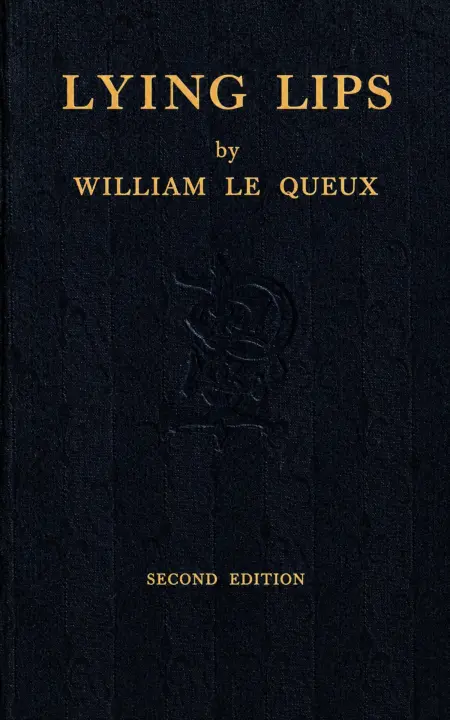
Lying lips
William Le Queux
THE CLASSIC COLLECTION · 1928
"The Crime Code" by William Le Queux is a crime-thriller novel written in the early 20th century. It likely follows Lionel Hipwell, a rising Foreign Office man and would‑be MP, who becomes a fugitive after a fatal street struggle and is swept into a labyrinth of jewel thieves, espionage, and high-stakes intrigue that stretches from London’s underworld to Continental diplomatic salons.
The opening of the story introduces Lionel’s privileged background, secret engagement, and gambling habit before a rainy-night scuffle in Bloomsbury leaves a man dead and Lionel fleeing in panic. He disguises himself as a lorry-driver, returns to London under an alias, and hides in shabby Camberwell lodgings, where a sharp-eyed fellow tenant, Lisely Hatten, begins to suspect him. After a clandestine meeting with his sympathetic father—and fresh press reports revealing the victim was a notorious burglar—Lionel blunders, in a dense fog, into a nearby house where a foreign gang is dividing stolen jewels; Lisely is among them, and they brand Lionel a police spy, planning to blind him. Drugged during the ordeal, he awakens abruptly at a glittering British Embassy dinner in Rome—bewildered, in diplomatic uniform, dancing with the captivating Contessina Angela—before returning to his hotel, where a Swiss-letter awaits, closing this disorienting, high-tension beginning.
Introduction adapted from the source catalogue; source summaries may be automatically generated.
Free to read · English · 74,595 words · No account needed
MAKE TIME FOR A GOOD BOOK
On by default. Untick to stop anonymous reading totals. Each page counts after 10 seconds in view. How this works.
Anonymous counting is on unless you have switched it off.
In a second I realized that the room was furnished quite differently from that of Mrs. Bowyer. Then it suddenly dawned on me that I had inadvertently entered the wrong house! Yet I saw standing there, statuesque and amazed, the handsome figure of my fellow-lodger, Lisely Hatten. With her was an over-dressed foreign woman, a tall, fair-haired young Englishman, of the type of a naval officer, and four beetle-browed, swarthy foreigners, all in a great state of anger and alarm.
“I found this fellow listening!” cried the very tall, muscular man of Negroid type, with thick lips and bloodshot eyes, who had seized me on the stairs. He spoke with a strange accent. “The spy has overheard!” Whereat the strange nocturnal party stood aghast.
“I heard nothing! I am no spy,” I protested instantly.
“Perhaps not,” exclaimed one of the other men, who was apparently in authority. “But you have seen!”
Then, next second I became aware that upon the table was a quantity of old-fashioned jewelry lying in a heap, gems which flashed and glittered beneath the light, but all in antique settings.
“I have seen nothing,” I assured my captors.
Were they jewel-thieves in the act of dividing their spoils?
“You are a police-spy!” shouted the dark-bearded, undersized foreigner
who had just spoken.
“Yes,” cried the girl who was my fellow-lodger. “I suspected him from the first. He told me he was a journalist, but nobody knows him in Fleet Street. He goes out on night duty from Scotland Yard.”
“That is certainly untrue,” I said resentfully. “I am no police-spy, and your affairs, whatever they may be, are surely no business of mine.”
The big, dark-faced man, who had made me his prisoner, laughed
mockingly and said:
“Unfortunately for you, we happen to know you. You are Lionel Hipwell. Why do you come to live here in disguise as Mr. Paige if you are not acting for the police?”
I was silent. What could I say?
It was plain that the pretty, half-foreign typist had suspected me, but to my amazement, not as the assassin of Bloomsbury. It was as an agent of the Criminal Investigation Department I had been suspected. In that second my whole outlook on life changed.
I saw myself faced with a greater peril than I ever could have dreamed. By mere mischance, bad fortune following on bad fortune, I had fallen upon the secret of what was evidently a most desperate gang of jewel thieves.
In that narrow, shuttered room, with its cheap table piled with gems of untold value, precious stones that my eyes had never before beheld, I stood bewildered, and at the mercy of my accusers.
Your reading position is saved on this browser. Take it to another device with a library code. Reading pages adapt to text, rather than matching a printed edition.
William Le Queux
William Le Queux
William Le Queux
William Le Queux
BEHIND THE BOOK
This eBook is for the use of anyone anywhere in the United States and most other parts of the world at no cost and with almost no restrictions whatsoever. You may copy it, give it away or re-use it under the terms of the Project Gutenberg License included with this eBook or online at www.gutenberg.org. If you are not located in the United States, you will have to check the laws of the country where you are located before using this eBook. Read the source licence.
The original source file, including credits and licence, is retained by this library. Request an original-format copy at no charge. Please include the book title and Project Gutenberg identifier #78372.
KEEP YOUR CURIOSITY GOING
Coulson Kernahan

Maurice Baring
Frances Wright
Cécile Tormay

Frederic Jesup Stimson

W. H. P. (William Henry Pope) Jarvis