THE CLASSIC COLLECTION✦Hawthorne (English Men of Letters Series)CLASSIC FREE BOOKS
Hawthorne (English Men of Letters Series)
Henry James
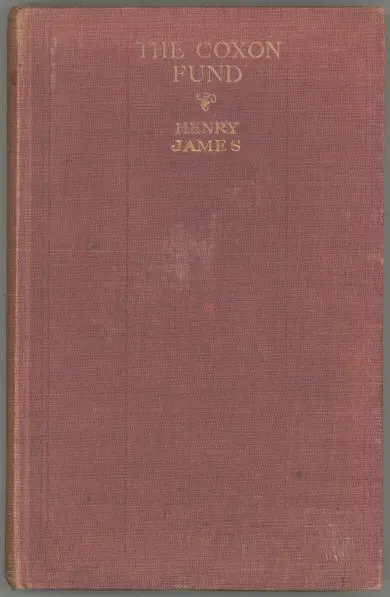
THE CLASSIC COLLECTION · 1915
"The Coxon Fund" by Henry James is a short story published in 1894. Frank Saltram possesses a brilliant mind that dazzles in conversation but produces nothing tangible. He lives off others' generosity while recognizing no obligations. When a substantial inheritance meant for a deserving intellectual becomes available, a moral dilemma emerges: should the unreliable but captivating Saltram receive it? The decision threatens an engagement and forces those around him to weigh genius against character, potential against performance.
Introduction adapted from the source catalogue; source summaries may be automatically generated.
Free to read · English · 23,385 words · No account needed
MAKE TIME FOR A GOOD BOOK
On by default. Untick to stop anonymous reading totals. Each page counts after 10 seconds in view. How this works.
Anonymous counting is on unless you have switched it off.
“My relations with Miss Anvoy are not at an end,” poor Gravener
stammered.
Again for an instant I thought. “The offer I propose to make you gives me the right to address you a question remarkably direct. Are you still engaged to Miss Anvoy?”
“No, I’m not,” he slowly brought out. “But we’re perfectly good
friends.”
“Such good friends that you’ll again become prospective husband and wife if the obstacle in your path be removed?”
“Removed?” he anxiously repeated.
“If I send Miss Anvoy the letter I speak of she may give up her idea.”
“Then for God’s sake send it!”
“I’ll do so if you’re ready to assure me that her sacrifice would now presumably bring about your marriage.”
“I’d marry her the next day!” my visitor cried.
“Yes, but would she marry you? What I ask of you of course is nothing less than your word of honour as to your conviction of this. If you give it me,” I said, “I’ll engage to hand her the letter before night.”
Gravener took up his hat; turning it mechanically round he stood looking a moment hard at its unruffled perfection. Then very angrily honestly and gallantly, “Hand it to the devil!” he broke out; with which he clapped the hat on his head and left me.
“Will you read it or not?” I said to Ruth Anvoy, at Wimbledon, when I had told her the story of Mrs. Saltram’s visit.
She debated for a time probably of the briefest, but long enough to make me nervous. “Have you brought it with you?”
“No indeed. It’s at home, locked up.”
There was another great silence, and then she said “Go back and destroy
it.”
I went back, but I didn’t destroy it till after Saltram’s death, when I burnt it unread. The Pudneys approached her again pressingly, but, prompt as they were, The Coxon Fund had already become an operative benefit and a general amaze: Mr. Saltram, while we gathered about, as it were, to watch the manna descend, had begun to draw the magnificent income. He drew it as he had always drawn everything, with a grand abstracted gesture. Its magnificence, alas, as all the world now knows, quite quenched him; it was the beginning of his decline. It was also naturally a new grievance for his wife, who began to believe in him as soon as he was blighted, and who at this hour accuses us of having bribed him, on the whim of a meddlesome American, to renounce his glorious office, to become, as she says, like everybody else. The very day he found himself able to publish he wholly ceased to produce. This deprived us, as may easily be imagined, of much of our occupation, and especially deprived the Mulvilles, whose want of self-support I never measured till they lost their great inmate. They’ve no one to live on now. Adelaide’s most frequent reference to their destitution is embodied in the remark that dear far-away Ruth’s intentions were doubtless good. She and Kent are even yet looking for another prop, but no one presents a true sphere of usefulness. They complain that people are self-sufficing. With Saltram the fine type of the child of adoption was scattered, the grander, the elder style. They’ve got their carriage back, but what’s an empty carriage? In short I think we were all happier as well as poorer before; even including George Gravener, who by the deaths of his brother and his nephew has lately become Lord Maddock. His wife, whose fortune clears the property, is criminally dull; he hates being in the Upper House, and hasn’t yet had high office. But what are these accidents, which I should perhaps apologise for mentioning, in the light of the great eventual boon promised the patient by the rate at which The Coxon Fund must be rolling up?
Your reading position is saved on this browser. Take it to another device with a library code. Reading pages adapt to text, rather than matching a printed edition.
Henry James
Henry James
Henry James

Henry James
BEHIND THE BOOK
This eBook is for the use of anyone anywhere in the United States and most other parts of the world at no cost and with almost no restrictions whatsoever. You may copy it, give it away or re-use it under the terms of the Project Gutenberg License included with this eBook or online at www.gutenberg.org. If you are not located in the United States, you will have to check the laws of the country where you are located before using this eBook. Read the source licence.
The original source file, including credits and licence, is retained by this library. Request an original-format copy at no charge. Please include the book title and Project Gutenberg identifier #1193.
KEEP YOUR CURIOSITY GOING
Coulson Kernahan

Maurice Baring
Frances Wright
Cécile Tormay

Frederic Jesup Stimson

W. H. P. (William Henry Pope) Jarvis