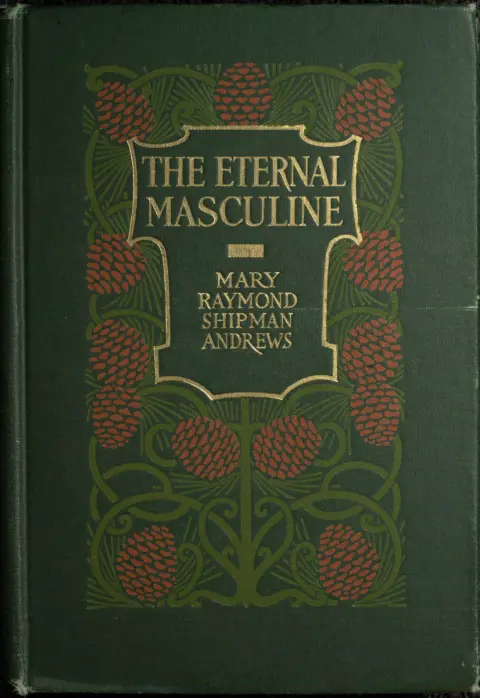
The eternal masculine
Mary Raymond Shipman Andrews
THE CLASSIC COLLECTION · 1911
"The Courage of the Commonplace" by Mary Raymond Shipman Andrews is a novel written during the early 20th century. It revolves around the social dynamics at Yale University during a pivotal event called "Tap Day," where junior class members are selected for prestigious senior societies. The narrative explores themes of ambition, self-worth, and the pressures young men face as they seek approval and recognition from their peers. The story primarily follows Johnny McLean, a junior at Yale who struggles with feelings of inadequacy and fear of failure, especially during the emotionally charged Tap Day. As he and his classmates await their fate, Johnny's concerns reflect a broader commentary on the nature of success and honor within elite circles. Johnny does not get tapped, leading him into a period of reflection, ultimately spurring him to embrace hard work and personal growth. After graduating, he becomes a superintendent at a mine where he demonstrates remarkable courage during a crisis, stepping up to guide his trapped coworkers to safety. Ultimately, he earns not only the admiration of his peers but also reignites a romantic connection with a girl he once respected, bringing redemption and fulfillment to his earlier disappointments. The novel powerfully illustrates the idea that the courage to face everyday challenges can lead to extraordinary accomplishments.
Introduction adapted from the source catalogue; source summaries may be automatically generated.
Free to read · English · 10,882 words · No account needed
MAKE TIME FOR A GOOD BOOK
On by default. Untick to stop anonymous reading totals. Each page counts after 10 seconds in view. How this works.
Anonymous counting is on unless you have switched it off.
The play was in full action. Grave and responsible seniors worked swiftly here and there through the tight mass, searching each one his man; every two or three minutes a man was found and felt that thrilling touch and heard the order, "Go to your room." Each time there was a shout of applause; each time the campus rushed in a wave. And still the three hundred stood packed, waiting--thinning a little, but so little. About thirty had been taken now, and the black senior hats were visibly fewer, but the upturned boy faces seemed exactly the same. Only they grew more anxious minute by minute; minute by minute they turned more nervously this way and that as the seniors worked through the mass. And as another and another crashed from among them blind and solemn and happy with his guardian senior close after, the ones who were left seemed to drop into deeper quiet. And now there were only two black hats in the throng; the girl looking down saw John McLean standing stiffly, his gray eyes fixed, his face pale and set; at that moment the two seniors found their men together. It was all over. He had not been taken.
Slowly the two hundred and fifty odd men who had not been good enough dispersed, pluckily laughing and talking together--all of them, it is safe to say, with heavy hearts; for Tap Day counts as much as that at Yale.
John McLean swung across the diagonal of the campus toward Welch Hall where he lived. He saw the girl and her chaperon come out of Durfee; and he lingered to meet them. Two days ago he had met the girl here with Brant, and she had stopped and shaken hands. It seemed to him it would help if that should happen today. She might say a word; anything at all to show that she was friends all the same with a fellow who wasn't good enough. He longed for that. With a sick chaos of pain pounding at what seemed to be his lungs he met her. Mrs. Anderson was between them, putting out a quick hand; the boy hardly saw her as he took it. He saw the girl, and the girl did not look at him. With her head up and her brown eyes fixed on Phelps gate-way she hurried along--and did not look at him. He could not believe it--that girl--the girl. But she was gone; she had not looked at him. Like a shot animal he suddenly began to run. He got to his rooms; they were empty; Baby Thomas, his "wife," known as Archibald Babington Thomas on the catalogue, but not elsewhere, had been taken for Scroll and Key; he was off with the others who were worth while. This boy went into his tiny bedroom and threw himself down with his face in his pillow and lay still. Men and women learn--sometimes--as they grow older, how to shut the doors against disappointments so that only the vital ones cut through, but at twenty all doors are open; the iron had come into his soul, and the girl had given it a twist which had taken his last ounce of courage. He lay still a long time, enduring--all he could manage at first. It might have been an hour later that he got up and went to his desk and sat down in the fading light, his hands deep in his trousers pockets; his athletic young figure dropped together listlessly; his eyes staring at the desk where had worked away so many cheerful hours. Pictures hung around it; there was a group taken last summer of girls and boys at his home in the country, the girl was in it--he did not look at her. His father's portrait stood on the desk, and a painting of his long-dead mother. He thought to himself hotly that it was good she was dead rather than see him shamed. For the wound was throbbing with a fever, and the boy had not got to a sense of proportion; his future seemed blackened. His father's picture stabbed him; he was a "Bones" man--all of his family--his grandfather, and the older brothers who had graduated four and six years ago--all of them. Except himself. The girl had thought it such a disgrace that she would not look at him! Then he grew angry. It wasn't decent, to hit a man when he was down. A woman ought to be gentle--if his mother had been alive--but then he was glad she wasn't. With that a sob shook him--startled him. Angrily he stood up and glared about the place. This wouldn't do; he must pull himself together. He walked up and down the little living room, bright with boys' belongings, with fraternity shields and flags and fencing foils and paddles and pictures; he walked up and down and he whistled "Dunderbeck," which somehow was in his head. Then he was singing it:
Your reading position is saved on this browser. Take it to another device with a library code. Reading pages adapt to text, rather than matching a printed edition.
Mary Raymond Shipman Andrews
Mary Raymond Shipman Andrews

Mary Raymond Shipman Andrews
Mary Raymond Shipman Andrews
BEHIND THE BOOK
This eBook is for the use of anyone anywhere in the United States and most other parts of the world at no cost and with almost no restrictions whatsoever. You may copy it, give it away or re-use it under the terms of the Project Gutenberg License included with this eBook or online at www.gutenberg.org. If you are not located in the United States, you will have to check the laws of the country where you are located before using this eBook. Read the source licence.
The original source file, including credits and licence, is retained by this library. Request an original-format copy at no charge. Please include the book title and Project Gutenberg identifier #5825.
KEEP YOUR CURIOSITY GOING
Coulson Kernahan

Maurice Baring
Frances Wright
Cécile Tormay

Frederic Jesup Stimson

W. H. P. (William Henry Pope) Jarvis